Blog
Atlanta Apartment Lease-Up: Qualify for a DSCR Refinance
By Jason Taken · Principal
12 minute read
See what an Atlanta apartment lease-up must prove before a DSCR refinance: collected rent, stable expenses, completed work, reserves, and enough proceeds.
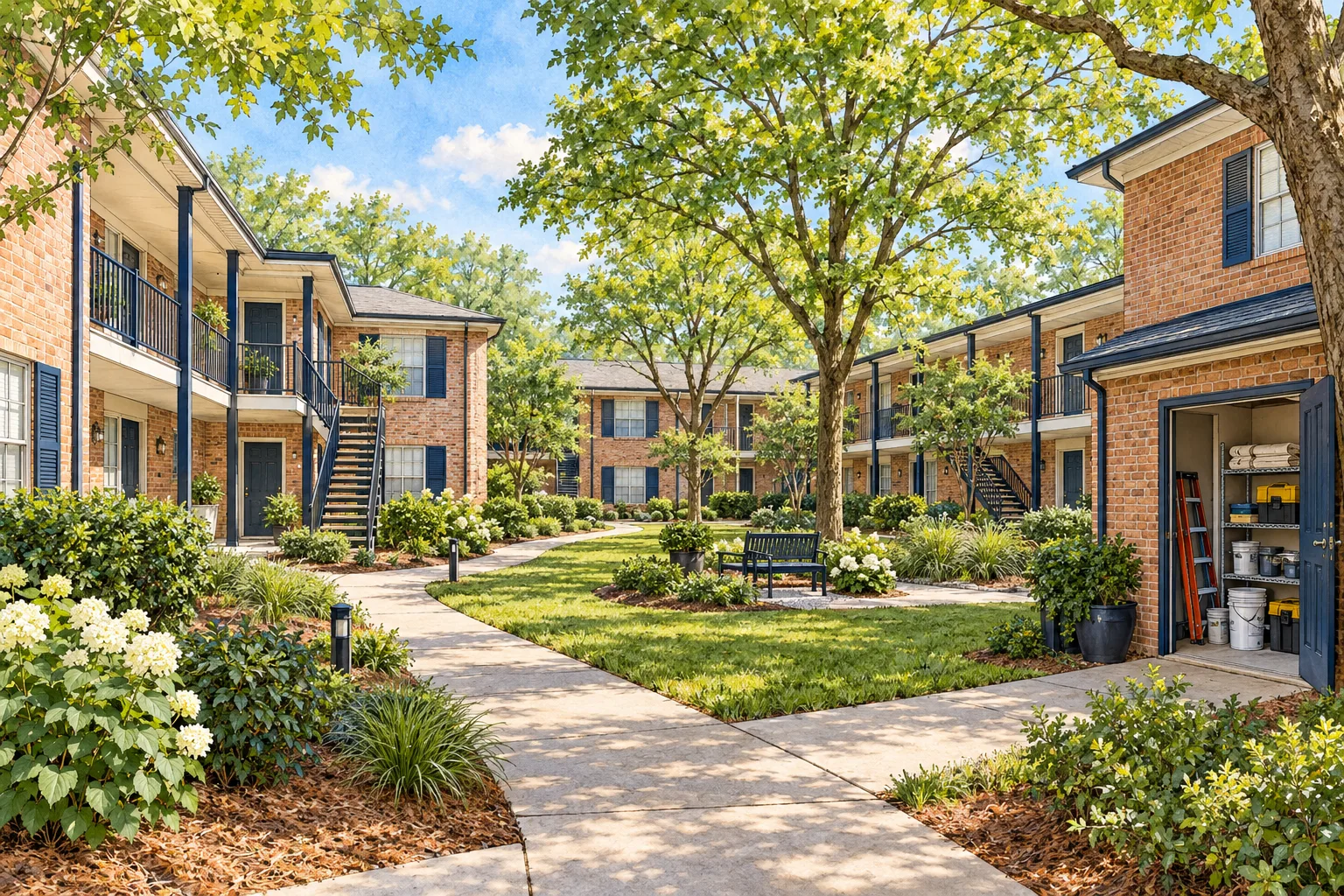
An Atlanta apartment lease-up is ready for a DSCR refinance when cash flow the lender accepts supports the planned debt and the building meets the lender’s other conditions. Finished units and signed leases are steps toward that result. Collected rent, sustainable expenses, lawful occupancy, and enough net proceeds to retire the bridge complete the test.
For a commercial apartment property, debt service coverage ratio compares accepted yearly cash flow with yearly debt payments. That differs from a residential rent-to-housing-payment test. A five-plus-unit building needs a commercial review even if the owner has used residential DSCR loans on rental houses before.
Jaken Finance Group’s multifamily bridge financing and commercial multifamily DSCR options address different stages of the investment. The new loan needs separate approval. Build its evidence rules into the purchase plan so that the bridge term has a clear purpose and a measurable exit.
What does stable mean for your loan?
Ask the next lender what it means by stable. How many units must be occupied? How much rent must be paid? How long must those results last? What work must be done? A building can pass one test and fail the next. Get the tests in writing before you set a closing month.
Agency terms provide a useful example of why the details matter. Fannie Mae’s conventional properties term sheet describes stable occupancy, often 90%, for 90 days before funding, with case-specific treatment for properties still in lease-up. It also lists a 1.25 minimum DSCR. Those are that product’s terms, not a promise that every Jaken Finance Group file follows or qualifies for them.
A private loan or bank loan may use different thresholds, records, or timing. Do not transfer an agency occupancy rule into a different lender’s approval. Likewise, a strong occupancy percentage does not show that the building can pay its expenses and debt. The program’s coverage math remains a separate test.
Before starting work, ask which milestones can be reviewed in advance and which must be done at closing. A lender may discuss a projected loan before all conditions are met, but a discussion is not a funded commitment. Keep the conditions and remaining evidence visible in the project calendar.
Track four stages for every apartment
Track four dates for each unit: work done, legal move-in clearance, lease signed, and rent paid. They are often different dates. A finished unit may still need final approval. A signed lease may start with free rent. Do not count each stage as if it already puts cash in the bank.
List rent, lease dates, free rent, deposits, unpaid amounts, and receipts by unit. Use the same unit number in the work plan, leases, and books. A lender can then trace a unit from repair bill to lease to rent payment. That is much clearer than three reports with totals that do not match.
Keep model units, employee units, and unavailable units clearly labeled. Their physical condition may be excellent while their income treatment differs from a paying apartment. Ask how the lender includes them in its occupancy math. Avoid quietly changing the denominator to improve the reported percentage.
For a sample 24-unit community, 22 occupied units equal about 91.7% physical occupancy. That figure alone does not show economic occupancy or the amount collected. If several residents have free rent or unpaid balances, income can remain far below the fully leased schedule. The lender needs the money trail as well as the door count.
Show what concessions do to effective rent
A lease at $1,500 per month with one free month over a twelve-month term produces $16,500 of rent for that term. Dividing by twelve gives $1,375 per month before other losses. The $1,500 face rent and the $1,375 effective rent describe different things; both belong in the underwriting file.
If ten new leases each provide that free month, the combined concession is $15,000. It can help fill units, but it also reduces the income available during that period. Show when the concession occurs and whether it is one-time or part of an ongoing leasing practice.
Fannie Mae’s small-loan cash-flow guidance explicitly treats concessions as an income adjustment in its math. Other programs may analyze them in a different way. Ask the chosen lender how current concessions, renewal offers, and recently expired incentives affect the lender’s income figure. Do not assume they disappear at refinance.
Do not treat a security deposit as a replacement for missing rent. Maintain separate deposit records and follow relevant handling rules. The Georgia landlord-tenant handbook provides official guidance on rental duties. Good business records help both property management and lender review.
Match the T-12 with recent progress
The trailing twelve-month statement, or T-12, captures the full recent history. A lease-up can look weak in that history even after several units improve. Rather than hiding the weak months, explain the sequence: units offline, work finished, leases signed, concessions used, and collections received.
Put recent monthly results beside the T-12. Show what happened and label what is still a forecast. One strong month is useful evidence. It is not proof that the next twelve months will match it. Check when leases start and end. Check which bills change with the season before using a full-year estimate.
A summer power bill may be a poor guide to winter costs. A yearly insurance bill may not appear in the last month at all. Use the bills and contracts to build a fair view of costs. Match the income and cost periods. Do not mix periods just to make the result look stronger.
The Chicago T-12 refinance guide shows a detailed cash check from scheduled rent to lender cash flow. The accounting method applies here, but Atlanta rent support, tax inputs, insurance, and property records must be shown locally. A successful lease-up needs both clean records and sound forward operations.
A hypothetical 24-unit stable budget
Assume the business plan targets $1,500 monthly rent across 24 apartments, producing $432,000 of yearly scheduled rent. The stable forecast below allows for vacancy, collection loss, and concessions rather than assuming every scheduled dollar arrives. It reflects a future operating case, not the current results of a building with only 22 occupied units.
The forecast deducts $21,600 for vacancy, $4,320 for collection loss, and $12,000 for concessions. It adds $6,480 of ongoing other income, producing $400,560 of effective income. Assumed running costs of $212,560 leave $188,000 of NOI. None of these amounts is presented as an Atlanta market benchmark.
| Stable yearly forecast | Amount |
|---|---|
| Scheduled apartment rent | $432,000 |
| Vacancy allowance | ($21,600) |
| Collection loss | ($4,320) |
| Concessions | ($12,000) |
| Ongoing other income | $6,480 |
| Effective gross income | $400,560 |
| Running costs | ($212,560) |
| Net operating income | $188,000 |
| Assumed replacement-reserve deduction | ($8,000) |
| Cash flow used for coverage | $180,000 |
The cash budget should include property taxes, insurance, utilities, management, repairs, payroll if relevant, and other ongoing costs. The replacement allowance is shown on its own to distinguish NOI from the cash flow used in this example’s coverage test. The real lender may use different labels or extra adjustments.
Each line needs proof before the lender can use it. Support rent with nearby lease evidence and the building’s own records. Support costs with bills and quotes. Show where other income comes from. This table is a target to prove. Finishing the work does not by itself make that income or value real.
Size the new loan and compare it with the payoff
Assume a planned long-term loan needs 1.25 coverage and uses a 7.25% interest rate with monthly payments over a 25-year amortization schedule. These are sample terms, not a Jaken Finance Group rate quote. At $180,000 of cash flow the lender accepts, the maximum yearly debt payment is $144,000.
Those payment inputs support about $1,660,195 of debt. For a separate value test, divide the modeled $188,000 NOI by an assumed 6.5% cap rate. That yields roughly $2.892 million. A sample 70% LTV limit would permit about $2.025 million, so coverage is the tighter modeled limit.
Now assume the fully drawn bridge payoff is $1.6 million and refinance costs are $45,000. The supported loan leaves only about $15,195 after those amounts. That is a small margin relative to the project size. An extra repair escrow, exit charge, or weaker income could eliminate it.
| Refinance review | Projected stable case | Weaker accepted-income case |
|---|---|---|
| Yearly cash flow used for coverage | $180,000 | $150,000 |
| Coverage-based loan | $1,660,195 | $1,383,495 |
| Bridge payoff plus assumed closing costs | $1,645,000 | $1,645,000 |
| Result at closing | $15,195 returned | $261,505 needed |
The weaker case changes only cash flow the lender accepts for this example. A full downside review should also test value, rates, reserves, and payoff timing. The gap is a cash need, not merely a lower return on paper. The sponsor must have an approved source for it if that is the loan the building supports.
Explore the worked example
Test Atlanta apartment lease-up proceeds
This is the article’s future stabilized case. Replace it with current collections to check today’s income.
Illustrative results for the starting values. All editable loan terms are assumptions.
- Modeled commercial loan ceiling
- $1,660,195
- Net proceeds after payoff and costs
- $15,195
- Owner cash still invested / needed
- -$15,195
- Annual cash flow after modeled debt
- $36,000
| Annual NOI before replacement reserves | $188,000 |
|---|---|
| Annual cash flow used for debt coverage | $180,000 |
| Income-based property value | $2,892,308 |
| Value-based loan limit | $2,024,615 |
| Coverage-based loan limit | $1,660,195 |
- Income means collected or explicitly assumed effective annual income after vacancy, concessions and credit losses, including supported reimbursements. Keep costs paid through reimbursements in expenses.
- For a purchase, use the price plus work budget as the payoff input and set cash already spent to zero. For a refinance, use the real payoff and owner cash invested.
- Negative net proceeds are a closing cash requirement. Replacement reserves are deducted for coverage but not in the NOI used to estimate value here; an appraisal or lender may use a different convention.
- This simplified permanent-loan screen excludes debt-yield limits, loan-size caps, recourse, lease tests and lender adjustments. A future income case is not current borrowing capacity.
Why the last few leases may not solve the gap
Each new lease improves the plan only to the extent it produces net income the lender accepts. A new tenant may need turnover costs, a commission, free rent, and more utilities or management work. Subtract those effects before estimating how much extra debt the lease supports.
At the example’s payment and coverage inputs, each $10,000 reduction in accepted yearly cash flow reduces loan capacity by about $92,233. That makes expense errors and concessions meaningful. It also explains why adding a few signed leases may fail to solve a large payoff shortfall if costs rise at the same time.
Avoid targeting an occupancy percentage without an income target. The new loan needs an exact amount of debt service capacity. Work backward from the payoff and closing costs. Then find the cash flow needed to support it. Compare that target with the building-level leasing and expense evidence, not only with the number of occupied units.
Ask whether recent leasing gains must persist for a set period under the chosen program. If they do, finishing the final lease one week before maturity may be too late. Build the review period into the bridge schedule at purchase and revise it as real leasing results develop.
Manage the cash burn while evidence develops
Prepare a monthly cash forecast through refinance, not just through the end of the work. Include interest, taxes, insurance, utilities, staffing, marketing, turn costs, and tenant incentives. Offset those costs with expected collections by month. A projected yearly NOI can look strong while the first several months need large extra cash.
Keep an interest reserve separate from operating and repair reserves. A lender-controlled interest account may not be used for a contractor invoice or utility bill. Check allowed uses, release rules, and the effect on the final payoff. A financed reserve can increase debt even when it reduces the owner’s immediate cash payment.
Maintain a reserve for delays that is actually on hand. A planned refinance distribution cannot fund expenses incurred before that new loan closes. If the project depends on the sale of another asset, list its status and timing risk. Make the source of each cash contribution explicit rather than assuming the sponsor can fill any gap.
Before spending the final repair dollars, refresh the exit estimate. A change in taxes, insurance, rent the lender accepts, or debt pricing can alter proceeds. Early review may show that the sponsor should retain more cash, reduce discretionary spending, or change the loan plan while there is still time to respond.
Check Atlanta property and operating rules
List the municipality and county for the real parcel. For property within Atlanta city limits, use the Office of Buildings to check the work and inspection process. An Atlanta mailing address does not prove that the City is the permit authority.
Record final approvals for renovated units and common work where needed. Ask whether the scope or change of use affects occupancy rules. The business plan should not count income from space that cannot yet be lawfully occupied. Keep the evidence with the unit schedule so leasing and construction teams use the same status.
Get a current property insurance quote for the completed use, occupancy, and condition. Coverage during renovation may differ from stable coverage. Check any rules involving vacancy, roofs, loss history, and deductibles. Underwriting should use the expense and coverage suited to the building at the planned loan closing.
For older apartment buildings, discuss applicable EPA renovation and lead-safe work rules with the contractor. Budget needed procedures before relying on a turn cost per unit. A lawful, completed unit and a clear scope backed by records support both the plan to run the building and the loan review.
Watch the quality of the lease-up after move-in
Track payment performance after the first month, not just the number of signed leases. A rapid move-in schedule can look successful before collection problems appear. Review arrears, returned payments, resident turnover, and the use of payment plans each month. Those records show whether the new income is becoming stable.
Keep leasing goals consistent with the building’s written screening standards and applicable housing rules. Filling units quickly should not mean changing standards without a clear, lawful process. A leasing team needs a shared plan for rent, concessions, deposits, and records so that the owner can explain each new lease to the lender.
Review maintenance response and resident feedback as part of the plan to run the building. Repeated unresolved issues can create turnover costs after a unit is counted as occupied. A new loan budget that assumes low vacancy should have a practical plan for keeping residents and maintaining the building. Stable operations are a business result that must last beyond the loan closing.
Set a new loan readiness checklist
First, check the building work: completed scope, needed approvals, clear unit status, and a funded plan for remaining capital needs. Second, check income: leases, concessions, receipts, arrears, and a rent roll that matches the books. Third, check expenses with current tax, insurance, utility, management, and repair support.
Then check the financing: cash flow the lender accepts, rate and amortization inputs, coverage rule, valuation, reserves, and loan type. Compare the expected proceeds with a current payoff and closing budget. Show any gap and its source of funds. A checklist that stops at occupancy misses the most important closing math.
If the numbers do not support the payoff, review alternatives before maturity. More equity, a different feasible loan, a negotiated extension, or a supported sale may be options. Each has conditions and costs. More time is useful only when the expected improvement justifies its cash burn and the sponsor can fund the period.
For an Atlanta apartment review, submit a commercial loan request with the unit schedule, T-12, recent monthly statements, leases, work status, and bridge payoff. Include the original stable operations plan and explain what has changed. That gives Jaken Finance Group the information to assess a bridge or permanent solution against the building’s real progress.