Blog
Best Rent Estimate Tools for Real Estate Investors
By Jaken Finance Group · Principal, Jaken Finance Group
Best rent estimate tools for real estate investors compared — RentCast, Rentometer, Zillow, Mashvisor — comps depth, alerts, pricing, and workflow fit.
Investors shopping best rent estimate tools are really choosing a job: quick pricing, lender-grade comps, portfolio monitoring, or full STR vs LTR analytics. No single site wins every task — but one tool should be your default for long-term holds and DSCR prep.
This comparison covers RentCast, Rentometer, Zillow Rent Zestimate, and Mashvisor with honest tradeoffs. Related: RentCast review · rent estimates for DSCR loans
Affiliate disclosure: Jaken Finance Group may earn a commission if you sign up through our RentCast links, at no extra cost to you. We only recommend tools we believe help investors underwrite rents honestly.
Try RentCast freeMethodology & disclosures
- How we compare: Feature sets and pricing from each vendor’s public marketing and help docs as of mid-2026. Programs change — verify before purchase.
- Not endorsements: Mention of third-party tools is editorial; we are not compensated by Rentometer, Zillow, or Mashvisor.
- Not financial advice. Rent tools inform analysis; lenders and appraisers make binding rent opinions.
Comparison at a glance
| Tool | Comps transparency | Portfolio / alerts | STR / Airbnb | Typical price | Best for |
|---|---|---|---|---|---|
| RentCast | High — similarity scores, map, 5–20 comps | Yes — alerts, market emails | No | Free; Pro ~$12–$19/mo | LTR investors, DSCR prep, PMs |
| Rentometer | Medium — Pro reports with comps | Limited vs RentCast | No | Free tier + paid Pro | Fast rent checks, PDF reports |
| Zillow Rent Zestimate | Low — single estimate | No | No | Free | Gut-check only |
| Mashvisor | Medium — investment-focused | Portfolio analytics | Yes — STR vs LTR | Subscription (higher) | STR vs hold decisions, market search |
1. RentCast — recommended default for LTR investors
Best for: Sponsors who need comps-backed rent estimates, zip market trends, and portfolio rent alerts without buying a full investment marketplace suite.
What you get:
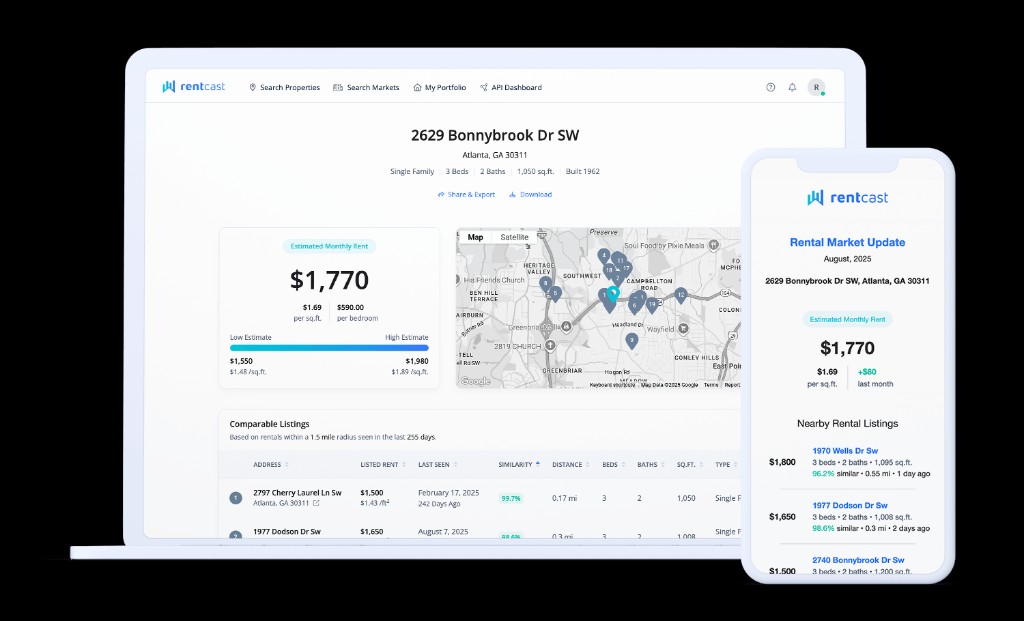
- Nationwide rent AVM with low / high band
- Comparable listings with similarity %, distance, and recency
- Portfolio dashboard, rent targets, and market update emails
- Optional Property Data API for automations (separate billing)
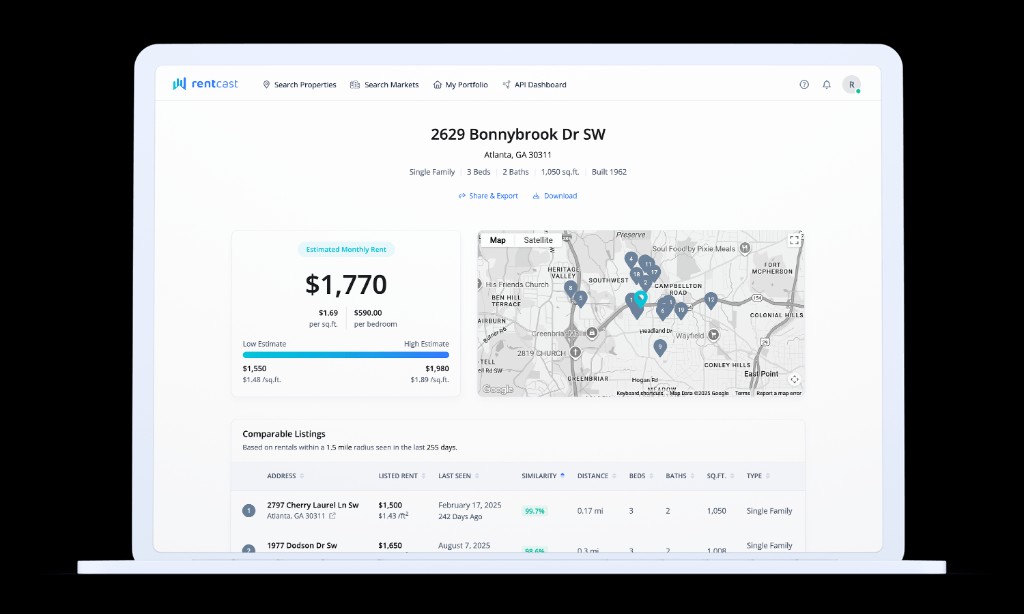
Why investors pick it: Transparency for lender conversations and DSCR qualification — you can show which rentals supported your number.
Tradeoffs: Not an Airbnb revenue modeler; API power users need a second budget line.
Start with RentCast free · Full walkthrough: RentCast review
2. Rentometer — speed and simple reports
Best for: A fast median rent read before you deeper-dive a market, or a branded Pro Report for owners and partners.
Strengths:
- Very fast address and neighborhood pulls
- Long track record with landlord users
- Rent Yield Tracker and API for power users (separate product lines)
Weaknesses vs RentCast:
- Less emphasis on ongoing portfolio alerts and historical rent tracking in one dashboard
- Free tier limits push active acquirers to paid plans quickly
When to choose it: You analyze few holds and want PDF deliverables more than live portfolio monitoring.
3. Zillow Rent Zestimate — free gut-check only
Best for: Zero-cost sanity check on an address you already know well.
Strengths: Free, ubiquitous, familiar to sellers and agents.
Weaknesses:
- No investor comp workbook — single estimate without similarity-scored rental listings
- Not lender-grade documentation on its own
- No portfolio alerts or zip trend product comparable to RentCast
When to choose it: Never as your only source on a DSCR or bank file. Use it to flag more than $200/mo divergence, then confirm with RentCast or an appraiser rent schedule.
4. Mashvisor — STR vs LTR and market discovery
Best for: Investors deciding Airbnb vs traditional rental, browsing investment properties, or modeling occupancy-driven revenue.
Strengths:
- Side-by-side STR and LTR projections
- Heat maps and investment filters
- Deeper deal-finding than pure rent-estimate sites
Weaknesses:
- Higher cost and heavier UI than a rent-only tool
- Overkill if you only need monthly lease rent for a DSCR refi
When to choose it: The question is “Which strategy on this street?” not “What is market rent for this lease-up?”
Decision guide — pick by job
| Your task | Start here |
|---|---|
| Underwrite DSCR on a known address | RentCast + DSCR calculator |
| One-off pricing before a showing | Rentometer or RentCast free |
| Monitor 10–50 doors for rent raises | RentCast Pro |
| STR vs LTR on same property | Mashvisor |
| Free sanity check | Zillow, then confirm with comps |
RentCast vs Rentometer (short answer)
Choose Rentometer when speed and PDF reporting dominate. Choose RentCast when you need deeper comp sets, portfolio alerts, and market trend context for hold and refi decisions — the workflow we see most often on DSCR files.
Pricing snapshot — checked October 2026
Subscription tiers shift often, so we pulled the published plans directly before this update. Promotions were running on both sites when we checked.
| Plan | Price (list) | What the plan includes |
|---|---|---|
| RentCast Free | $0 | Nationwide rent prices, 5 comps, 5 portfolio properties, rent alerts |
| RentCast Pro | $19/mo monthly or $12/mo billed annually | 20 comps, 50+ portfolio properties, custom comp radius and look-back, PDF branding |
| Rentometer Basic | $59/yr (annual only) | Instant estimates, 5 reports with comps |
| Rentometer Essential | $16/mo monthly | 10 reports with comps, report branding, mobile app |
| Rentometer Pro | $29/mo monthly | 50 reports with comps, market updates, deal worksheet, bulk estimates, API access |
Sources: RentCast pricing and Rentometer pricing, both viewed October 2026. Rentometer’s annual plans bundle far more reports than its monthly plans. Price the plan against how many addresses you screen per month, not the headline rate.
How lenders actually set rent on your file
Your tool’s number is a starting point. The lender’s rent figure usually comes from the appraiser. That is why the comps you choose should look like the ones an appraiser will pull.
Fannie Mae’s rental income guidance (updated September 2, 2026) lists the sources lenders use, in order of preference:
- The appraisal report or the Single-Family Comparable Rent Schedule (Form 1007), if it is less than 12 months old at the note date
- An appraiser’s opinion of market rent when the property is not currently rented
- A written borrower statement only when no appraisal or Form 1007 is required
Those are agency rules, not DSCR rules. Still, most DSCR files lean on the same Form 1007 process. Read how that form drives your ratio in our guide to the DSCR appraisal and 1007 rent schedule.
Two-to-four unit buildings: the same guidance requires gross rent to be stated for each unit, not as one building total. Run a separate estimate per unit type. A garden unit and a top-floor unit with the same bedroom count rarely lease for the same rent. Small multifamily owners should also read our guide to DSCR loans on triplex and fourplex properties.
The practical takeaway: pick tools that let you export or screenshot the specific comps. Hand them to the appraiser through your loan officer before the inspection. An appraiser cannot weigh comps they never saw.
Worked example — what a $200 rent miss does to DSCR
Illustration only. Your rate, taxes, and insurance will differ.
An investor buys a single-family rental with a $240,000 loan at 7.5%, 30-year amortizing.
| Line | Monthly |
|---|---|
| Principal and interest | $1,678 |
| Property taxes | $280 |
| Insurance | $110 |
| PITIA | $2,068 |
Scenario A — tool estimate: A rent tool shows $2,300. DSCR = $2,300 ÷ $2,068 = 1.11.
Scenario B — appraiser rent: The Form 1007 lands at $2,100. DSCR = $2,100 ÷ $2,068 = 1.02.
That $200 gap moves the file from comfortable to borderline. At some lenders it changes pricing or leverage. Run both numbers on the minimum rent for DSCR calculator before you sign a contract.
For rate context, Freddie Mac’s survey put the 30-year fixed at 7.28% for the week of October 1, 2026, per Freddie Mac PMMS. That figure tracks owner-occupied loans, not investor DSCR pricing. It still shows why a thin rent cushion matters when payments are this high.
Use HUD Fair Market Rents as a floor check
HUD publishes free Fair Market Rents for every metro area and non-metro county. They estimate 40th percentile gross rents for standard-quality units. New figures take effect at the start of the federal fiscal year, generally October 1.
Three ways investors use them:
- Low-end sanity check. If your tool’s rent sits far below the local FMR for that bedroom count, your comps may be stale or poor quality.
- Housing voucher planning. Voucher payment standards key off FMRs. Check them before you pitch a unit to voucher tenants.
- Utility adjustment. FMRs are gross rents, which include utilities. Subtract tenant-paid utilities before comparing to a contract rent.
FMRs describe an area, not your street. Never use one as your underwriting rent.
Five rent-estimate mistakes we see on loan files
- Asking rents treated as signed rents. Listings that sat 60 days were priced too high. Ask the tool for days on market or leased status when it is available.
- Mixed unit types. A three-bed duplex unit is not a comp for a three-bed detached house. Filter by property type first.
- Stale comps. Fannie Mae ages out rent schedules at 12 months. Apply the same discipline to your own comp sets.
- Ignoring who pays utilities. A $150 water and trash bill changes what a tenant can pay in rent.
- One tool, no cross-check. Run at least two sources. Then call one local property manager and ask what actually leased last month.
A five-minute rent workflow before you write an offer
- Pull the RentCast or Rentometer estimate and save the comp list.
- Check the Zillow Rent Zestimate. Flag gaps over $200.
- Compare against the HUD FMR for the bedroom count.
- Plug the lowest defensible number into the DSCR calculator.
- If the deal only works at the high estimate, renegotiate price or walk.
Lenders size loans on conservative rent, so build your offer the same way.
Bottom line
The best rent estimate tool for most buy-and-hold and BRRRR sponsors is the one that shows comps you can defend. For that bar, RentCast is our recommended default; layer Mashvisor when STR economics drive the deal and use Zillow only as a cross-check.
Best rent estimate tools — next step
Lock market rent before leverage. When the deal supports permanent debt, explore DSCR rental loans at 5.75%–10.5% on qualified files.
Try RentCast free · Pre-qualify for DSCR · Submit scenario · (833) 264-7776.