Blog
How Accurate Rent Estimates Affect DSCR Loan Qualification
By Jaken Finance Group · Principal, Jaken Finance Group
Accurate rent estimates affect DSCR loan qualification — rental comps drive ratios, LTV caps, and underwriting. Step-by-step RentCast workflow for investors.
A DSCR loan for a one- to four-unit rental often compares gross rent with PITIA. This payment includes principal, interest, taxes, insurance, and any HOA dues. A commercial loan uses net operating income divided by debt service. Ask which method applies. If the lender accepts less rent than you planned, the loan size or terms may change.
This guide explains how accurate rent estimates affect DSCR loan qualification, walks a worked ratio example, and shows a RentCast workflow you can run before bridge close or permanent refi. Related: RentCast review · DSCR vs hard money vs conventional · DSCR calculator
Affiliate disclosure: The RentCast links in this guide are affiliate links. Jaken Finance Group may receive a commission when you sign up through them, with no added cost to you. That relationship does not make a tool’s rent estimate an appraisal or a lender’s approved rent.
Try RentCast free for comps-backed rent lookups.
Why lenders care about market rent vs lease rent
DSCR underwriting asks: Will this property’s income cover the debt? Lenders may use:
| Rent source | When it applies |
|---|---|
| Executed lease | Stabilized purchase or refi with tenant in place |
| Market rent schedule | Vacant property, recent turnover, or lease below market |
| Appraiser / lender AVM | Tie-break when sponsor comps disagree with file |
Your job in acquisition is to align purchase basis and rehab budget with rent the lender will believe — not rent you hope to achieve after premium finishes.
What agency rules say about lease vs market rent
DSCR programs are not agency loans, but many borrow the agency playbook for rent evidence. It helps to know that playbook.
Fannie Mae’s rental income from the subject property section (Selling Guide, current as of October 2026) sets the purchase rules. The lender needs a Single-Family Comparable Rent Schedule (Form 1007) or Form 1025. It also needs the executed lease when a tenant transfers with the sale. If market rents do not reasonably support the lease, the lender must either justify the higher figure in writing or use the lesser amount. Fannie Mae also multiplies gross rent by 75% before it subtracts PITIA, which builds in a vacancy and expense cushion.
Fannie Mae’s general rental income rules also say the appraisal or Form 1007 cannot be dated 12 months or more before the note date. If your rent schedule is from last year’s purchase, expect a new one at refi.
Two takeaways for DSCR borrowers:
- Expect “lesser of lease or market.” A lease $300 above the appraiser’s market rent rarely gets full credit unless you can show it is stable, such as a long tenant history or a corporate lease.
- A below-market lease can hurt you too. Some lenders cap rent at the in-place lease even when market is higher. Ask before you sign a cheap renewal ahead of a refi.
For how appraisers build the rent schedule, see DSCR appraisals and the 1007 rent schedule.
Permanent DSCR rental loans on files that clear the full DSCR qualification requirements commonly price in the 5.75%–10.5% rate band with LTV caps per program (see DSCR loans and state hubs like DSCR loans Georgia and DSCR loans North Carolina).
Worked example: a $150 rent miss on a 1–4 unit refi
On 1–4 unit rentals, most DSCR programs divide gross monthly rent by PITIA (principal, interest, taxes, insurance, and HOA). Taxes and insurance sit in the denominator only. Do not also subtract them from rent, or you count them twice.
Example: a stabilized 3BR/2BA SFR appraised at $300,000, refinanced at 72% LTV ($216,000), 30-year fixed at 8.5%.
| Line item | Monthly |
|---|---|
| Principal and interest on $216,000 | $1,660.85 |
| Tax + insurance | $385.00 |
| PITIA | $2,045.85 |
| Sponsor rent | Lender market rent (−$150) | |
|---|---|---|
| Gross rent | $2,200 | $2,050 |
| DSCR (rent ÷ PITIA) | 1.08 | 1.00 |
| Rent needed for 1.10 | $2,250 | $2,250 |
| Rent needed for 1.20 | $2,455 | $2,455 |
The $150 haircut drops the file from a comfortable pass to the bare 1.00 line. At programs that price better above 1.10 or 1.20, neither rent clears. The lesson: small rent optimism on a tight file removes options (rate tier, full LTV) and can force a lower loan amount or a longer bridge hold.
How the rent number sizes the loan
Flip the math and solve for the largest loan the rent supports. Illustration: same $2,050 market rent, same $385 tax and insurance, same 8.5% rate.
| DSCR target | Max P&I | Max loan (30-year) |
|---|---|---|
| 1.00 | $1,665 | ~$216,500 |
| 1.20 | $1,323 | ~$172,100 |
A 1.20 target cuts about $44,000 of proceeds on the same house. That gap is why BRRRR investors should know the lender’s DSCR tier before they set a rehab budget.
Stress the payment, not just the rent
Run the same file with the rate 75 bp higher (9.25%) and tax plus insurance 10% higher ($423.50). P&I rises to $1,776.98. DSCR falls to 1.00 at $2,200 rent and 0.93 at $2,050 rent. If a rate lock slips or an insurance renewal jumps before closing, the low-band rent is the one that fails.
Run your address through DSCR loan cash flow: Charlotte vs Raleigh vs Atlanta for metro-level expense realism.
How to pull rental comps the right way
Before you trust any single AVM number, validate comps:
- Match property type — SFR vs condo vs duplex; lenders reject mixed comp sets.
- Match size — beds, baths, and square footage within ~10–15% of subject.
- Tight geography — same subdivision or school zone when possible; widen radius only with disclosure.
- Recency — prioritize listings seen in the last 90–180 days; stale comps inflate false confidence.
- Similarity score — prefer comps above ~90% similarity when the platform provides it.
- Adjust for condition — model your post-rehab finish, not average comp condition, with a documented premium or discount.
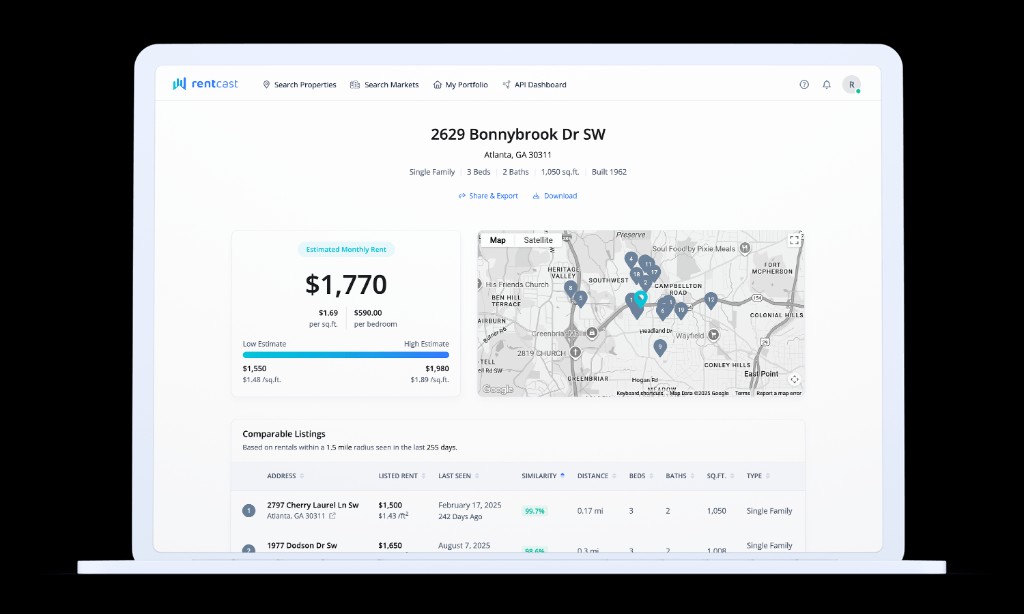
RentCast exposes similarity percentage, distance, listed rent, and last seen dates — the fields underwriters and appraisers expect in a rent schedule appendix.
Where AVM rent data comes from
Rent AVMs are only as good as their inputs. RentCast says on its API page that it covers 150+ million property records, draws on public records, tax assessors, and online listings, and processes about 500,000 record updates a day. That breadth is useful, but listing data shows asking rent, not signed rent. Treat every AVM figure as a starting point you confirm with leases and local property managers.
Duplexes to fourplexes: rent each unit separately
On a 2–4 unit property, the appraiser fills out a small residential income report (Form 1025) with rent for each unit. Your estimate should match that structure:
- Pull comps by unit type (a 1BR in a duplex comps to other 1BRs, not to the whole building).
- Note who pays which utilities. Owner-paid heat or water lowers what a tenant will pay in rent.
- Flag any unit that is vacant or below market. The lender may count it at market, at the lease, or at zero until leased.
Example: a duplex with a 2BR at $1,450 and a 1BR at $1,050 grosses $2,500. If the 1BR comps only at $975, the lender’s rent falls to $2,425. On $2,250 PITIA, DSCR moves from 1.11 to 1.08. That may not change approval, but it can change the pricing tier.
Five or more units usually move to a commercial-style test based on net operating income, with vacancy and expense loads. See DSCR loans for apartments and multifamily for that math.
Step-by-step RentCast workflow (acquisition or BRRRR exit)
1. Baseline the subject
Search the exact address (or legal description if pre-MLS). Confirm beds, baths, sqft, and year built match tax records — wrong inputs skew the AVM.
2. Read the estimate band, not the headline only
Note low estimate, point estimate, and high estimate. Underwrite DSCR at low to mid band unless you have a signed lease above market with renewal risk disclosed.
3. Audit the comp table and map
Open 15–20 comps on Pro (five on free). Drop:
- Different property types
- Outliers more than 20% above/below the cluster without a story
- Listings not seen in 6+ months
4. Build your lender rent schedule
Export or transcribe 5–8 best comps with address, rent, distance, similarity, and date. Add one-line adjustment notes (garage, basement, flood zone, HOA).
Pull comps on RentCast5. Model DSCR before you offer
Plug conservative gross rent into the DSCR calculator. Stress +75 bp on rate and +10% on tax/insurance — common 2026 sensitivity on Southeast and Florida files.
6. Re-run at lease-up
After tenant placement, compare actual lease to RentCast portfolio estimate and set rent alerts if market moves — useful before a seasoned refi.
Bridge acquisition still funds on hard money timelines (7–10 business days on qualified files); DSCR exit typically needs 14+ business days plus seasoning — plan both with honest rent.
Common rent mistakes that break DSCR files
| Mistake | Fix |
|---|---|
| Zillow Rent Zestimate only | Triangulate with comp tables (RentCast, appraiser, PM) |
| Seller “pro forma” rent | Require comps at same finish level |
| No vacancy or management | Use 25–30% expense load unless documented lower |
| Ignoring post-close tax reassessment | Pull county assessor step-up after rehab |
| Insurance quote from prior owner | Re-quote at investor DP-3 / dwelling limits |
| STR math on LTR DSCR exit | Lenders underwrite long-term lease economics |
Fall 2026 rent conditions to build into your estimate
Market rent is a moving target, and the season you lease in matters. The Apartment List National Rent Report for September 2026 shows:
- National median rent: $1,388 per month
- Month over month: down 0.1%, the first monthly decline since January
- Year over year: down 0.4%, up from a low of −1.6% in April 2026
- Multifamily vacancy: 7%, still high compared with long-run norms
- Time on market: 34 days on average to lease a listed unit
What that means for a DSCR file:
- Comps from June and July may run high. Peak-season listings set the top of the band. A unit you list in November competes with off-season discounts.
- Budget for lease-up time. If the property is vacant at refi, a month or more of carry while you place a tenant is normal. Some lenders also want a signed lease before they fund a cash-out.
- Flat national rents do not mean flat local rents. National numbers mix hot and soft metros. Pull zip-level trends for your subject, not a headline average.
The rent evidence package to send with your file
Underwriters move faster when the rent story arrives complete. Before you apply, assemble:
| Item | Why it matters |
|---|---|
| Executed lease(s) with start date and term | Shows in-place rent and tenant stability |
| Two months of rent deposits or a rent ledger | Proves the lease is real and being paid |
| 5–8 adjusted rental comps with dates | Supports market rent if the lease is above it |
| Photos of finished rehab | Justifies a premium over average-condition comps |
| Current tax bill and insurance quote | Locks the PITIA side of the ratio |
| HOA statement, if any | HOA dues count in PITIA |
Short-term rental income follows different rules. If the exit relies on nightly bookings, start with DSCR loans for short-term rentals instead of a long-term comp set.
When to escalate beyond RentCast
Order appraisal with rent schedule when:
- Non-standard asset (mixed-use, ADU-only income, large acreage)
- Rural markets with fewer than five viable comps
- Lender explicitly requires 1007 / operating income form
RentCast reduces surprise at application; it does not replace collateral appraisal on every file.
Bottom line
Accurate rent estimates affect DSCR loan qualification because ratio and LTV are rent-sensitive at the margin. Use comps-backed tools, underwrite low in the band, and align bridge basis with permanent debt math before you close.
Rent estimates and DSCR — next step
Document market rent before you commit leverage. When the file clears your DSCR screen, pre-qualify for permanent rental debt on qualified properties.
Use RentCast to organize a first rent screen, then save the comparable listings behind your estimate. Submit the rental scenario with your lease, rent range, and proposed payment so the financing review starts from the same assumptions.