Blog
Occupied Auction Property: Possession and Rehab Draws
By Jason Taken · Principal
8 minute read
Plan an occupied auction rehab through lawful access, scope changes, and the first draw. Review possession timing and cash needs with Jaken Finance Group.
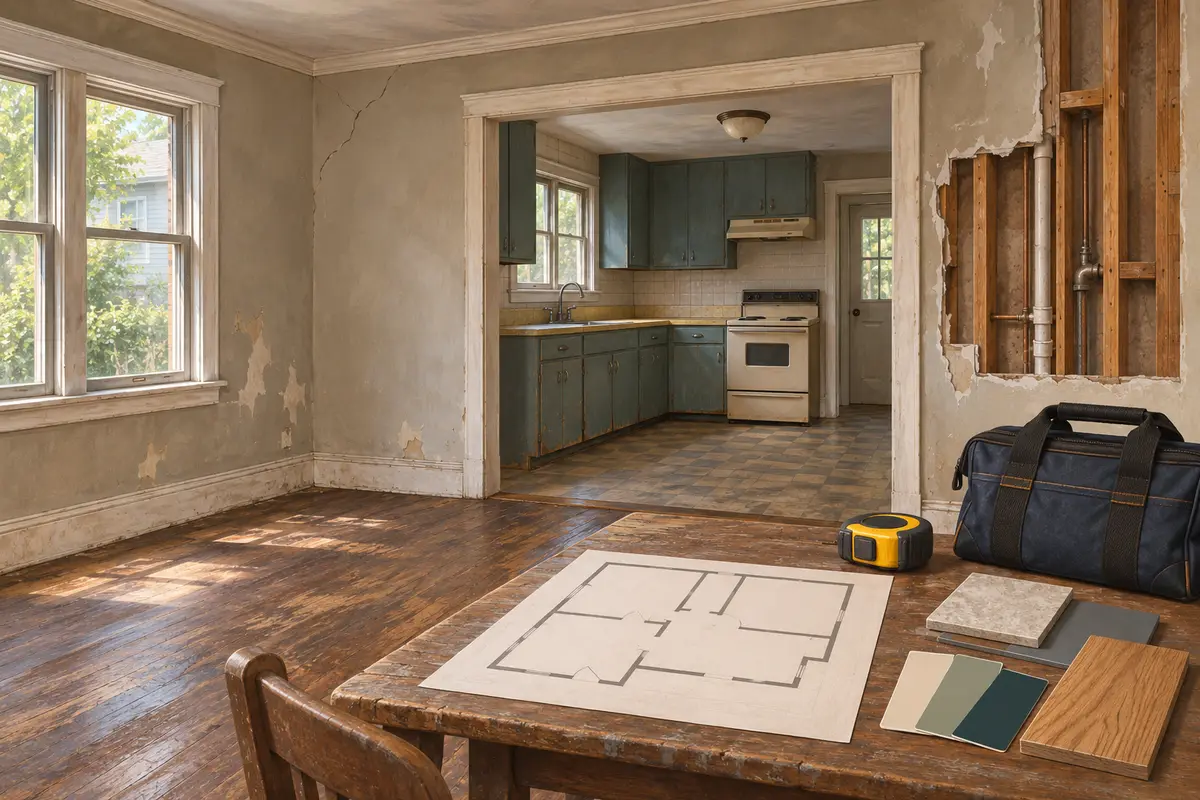
Winning an occupied auction house starts a sequence of separate decisions: payment, ownership documentation, lawful possession, condition review, approved construction, and rehab disbursements. A funding decision made before interior entry addresses only part of that sequence.
Plan an occupied auction rehab around lawful access and the actual draw conditions. You may be carrying the acquisition loan before a contractor can verify the scope. Once access is available, the first inspection may reveal work that was not included in the original commitment.
Before bidding, send Jaken Finance Group the sale documents, occupancy information, available evidence, repair assumptions, and proposed exit through the fix-and-flip review form. Ask whether the property and occupancy fit the proposed acquisition structure and how the first rehab draw would work.
Separate payment, title, and possession
Use three different entries in your project schedule. Record when payment must arrive, which ownership or confirmation steps remain, and who will establish that entry is lawful. Do not use “auction won” as the start date for demolition.
Auction.com’s property-details guide distinguishes access information from occupancy status and warns buyers not to enter merely because a property appears vacant. Treat access permissions as a fact to verify. Auction.com property-details guidance
Ask a qualified local attorney to review the actual sale type, court or trustee documents, deed process, possible redemption rights, and occupant status. The answers can differ between mortgage foreclosure, tax sales, and a bank’s later REO sale.
Give the lender the resulting schedule and unresolved issues. If acquisition funding requires possession, a title condition, or a particular insurance status, resolve that before counting on the loan. A program’s general description does not establish that an occupied address qualifies.
Identify the occupant before estimating turnover
“Occupied” is an observation, not a legal classification. The person inside might be a former owner, a tenant with a lease, or someone whose status needs investigation. Avoid assigning one automatic eviction timeline to every occupied house.
The federal Protecting Tenants at Foreclosure Act can require at least 90 days’ notice for covered bona fide tenants and can protect occupancy through the remaining lease term, subject to statutory exceptions. State or local law may provide additional protection. This is not a universal 90-day possession schedule. Have counsel determine applicability and the required process. OCC guidance on tenants at foreclosure
Collect available leases, notices, court records, and seller occupancy statements through authorized channels. If information is unavailable, carry that uncertainty into the bid and loan review. Do not assume an occupant’s absence during a drive-by establishes vacancy.
Any negotiated move-out arrangement should follow local requirements and written terms reviewed by your attorney. Do not schedule a rekey or utility shutoff as a substitute for establishing lawful possession.
Price waiting time as its own project phase
Build at least two timelines: the expected possession case and a longer case. Include ownership or confirmation steps, the possession process, condition review, permits, construction, marketing, and loan repayment.
The following interest example is hypothetical, not a Jaken Finance Group quote. Assume the relevant interest-bearing loan balance is $150,000 at 11% annually. Monthly interest is $150,000 × 11% ÷ 12 = $1,375. Assume another $850 per month for taxes, insurance, utilities, and other holding expenses.
| Waiting period before work | Interest | Other carry | Total waiting cost |
|---|---|---|---|
| Two months | $2,750 | $1,700 | $4,450 |
| Four months | $5,500 | $3,400 | $8,900 |
These totals exclude attorney fees, negotiated possession payments, repairs, and any other unlisted costs. A longer possession phase can also move the sale beyond the original loan term.
Ask whether your loan charges interest on the full commitment, drawn funds, or another stated basis. Confirm minimum interest, extension provisions, and fees in the documents. Recalculate using the actual structure; do not copy the example’s balance or rate.
Keep insurance aligned with actual use
Tell the insurer and lender what is known about occupancy, access restrictions, condition, and planned renovation. Ask what coverage can be bound, what evidence is required, and when a change in status must be reported.
Record any inspection requirement before assuming the policy can support acquisition funding. After possession, confirm coverage for vacancy and the planned construction as applicable. A quote for a different use or condition does not settle this requirement.
Place premiums and deductibles in the cash plan. Use the auction maximum bid and reserves calculator to keep those amounts separate from repair reimbursement and purchase payment.
Use the first authorized visit to reconcile the scope
Once entry is lawful and authorized, arrange the appropriate contractor and specialist review. Document the condition before substantial work changes the evidence. Focus on safety and the differences between the provisional budget and the actual house.
Build a comparison table:
| Original assumption | Observed condition | Next action |
|---|---|---|
| Cosmetic kitchen work | Leak damage extends into subfloor | Price repair and request scope review |
| Mechanical replacement allowance | Distribution system also needs work | Obtain revised trade proposal |
| No structural work planned | Condition raises structural concern | Obtain qualified assessment before affected work |
| Standard finish demolition | Building age and materials require evaluation | Confirm appropriate testing and work practices |
For applicable pre-1978 housing work, EPA’s renovation rules address certification and lead-safe practices. Include the qualified contractor’s requirements before treating demolition as a routine first milestone. EPA renovation contractor requirements
Send material differences to the lender promptly. Preserve dated photos, reports, estimates, and correspondence. The no-access repair estimating guide explains how an evidence ledger makes that comparison easier.
Approve scope changes before counting on reimbursement
Separate three decisions when additional work appears: whether it is necessary, whether the lender approves it, and how it will be paid. Necessary work is not automatically an approved draw item.
Ask whether the existing holdback can be reallocated, whether additional borrower funds are required, and whether revised value or eligibility review is necessary. A higher repair estimate does not automatically increase the loan commitment.
Keep the contractor’s change order and the lender’s written decision together. Update the budget, schedule, and remaining cash. Avoid paying for optional finishes while a required structural or system issue remains unresolved.
If work must pause while the revised scope is reviewed, carry that time into the interest and maturity plan. Contact the lender before a schedule problem becomes a missed payment or a maturity deadline.
Confirm the first draw package before work starts
Jaken Finance Group’s photo-funded program describes post-close progress photos and inspections. The acquisition review does not waive those later controls. Get the actual requirements for your structure.
Use the fix-and-flip draw process guide to prepare questions about:
- Approved line items and the first measurable milestone.
- Who may request a draw and how it is submitted.
- Required invoices, payment evidence, and lien documentation.
- Access for the reviewer or inspector and evidence before work is concealed.
- Treatment of deposits, stored materials, contingency, and change orders.
- Inspection fees, deductions, and remaining holdback.
Match contractor billing dates with the draw process. An invoice due on Friday and a pending inspection do not produce cash on Friday. Ask for the complete release sequence instead of assuming a fixed turnaround.
Example: cash still deployed after the first draw
Assume the buyer pays $18,000 for work and $2,000 for investigation before requesting reimbursement. The lender receives an $18,000 request, approves $16,000 of eligible completed work, and deducts a hypothetical $200 fee. These are invented terms for a cash illustration.
| First-draw cash item | Amount |
|---|---|
| Buyer cash already paid | $20,000 |
| Gross approved draw | $16,000 |
| Assumed fee deducted | $200 |
| Net cash received | $15,800 |
| Buyer cash still deployed | $4,200 |
The $4,200 consists of the $2,000 investigation cost, $2,000 not approved in that request, and the $200 fee. Whether any remaining work becomes eligible later depends on the loan documents and subsequent approval. Do not budget it as a guaranteed future reimbursement.
Keep enough liquidity for the next milestone, ongoing carry, and unresolved repairs. A holdback balance is not a checking account balance. Reconcile each draw before authorizing the next round of contractor payments.
Recheck the exit after the real scope is known
Compare the revised project with a resale exit and, if appropriate, a rental exit. Updated repairs, timing, and debt balance may change which option is viable. A potential refinance requires a new underwriting decision.
For a rental takeout, review the lender’s actual valuation, condition, rent documentation, reserves, title, and borrower requirements. Jaken Finance Group’s no-seasoning DSCR refinance overview describes a qualified path; it does not promise that an unfinished or inaccessible house can refinance.
Agency financing has its own completion rules. Fannie Mae’s guide requires verification of specified repairs or completion under the applicable transaction rules. That is another reason an acquisition decision cannot establish future loan eligibility. Fannie Mae completion requirements
Before bidding, request an auction rehab review with the possession assumptions and first-draw cash plan attached. Establish the funding conditions, lawful access plan, and reserves early enough that the first interior inspection can improve your project plan instead of exposing a cash shortage.