Blog
DFW Small-Bay Industrial Bridge Loans: Plan the Exit
By Jason Taken · Principal
12 minute read
Plan a DFW small-bay industrial acquisition with bridge financing, repair draws, tenant costs, and a tested refinance exit. See a full cash-gap example.
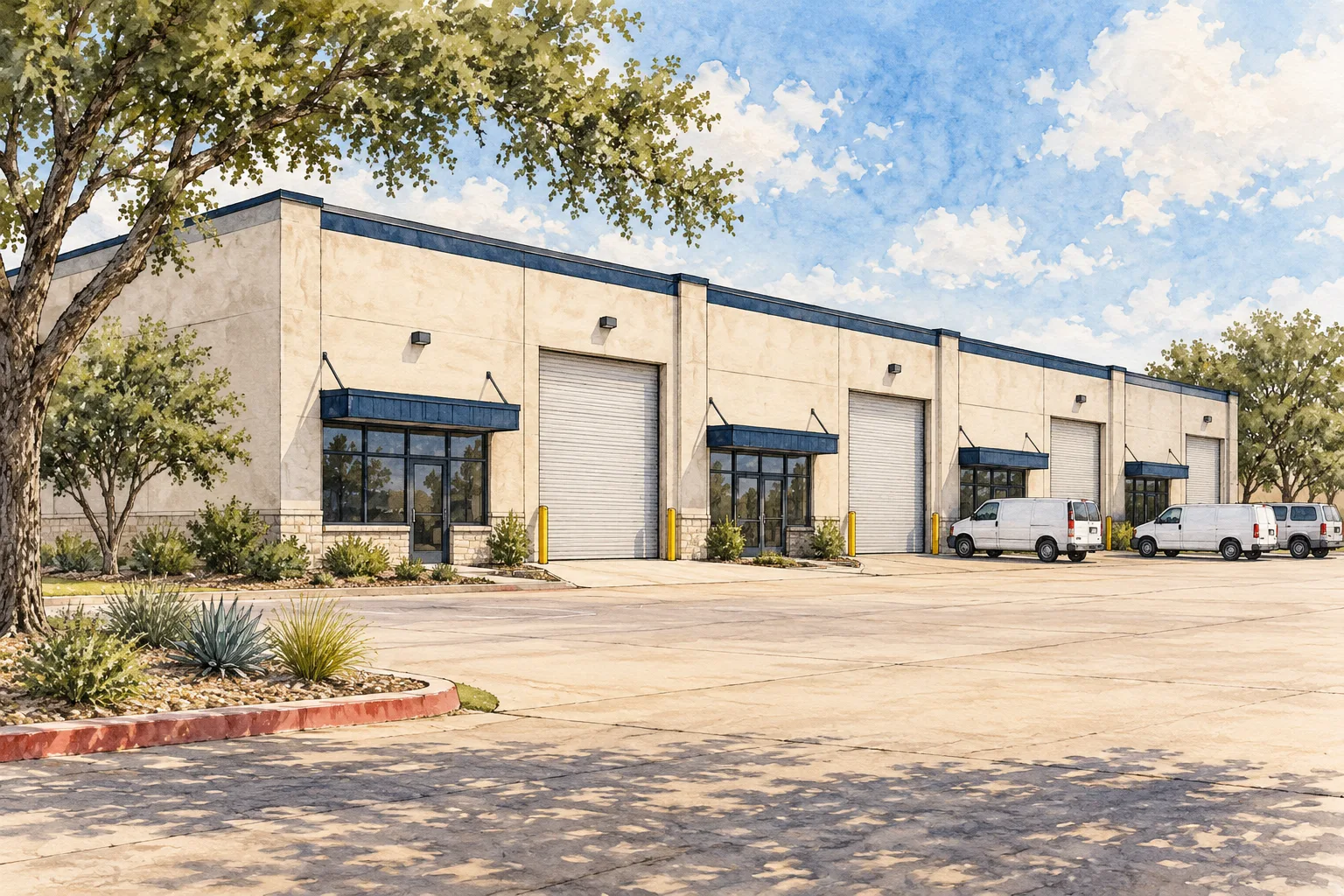
A DFW small-bay industrial bridge loan can fund a purchase while repairs and leasing bring the building into a condition suitable for long-term debt. The financing works best when the needed work is defined, the tenant costs are funded, and the later refinance is tested before the purchase closes.
Start with what must change before the next loan can close. Does the roof need work? Is a bay empty? Is a lease about to end? Give each issue a task, cost, and date. Rising values alone are a weak repayment plan. Show how the work and rent will support the next loan.
This guide covers DFW industrial and flex buildings held for tenant rent. If your business will use the space, compare the owner-occupied warehouse bridge and SBA guide and request an owner-user loan review. The example below is made up, not a loan quote, local rent survey, or account of a funded deal.
Define the building before choosing the loan
Small-bay industrial covers many kinds of space. Two buildings of the same size may suit very different tenants. List each bay’s size and office area. Check ceiling height, doors, truck access, power, parking, and yard rights. Those features help show who can use the space and what work they may need.
Walk the building with the leasing plan in mind. A roll-up door does not prove a delivery truck can reach it safely. A large electrical panel does not prove the intended equipment can run on the available service. Ask the right professionals to verify the features that support your target tenant’s use.
Review existing uses as carefully as planned ones. A tenant may be operating under a limited approval or occupying more space than the lease describes. Match the unit plan, leases, and occupancy records. Resolve discrepancies before counting every bay as lawful, rentable collateral with the planned use.
Jaken Finance Group’s industrial and warehouse property financing supports a building-specific review. Use the commercial asset-class overview to understand the broader financing options. Residential purchase leverage and closing-speed headlines do not apply automatically to a commercial industrial purchase.
When is a bridge the right starting point?
A bridge may be useful when the building needs a roof repair, selected tenant improvements, or time to replace an expiring tenant. Describe why the work or lease event prevents the desired long-term debt today. Then list the evidence that would remove that issue. The bridge term should allow time for that evidence to develop.
If the building is already stable, compare long-term debt directly. A bridge adds another closing, another approval, and another set of costs. Speed can have value, but it should be weighed against the full financing path. Do not assume a two-step structure is better simply because the purchase deadline is approaching.
A workable plan includes a specific completion budget and a source for overruns. It also includes money for the months between finishing a bay and collecting normal rent. A new lease may contain free rent, landlord work, or conditions that delay the tenant’s duty to pay. Those terms affect both cash reserves and refinance timing.
The OCC commercial lending handbook discusses repayment capacity, property cash flow, and underwriting risks. It provides context for lender review, not a Jaken Finance Group approval standard. Ask the planned lender which property and borrower conditions must be met at closing and during the term.
Read each lease instead of relying on its label
A lease called triple net may still leave large costs with the owner. Read who pays the roof, structure, parking area, utility service, and major equipment replacements. Check reimbursement caps, exclusions, and administrative charges. A summary on a broker flyer cannot settle those duties.
Build a reimbursement schedule for taxes, insurance, and common-area expenses. Compare billed amounts with collected amounts, and list any year-end true-up. If the building is partly vacant, some expenses may remain with the owner regardless of lease language. Underwrite that unrecovered share during lease-up.
Review remaining lease term, renewal options, termination rights, and scheduled rent changes. Several leases expiring together can create a large cash need even when today’s occupancy looks strong. A long-term lender may view near-term rollover in a different way from a long lease with a reliable payment history.
Ask for rent ledgers and notes on late payments. A deposit or guarantee is useful, but it is not steady rent. Count tenants as well as doors. One business may rent three bays. If it leaves, all three may go dark at once. Check whether different tenant names belong to the same owner.
Budget repairs and tenant improvements separately
Repairs protect the building. Tenant improvements make a bay fit a new user. A leasing fee or free rent helps get that lease signed. Put each cost on its own budget line. The lender may fund some costs but not others. Do not assume the repair holdback pays every bill needed to fill a bay.
Get a roof assessment and bids for major work before fixing the purchase economics. Check heating and cooling systems, doors, paving, drainage, lighting, and fire protection. List costs that must be paid before a tenant opens. A repair that can wait six months has a different cash effect from a condition of occupancy.
Check who owns installed equipment and who must maintain it. A departing tenant may remove equipment you thought belonged to the building. A new tenant may need a power or ventilation upgrade beyond the basic bay renovation. Put those items in the lease negotiations and the financing budget together.
For a work draw, ask what must happen before cash is sent. Will the lender inspect the job? Does it need paid bills or lien waivers? Will it hold some funds until the end? Your contractor may need payment sooner. Keep cash for that gap even when the loan covers the approved cost.
A hypothetical DFW purchase budget
Assume an investor buys an existing multi-tenant building for $2 million. Building repairs total $200,000, and tenant improvements plus leasing costs total $100,000. The planned bridge commitment is $1.7 million: $1.5 million at purchase and a $200,000 approved work holdback. All terms are inputs for this example.
This structure assumes the lender has checked and approved each cost, value, collateral, and draw limit. It does not mean every purchase can combine 75% purchase financing with full repair funding. The total commitment and first advance must each meet the actual approval, including any as-is or completed-value constraint.
| Sample funding use | Amount |
|---|---|
| Purchase | $2,000,000 |
| Building repairs | $200,000 |
| Tenant improvements and leasing costs | $100,000 |
| Purchase, work, and leasing subtotal | $2,300,000 |
| Bridge commitment, fully drawn by exit | ($1,700,000) |
| Sponsor cash paid in to that subtotal | $600,000 |
| Purchase closing and third-party allowance | $40,000 |
| Assumed origination fee, 2% of commitment | $34,000 |
| Net carry allowance through stable operations | $90,000 |
| Total modeled sponsor cash spent | $764,000 |
The $90,000 carry allowance is an assumed net cash cost after interim property collections. It is intended to cover interest and cash shortfalls not already counted above. A live budget needs a monthly schedule to support it. Do not add the same operating loss or interest payment twice in separate worksheets.
Unspent cash reserves and temporary draw funding sit outside the $764,000 spent-cash total. Check whether interest accrues on the funded balance or another basis, and whether reserves are financed or borrower-funded. If financed reserves increase the payoff, include them in the exit balance. The example assumes the full exit principal remains $1.7 million.
Build the permanent income case from the leases
Assume the stable yearly schedule contains $300,000 of base rent and $90,000 of reimbursements. Deduct $24,000 for vacancy and collection loss and $12,000 for concessions. The resulting effective income is $354,000. This is an invented schedule for the exercise, not a DFW rental-rate claim.
Suppose supported running costs are $176,000, leaving $178,000 of net operating income. Deduct an assumed $8,000 replacement allowance for the coverage math, leaving $170,000. A lender may use different reserve treatment or labels. Keep the NOI and post-reserve amount distinct when discussing the planned exit.
Reimbursements deserve their own stress test. If tenants pay their rent but dispute common-area charges, the building can miss the expected cash flow. If a tax bill rises, a lease cap or vacant bay can leave part of the increase with the owner. Model the real collection terms, not full recovery by default.
Support the operating case with signed leases, a current rent roll, tenant payments, and recent expense evidence. A lease signed yesterday may improve the outlook but provide little collection history. Ask the long-term lender how much proof of results it needs and how it treats free-rent periods before choosing a new loan date.
Test whether the new loan clears the bridge payoff
For a simple value estimate, divide $178,000 of NOI by an assumed 6.5% capitalization rate. That produces roughly $2.738 million. At an assumed 70% LTV, value would permit about $1.917 million. The cap rate and value are scenario inputs; a commercial appraisal must support the real property value.
Now use a sample 1.25 coverage requirement, 7.25% interest rate, and 25-year amortization with monthly payments. The $170,000 cash-flow figure allows $136,000 of yearly debt payments. At those terms, it supports about $1,567,961 of debt. Coverage binds before the modeled value ceiling.
| Permanent exit math | Amount |
|---|---|
| Coverage-supported loan | $1,567,961 |
| Fully drawn bridge principal payoff | ($1,700,000) |
| Assumed refinance costs | ($40,000) |
| Extra sponsor cash needed | $172,039 |
The owner would need roughly $172,039 more to refinance, even though the building has a modeled value above the purchase and work budget. Added to $764,000 already spent, unrecovered sponsor cash becomes about $936,039. This is a measure of cash committed, not a valuation loss or a forecast of investment return.
The lesson is to test the long-term loan before maximizing the bridge. A bridge approval does not guarantee a matching refinance amount. The owner may need a smaller first loan, more lasting income, different accepted terms, extra equity, or another feasible exit. A later loan remains subject to separate approval.
Explore the worked example
Test the DFW industrial bridge exit
Use effective collected income and the full expenses that reimbursements are meant to cover.
Illustrative results for the starting values. All editable loan terms are assumptions.
- Modeled commercial loan ceiling
- $1,567,961
- Net proceeds after payoff and costs
- -$172,039
- Owner cash still invested / needed
- $936,039
- Annual cash flow after modeled debt
- $34,000
| Annual NOI before replacement reserves | $178,000 |
|---|---|
| Annual cash flow used for debt coverage | $170,000 |
| Income-based property value | $2,738,462 |
| Value-based loan limit | $1,916,923 |
| Coverage-based loan limit | $1,567,961 |
- Income means collected or explicitly assumed effective annual income after vacancy, concessions and credit losses, including supported reimbursements. Keep costs paid through reimbursements in expenses.
- For a purchase, use the price plus work budget as the payoff input and set cash already spent to zero. For a refinance, use the real payoff and owner cash invested.
- Negative net proceeds are a closing cash requirement. Replacement reserves are deducted for coverage but not in the NOI used to estimate value here; an appraisal or lender may use a different convention.
- This simplified permanent-loan screen excludes debt-yield limits, loan-size caps, recourse, lease tests and lender adjustments. A future income case is not current borrowing capacity.
Review environmental history before the purchase closes
Industrial due diligence includes past uses, not just the current tenant. Ask about automotive work, chemical storage, tanks, spills, drains, and neighboring operations. Provide the available history to an environmental professional and the lender. A freshly painted warehouse can still need investigation of earlier activities.
The EPA’s All Appropriate Inquiries guidance explains environmental due diligence and its role in certain liability protections. Appropriate inquiry generally must occur before purchase for those protections, with ongoing conditions afterward. A Phase I report is not a guarantee that a buyer has no environmental liability.
Ask the lender what reports it needs before you order them. Check who may rely on each report and how old it can be. A report made for a prior buyer may not work. If it calls for more tests, budget those tests and the time they take before you agree to close.
Do not treat a financing contingency as a substitute for understanding the building. Environmental findings may affect occupancy, work, value, insurance, or the choice of long-term lenders. A good bridge plan makes those dependencies visible before the investor commits the full equity contribution.
Check municipality, occupancy, and Texas property taxes
In Dallas, the City’s certificate-of-occupancy guidance addresses using or changing the use of commercial space. Verify the intended tenant’s use with the city before promising a move-in date. Build-out and use questions can affect the work needed, inspection path, and first rent payment.
Fort Worth has its own certificate-of-occupancy guidance. Other DFW municipalities need their own checks. A Dallas mailing address or nearby highway does not show the permit authority. Check the parcel’s jurisdiction and the approvals needed for each planned bay use.
The Texas Comptroller’s property valuation explanation describes the role of local appraisal districts and market-value appraisal. Do not model the seller’s old tax bill as a fixed operating cost for the entire hold. Review the real parcel, taxing units, exemptions if any, and a supported forward estimate.
Then apply the leases to that tax estimate. Find which tenants reimburse the increase, when they pay it, and which costs remain with the landlord. A fully recoverable yearly charge can still create a timing gap if the owner must pay first. That gap belongs in working cash, even if the owner recovers the cost later.
Test the largest tenant leaving before the new loan
Model the loss of the largest tenant using its real rent and reimbursement duties. Add the time needed to recover the space, finish work, and collect rent from a replacement. Include leasing costs and any new concessions. A building with several doors may still have a concentrated income risk if one business rents most of them.
Check whether the remaining tenants can cover basic running costs and debt during that period. Some expenses will fall when a bay is vacant, while taxes, insurance, and many building costs continue. Use the lease and vendor contracts to distinguish the two. A blanket expense percentage can miss the size of the cash need.
Finally, rerun the long-term loan with that tenant absent. The change may affect cash flow the lender accepts, valuation, and the lender’s view of the building. Decide in advance how much extra equity you could supply. That answer helps find an initial bridge balance that the sponsor can manage under a realistic downside case.
Set milestones that support the next loan
Use milestones that produce evidence: roof work accepted, occupancy approval issued, tenant improvements completed, lease commenced, and rent collected. A calendar date by itself is not proof of stable operations. Assign each milestone a cost, responsible party, and record that shows completion.
Start permanent-loan discussions before the bridge approaches maturity. Request feedback on the planned rent roll, remaining lease terms, expense inputs, and reserve needs. Compare that feedback with the business plan each month. Early differences give you time to adjust the budget or arrange equity while options remain open.
Price the cost of more time before you need it. Ask about extension fees, interest, and the lender’s right to decline. Test a sale with its own price, costs, and timeline. Neither path is assured. A backup works only if it can pay the debt and costs when they are due.
For a commercial loan review, send the contract, bay schedule, leases, financials, work bids, environmental records, occupancy status, and sponsor cash reserves. Include your permanent-loan math and the largest extra cash you could contribute at exit. That lets Jaken Finance Group assess the purchase and repayment plan as one connected transaction.