Updated
Some lenders will consider medical office construction before tenants sign, especially if they can finance a defined shell and the sponsor can cover the cost of leasing it. Ask what the lender will fund without leases and show how you will pay for tenant build-out, debt and operating costs until you collect enough rent.
Medical office vacancy and lease-up calculator
Estimate the cash you need from shell delivery through the first months of rent.
Estimated results
- Carry before first rent
- $384,000
- Monthly shortfall after rent starts
- $16,000
- Sponsor cash needed
- $580,000
- Gap after available cash
- $155,000
How the estimate adds up
- The reserve covers modeled holding costs. Enter sponsor-paid leasing costs separately and check when their bills come due. Budget for later leasing and carry beyond the months you enter.
Brokers with a client deal
Sign up as a brokerCompare financing paths · Run the 18,000-square-foot example · Prepare a lender package
Who finances a medical office before tenants sign?
Start with your intended tenants and what the loan must pay for. A lender may review an outpatient office shell with space for several practices. A building designed around one specialized use can be harder to finance before that tenant commits. The lender needs to know who could rent it and what it would cost to deliver space that each likely tenant can use.
| Financing path | What to confirm before budgeting around it |
|---|---|
| Bank or other portfolio construction loan | Whether the bank considers a project with zero signed tenants, how it measures any prelease requirement and when that test applies |
| Private construction loan | What it can underwrite with vacant space, the sponsor cash and guarantees it requires, and the period it allows for leasing before repayment |
| Shell funding with later tenant advances | What the first commitment covers, which conditions unlock tenant work, and how you will pay for that work if the advance is delayed |
| Wait for an anchor lease before closing | How long you can control the site or hold the design team, what the tenant must sign, and when rent can start under the lease |
A lender may need preleasing at approval, at the loan closing or before certain advances. Get the exact milestone and ask how it is measured. A lender using rentable area could view an 8,000-square-foot lease differently from one assessing the share of projected income it contributes. Ask whether lease options, cancellation rights and remaining work affect how much the lender counts. The OCC’s bank supervision handbook describes how lenders examine feasibility and preleasing when structuring construction credit. OCC commercial real estate lending handbook
The borrower and tenant structure matters. The lease-up case here is for a landlord developing space for unrelated practices. A practice building space for its own operations can ask about owner-user financing and SBA eligibility. The SBA 504 program lists investment in rental real estate among uses it excludes. SBA 504 program · SBA construction loan guide
What can you build before you know each tenant’s requirements?
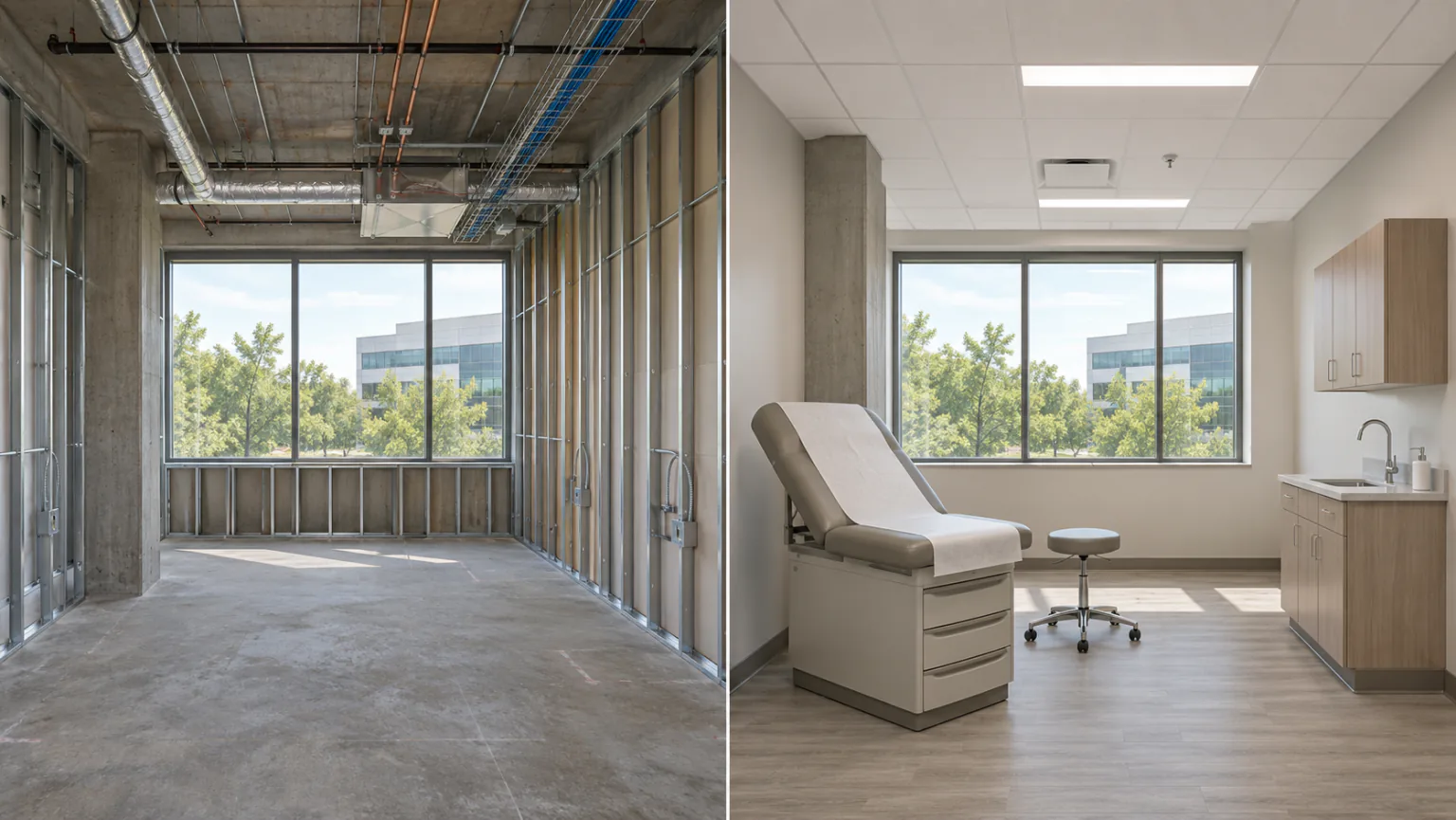
Have the architect and contractor price the base building and the suite work separately. The shell might include the structure, exterior, common areas and shared equipment. The final suite may need plumbing, electrical work, heating and cooling changes or specialized rooms. The scope varies with the space and the tenant. A 2017 Texas project registration, for example, describes a new two-story medical office in Sherman with a shell and core scope. Texas Department of Licensing and Regulation project record
| What to show the lender | How it can change the budget |
|---|---|
| Drawings for a divisible shell | Suites that can be leased separately may need their own entries, metering, connections and access for patients |
| Local demand for the planned suites | Dated comparable leases, space still available and the concessions offered nearby help test rent and how long vacant months might last |
| Allowances for each likely tenant type | A general exam suite and an imaging tenant may need different service and room layouts. Confirm what is included in the shell |
| Building and suite approval milestones | Ask the project team which approvals let you finish the shell and which changes require separate permits and inspections before a tenant can open |
| Timing and sources of tenant spending | Identify who orders work, which invoices are due before rent, and whether the lender advances or reimburses that money |
Ask the broker which space the likely practices could actually take. A clinic might want six exam rooms and a particular number of exam sinks. Another might need more electrical capacity or space for imaging. A wide rent range tells you less than a dated list of tenants, suite sizes, delivery needs and nearby alternatives. Have your design team identify what can stay useful across tenants and what would require expensive rework.
A letter of intent can help the lender see which suites are viable. Share it with a clear status. Identify the lease negotiation, tenant approval and work conditions still open. A signed lease can also leave months between delivery and the first collection. Tie the rent in your forecast to the first month each tenant is expected to pay. Preleased office construction guide
Worked example for an 18,000-square-foot medical building
A developer plans an 18,000-square-foot outpatient office building with two suites and no signed tenants at the construction loan application. After the shell is delivered, the developer expects one practice to take 8,000 square feet. Use a forecast of eight months with no collections and then six months with rent from that one suite. These are assumptions for a cash test.
Assume a $4.2M outstanding loan at shell delivery with interest-only payments at 10% a year in this model. That is $35K in monthly interest. Add a $13K monthly operating budget for expenses such as property taxes, insurance and maintenance. That gives you $48K per month in cash costs. During the six months after the first rent, assume the first suite pays $32K per month in rent and expense recoveries. That is $48 per square foot per year in combined collections on 8,000 square feet. The operating budget already includes the expenses the tenant helps reimburse.
| Cash test after shell delivery | Model result |
|---|---|
| Cash costs before the first rent | 8 × $48K = $384K |
| Shortfall per month after first rent | $48K − $32K = $16K |
| Shortfall for six months after first rent | 6 × $16K = $96K |
| Total to cover from reserve and sponsor cash | $384K + $96K = $480K |
| Sponsor carry after $250K of usable reserve | $230K |
| Separate sponsor-paid suite work and commission | $320K + $30K = $350K |
| Total sponsor cash needed | $230K + $350K = $580K |
| Gap with $425K of sponsor cash available | $155K |
The $320K is the assumed landlord contribution to the first suite’s work, at $40 per square foot. Assume the loan reserve can pay $250K of the holding costs as they are due. The $425K is available once shell costs are paid. Check your own budget for whether lender-funded tenant work is already in an advance or needs to be paid from that same cash. The model stops after six months of collections from one suite. Budget the second suite’s costs and any later carry separately.
What if the first rent arrives three months later?
Move the first payment back by three months and keep the six months at $32K in collections. The three empty months cost another $144K. The sponsor cash need rises to $724K, with an unfunded gap of $299K. In this case the sponsor’s cash runs short before the same leasing milestone. Check whether loan maturity or the deadline to use the reserve falls inside those extra months.
Keep a calendar for the lease signature, tenant work, inspections, free rent and actual collection. A tenant may be ready to sign in month five and be paying in month nine. Put the contractor and commission bills on their own dates. A reimbursement that arrives after a bill is due can leave you needing cash in the meantime even when the carry and the lease work are both budgeted. Construction draws and interest guide
How much of the reserve can you actually use?
Ask which expenses are eligible, what triggers each advance and when the reserve ends. A reserve restricted to loan interest can cover part of the $35K monthly interest in the example. The taxes, insurance, maintenance and suite bills still need sources. Put the approved amounts next to the bills they can pay. If only $200K of the proposed $250K can be used for expenses in the modeled period, the sponsor’s funding gap grows to $205K. The reserve can be discussed at the term sheet stage, then confirmed in the loan and draw documents.
When do you need to pay for the first suite?
Suppose the first practice signs in month five. The contractor requires an $80K deposit on the $320K of landlord work and the $30K leasing commission is due when the lease is signed. In that case, $110K of the $350K lease budget is due by month five. The remaining $240K is due as work progresses. The first five months of holding costs are $240K, within the $250K reserve if those funds are usable at that time. Confirm each amount on the cash calendar before agreeing to the work letter or commission terms.
If the lender offers to fund part of the suite work later, ask when it will advance that money. It may need to review the lease, the final plans, the suite budget or invoices. List the costs the sponsor must pay before reimbursement and the amount the advance adds to your payoff. You can then size the cash needed up front and test what the refinance must repay. Check which lease costs are already in your total construction budget before you use the calculator.
Can you start with less space or wait for an anchor?
Compare the costs that fall away if you delay a suite or building with the costs that stay. Utilities, parking and common systems may need to go in on day one. A smaller first phase can reduce the amount to lease. It also needs to work for patients and tenants throughout the build. Get separate bids and a written approval path for staged work, and ask what portion must be complete before a tenant can occupy space. Standalone Phase 1 financing guide
Waiting for an anchor can also change what you build. If a practice needs the full 8,000 square feet and commits to a delivery date, you can have the contractor price a defined scope. Compare that with the cash cost of holding the site longer. Check how much rent the tenant can afford once it opens and what conditions let it walk away. A signed lease can improve the financing conversation while adding a date and a more exact cost for the building owner to meet.
What if only one suite is leased when the loan matures?
Use the first suite’s income and the expenses you will carry across the building. In the example, $32K of monthly collections minus $13K of monthly expenses leaves $19K of monthly net operating income. That is $228K a year before debt service. The projected rent from the unleased 10,000 square feet belongs in a separate case. Include the time and concessions it would take to earn it.
Suppose a takeout lender uses that annual income, assumes a 1.25× debt-service coverage minimum, and models annual principal and interest payments equal to 9.5% of the starting loan balance. The income test allows $182,400 of annual loan payments and about $1.92M of gross loan proceeds. Against a $4.2M payoff that leaves $2.28M to fund before fees. Other lender limits can reduce the amount further. The test is for planning a refinance under assumed terms.
If that gap is too big for the sponsor to cover, ask about an extension early. Check its notice date and conditions. Use a realistic first and second rent date and test what it would cost to carry the building through either. Share a current payoff with the refinance lender if the property has already opened. Commercial real estate refinance guide
What should you send for medical office construction financing?
Start with your closing date, the total loan amount and the amount of space with signed leases. The next step depends on whether you need to buy the site, build the shell or finish suites.
- Describe the property. Send the site address and control, rentable area, suite layouts, planned tenants and permit status.
- Break out what you will build and when. Include the shell contract or bids, common systems, suite allowances, contingencies and the first date each part could be delivered.
- Show evidence for the leasing plan. Attach signed leases, letters of intent and a dated broker leasing report, as available. Mark when each practice could pay and what work you owe before then.
- Show the cash from shell delivery onward. Include monthly loan payments, operating costs, tenant work, cash available and the amount and timing of any reserve draws. Add a late first rent case.
- Show how the loan gets paid off. Include the loan maturity, extension terms if available and a takeout estimate based on the rent you can support by that date.
Submit a medical office construction deal with the calculator summary and your next deadline. If you are comparing lender types before sharing a request, start with the commercial construction lender guide.