Five-unit infill apartment development
5-Unit Construction and Refinance Example
Acquire land → build → lease → refinance
Build five apartments with $200,000 of land, $825,000 of hard costs and $100,000 of soft costs. The starting timeline includes twelve construction months and four months for lease-up and permanent financing. The takeout is tested against stabilized income as well as value.
By Jaken Finance Group ·
Edit this funding example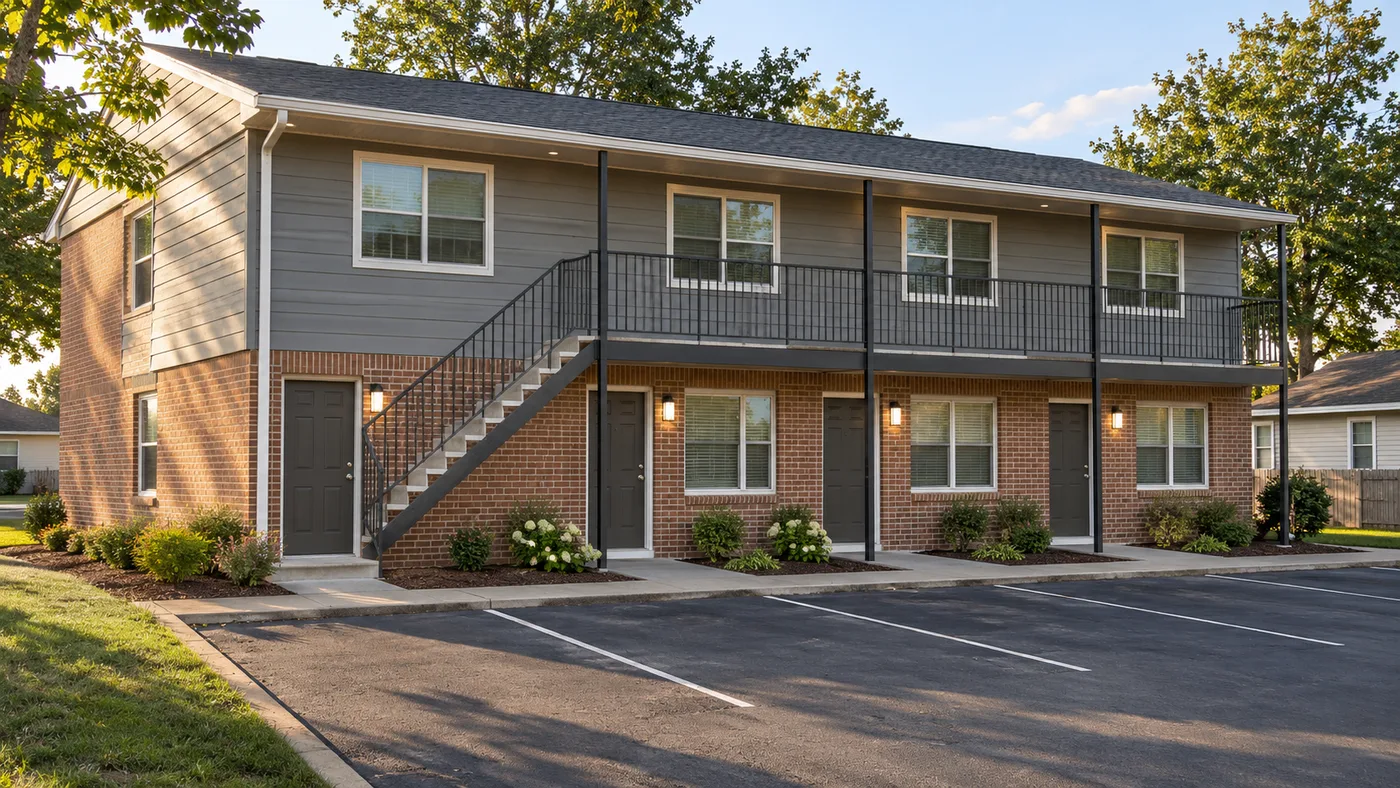
How this funding example works
The starting calculation follows the assumptions described above. Change inputs in the calculator to explore your own numbers. All rates, leverage, rents, cap rates and fees are planning assumptions; they do not establish an offer, appraisal or loan eligibility.
Build a complete development budget
Land, hard costs, soft costs and a fully spent hard-cost contingency make up the eligible project budget in this illustration. Acquisition closing costs, origination, drawn-balance interest and carrying expenses are outside that eligible-cost calculation and are paid from owner cash. Lender eligibility can differ; reconcile the actual commitment line by line.
The project loan is drawn in stages. Acquisition funds advance at closing; work is paid before equal month-end reimbursements. Interest is paid from owner cash on the beginning monthly drawn balance. No rent is credited during renovation, construction or lease-up, which keeps the project carry visible. The cash schedule includes the temporary need to pay work before receiving a draw.
These are development assumptions rather than a construction bid or a statement of local rental demand. Obtain site-specific land diligence, a supported contractor schedule, finished tax and insurance estimates, and unit-level rent evidence. Entitlement delays before closing and extraordinary site work need their own budget if applicable.
Make the example your own
Edit the deal. See the cash change.
Change any assumption to update the loan sizing, cash requirement and exit. Starting values are planning assumptions; actual terms require property and borrower review.
Starting example shown below. Inputs update automatically when JavaScript is available.
- Modeled permanent loan
- $992,911
- Net refinance cash / cash needed if negative
- $51,428
- Owner cash remaining in the deal
- $392,971
- Monthly owner cash flow after reserves
- $1,610
| Land purchase | $200,000 |
|---|---|
| Hard costs | $825,000 |
| Soft costs / permits | $100,000 |
| Contingency assumed fully spent | $82,500 |
| Eligible acquisition and work budget | $1,207,500 |
| Acquisition closing costs | $15,000 |
| Project loan origination fee | $18,113 |
| Extension / other project financing fee | $0 |
| Drawn-balance interest through exit | $83,811 |
| Tax, insurance, utilities and other holding costs | $25,600 |
| Total project cost before sale/refinance costs | $1,350,024 |
| Modeled total loan commitment | $905,625 |
|---|---|
| Acquisition loan advance | $150,000 |
| Work funds disbursed in stages | $755,625 |
| Cash spent at acquisition closing | $83,113 |
| Cumulative owner cash spent before exit | $444,399 |
| Peak cash spent before monthly reimbursement | $469,271 |
| Unspent liquidity reserve | $40,000 |
| Peak liquidity required including reserve | $509,271 |
| Work months | 12 |
| Post-work sale / lease-up and refinance months | 4 |
| Scheduled rent | $150,000 |
|---|---|
| Vacancy / credit loss | $7,500 |
| Other collected income | $3,000 |
| Management on collected rent | $11,400 |
| Property taxes | $18,000 |
| Insurance | $6,000 |
| Owner-paid utilities | $3,000 |
| Repairs | $5,000 |
| Other operating expenses | $4,000 |
| NOI before financing and capital reserves | $98,100 |
| Replacement reserve | $1,500 |
| Cash flow used for debt coverage | $96,600 |
| Income-based value assumption | $1,569,600 |
| Annual permanent debt service | $77,280 |
| Annual owner cash flow after reserve | $19,320 |
| Value-based loan ceiling | $1,177,200 |
|---|---|
| Coverage-based loan ceiling | $992,911 |
| New permanent loan | $992,911 |
| Project loan principal payoff | $905,625 |
| New loan origination fee | $19,858 |
| Other refinance closing costs | $10,000 |
| Initial escrow / lender reserve funding | $6,000 |
| Project loan prepayment charge | $0 |
| Net refinance cash / cash needed if negative | $51,428 |
| Cash remaining invested after refinance | $392,971 |
| Permanent monthly principal and interest | $6,440 |
| Underwritten NOI ÷ annual debt service | 1.25× |
| Cash-on-cash on positive cash remaining invested | 4.9% |
| Total project cost including refinance and prepayment fees | $1,379,882 |
Inspect the monthly work, draws and cash schedule
| Month | Work paid | Loan draw | Ending loan balance | Interest paid | Other carry | Owner cash spent to date |
|---|---|---|---|---|---|---|
| 1 | $83,958 | $62,969 | $212,969 | $1,313 | $1,600 | $107,015 |
| 2 | $83,958 | $62,969 | $275,938 | $1,863 | $1,600 | $131,468 |
| 3 | $83,958 | $62,969 | $338,906 | $2,414 | $1,600 | $156,472 |
| 4 | $83,958 | $62,969 | $401,875 | $2,965 | $1,600 | $182,027 |
| 5 | $83,958 | $62,969 | $464,844 | $3,516 | $1,600 | $208,133 |
| 6 | $83,958 | $62,969 | $527,813 | $4,067 | $1,600 | $234,790 |
| 7 | $83,958 | $62,969 | $590,781 | $4,618 | $1,600 | $261,998 |
| 8 | $83,958 | $62,969 | $653,750 | $5,169 | $1,600 | $289,757 |
| 9 | $83,958 | $62,969 | $716,719 | $5,720 | $1,600 | $318,066 |
| 10 | $83,958 | $62,969 | $779,688 | $6,271 | $1,600 | $346,927 |
| 11 | $83,958 | $62,969 | $842,656 | $6,822 | $1,600 | $376,339 |
| 12 | $83,958 | $62,969 | $905,625 | $7,373 | $1,600 | $406,302 |
| 13 | $0 | $0 | $905,625 | $7,924 | $1,600 | $415,826 |
| 14 | $0 | $0 | $905,625 | $7,924 | $1,600 | $425,350 |
| 15 | $0 | $0 | $905,625 | $7,924 | $1,600 | $434,875 |
| 16 | $0 | $0 | $905,625 | $7,924 | $1,600 | $444,399 |
Results round to whole dollars; calculations retain unrounded amounts. Retained liquidity is not a spent project cost. Initial escrow funding reduces cash available at closing and remains an asset, separate from fees. Negative cash remaining in the deal means refinance proceeds exceed cash spent; those proceeds are borrowed money. Income taxes, tax benefits and ownership distributions are excluded. The entered amortization is separate from loan maturity and the fixed-rate period.
Lease the building into the permanent loan
The annual pro forma starts with unit count times monthly rent times twelve, then deducts vacancy, management and itemized operating expenses. Other income is entered as collected income rather than a second scheduled amount. Capital replacement reserves are deducted after operating NOI to arrive at cash available for debt coverage.
Income-based value is operating NOI divided by the entered cap rate. That is a sensitivity assumption, not an appraisal. The lender can use different rents, expenses, reserves, value and stabilization requirements. An apparently attractive completed value does not remove the income limit on the permanent loan.
Reconcile the construction payoff and the takeout
The refinance uses the lower of the entered value-based ceiling and the coverage-based ceiling. Origination is calculated on the new loan, then other closing costs and any old-loan prepayment charge are deducted. A negative closing result is a cash requirement. Released equity is borrowed money, not project profit.
The new debt payment is calculated from the entered interest rate and amortization. Debt coverage uses annual cash flow after the replacement reserve divided by annual principal and interest. Property taxes and insurance have already been deducted in the NOI and are not added to debt service again.
A positive refinance distribution does not mean the entire equity contribution is recovered. The cash-remaining line shows the part still invested after payoff and fees. A negative distribution means a new cash contribution is needed at the takeout. Stress both the project timeline and stabilized rent before relying on the permanent financing.
What to verify for a real property
- The entered project LTC is a negotiated assumption, not an advertised approval or commitment.
- No project-period rent is credited, even during lease-up. The permanent pro forma begins only after the modeled exit.
- Completion, occupancy, lease-up, draw approvals and reserve requirements must fit the actual construction maturity.
Use the published program parameters as the starting program reference. The OCC commercial real estate lending handbook provides general background on development and income-property lending risks; it does not set Jaken Finance Group’s terms.
Related financing and planning tools
Bring the address, budget, current operating records and intended exit to the review. Request financing for your property.
Explore another funding example
Buy → renovate → sell
Fix & flip
Explore the funding example
Buy → rehab → rent → refinance → repeat
BRRRR: rehab + refinance
Explore the funding example
Purchase → lease → hold
DSCR rental purchase
Explore the funding example
Acquire land → build → lease → refinance
30-unit build + refinance
Explore the funding example
Review leases → underwrite NOI → refinance