Blog
Cost Segregation for an Existing Rental Property
By Jaken Finance Group · Principal, Jaken Finance Group
10 minute read
Organize records for a late cost segregation review. Understand Form 3115 questions with a free review packet, schedule checker and filing-path infographic.
An existing rental can be considered for cost segregation after its original purchase year, but a late study is not a permission slip to rewrite old returns. The owner and CPA must reconcile original costs, depreciation history and elections, then determine the appropriate procedure for implementing any change. The report’s delivery date does not replace the original asset facts.
The practical starting point is a complete depreciation file. Without it, an attractive “catch-up” estimate can overlook deductions already claimed, earlier elections, replaced assets or changes in ownership and use. Gathering the records first makes both the study proposal and accounting-method discussion more useful.
Download the existing rental cost segregation review packet (PDF) and use the schedule checker below to identify gaps. Federal procedural sources were checked November 3, 2026. This educational guide explains questions to raise; it does not select a filing method, change number, adjustment or deadline for your return.
Separate a late report from a new acquisition
A study performed today analyzes costs and classifications using the relevant historical facts. It does not mean the property was acquired today. Original purchase records, contracts, placed-in-service dates and later improvements remain essential to determining which depreciation rules applied to each asset.
IRS Notice 2026-11 addresses the restored 100% bonus framework for qualifying acquisitions after January 19, 2025. An older acquisition does not automatically receive that percentage because the owner orders a study in 2026. Later improvements may have different facts and should be identified separately.
The same distinction applies to a refinance. A higher appraisal or a new loan does not by itself restart depreciation or establish a new cost basis. Provide the refinancing records where relevant, but do not substitute them for the purchase and improvement ledger. The BRRRR guide shows how to keep those records separate.
If ownership changed through a transaction more complicated than a straightforward purchase, flag that history early. Transfers, conversions, exchanges and entity changes can raise questions outside a simple late-study example. The preparer needs the actual sequence before deciding which entity, asset costs and methods are under review.
Build a year-by-year record inventory
Start with the first year the property or relevant asset entered service. Obtain each completed year’s asset-level depreciation schedule through the last return being reviewed. The number on a tax return summary may not show recovery periods, conventions, elections, accumulated depreciation or separate additions. Ask for the underlying schedules.
Match those schedules to the returns actually filed. A preparer’s working draft and the final filed version can differ. Identify amended returns, administrative adjustment requests and prior accounting-method changes if any exist. Do not assume the most recent spreadsheet in a folder reflects the controlling filing history.
Create a document index with year, entity, property, schedule source, filing status and unresolved questions. If a preparer changed, ask the prior firm for the relevant asset detail and supporting election statements. Missing records often require communication across more than one tax year or preparer.
The checker below identifies only missing schedule years from your list. It cannot tell whether an asset was omitted or a method was permissible. A complete list is the beginning of the review, not a conclusion that every prior return is correct or that a study will produce an additional deduction.
WORK THROUGH YOUR ASSUMPTIONS
Prior-year depreciation records checker
List the years for which you have the complete depreciation schedule, not just the tax return summary. Missing records are questions to resolve, not proof of a missed deduction.
Entries stay on this page. Nothing is submitted, saved or sent to Maven.
Reconstruct the cost ledger without inventing precision
Retain the purchase agreement, settlement statement and support for land and other allocations. Add improvement invoices, payment records, project descriptions and service dates. Reconcile the costs to the asset schedules rather than assuming that every historical expenditure was capitalized or that every listed asset still exists.
IRS Publication 527 explains residential rental costs, basis and depreciation. It also illustrates why the preparer needs more than a current market value. Historical acquisition costs and subsequent adjustments answer a different question from what a property might sell for today.
Where records are incomplete, distinguish known amounts from estimates and ask what support is acceptable. An engineering analysis can help identify and allocate costs, but it does not erase the need to reconcile the total cost being allocated. Do not manufacture an invoice, a service date or a land allocation to make a projected adjustment larger.
Identify replaced or disposed assets. A renovation may have removed items that appear on an earlier schedule, and a prior study may already have classified some components separately. A new report should not silently duplicate those costs. Explain the improvement history to both the provider and preparer before final allocations are adopted.
Why Form 3115 may enter the discussion
Form 3115 is used to request a change in accounting method. Depreciation changes can involve methods, recovery periods or conventions, but the treatment depends on the actual change and history. A provider’s statement that a report supports a different classification does not itself decide which procedural route applies.
The Form 3115 instructions distinguish automatic and non-automatic procedures. Automatic consent is conditional: it requires a change within the applicable guidance and compliance with the associated requirements. It does not mean the filer can skip the form, use any year or assume the IRS has approved the study’s factual conclusions.
Revenue Procedure 2025-23 contains the automatic-change list, including depreciation provisions, subject to applicable modifications. The preparer must check the specific section, scope, exclusions and current amendments. Do not select a designated change number from the phrase “cost segregation” alone.
Revenue Procedure 2015-13 provides a broader procedural framework. The document’s date does not mean every provision is obsolete, nor does linking it mean no later modification applies. Ask the preparer to identify the current authority being used for the actual year and proposed change.
An amended return is not the universal alternative
Owners often ask whether a late study means amending every prior return. There is no universal answer. The nature of the issue, whether a method was adopted, the affected years, entity rules and available procedures can matter. A correction, a method change and a late election are not interchangeable labels.
A property reported for a short history can raise different questions from an asset consistently depreciated for many years. That does not justify a simple rule that one filed return always means amendment or two always mean Form 3115. The applicable guidance contains conditions and special provisions that the preparer must evaluate.
Partnerships can also have procedural rules different from an individual’s return. Provide the entity’s actual filing history rather than assuming the owner can change a personal return to implement an entity-level study. If several owners or entities are involved, identify who owns the assets and who would make the proposed change.
Settle the procedural engagement before purchasing implementation work. Ask whether the study fee includes only the report, whether the tax preparer will handle any Form 3115 or other filing, and what additional records and fees are expected. A late-study proposal should not conceal a separate filing project inside a one-line savings estimate.
What a Section 481(a) adjustment is trying to do
A Section 481(a) adjustment addresses amounts that would otherwise be duplicated or omitted because of an accounting-method change. In an appropriate depreciation change, the preparer compares the relevant prior treatment with the allowable treatment under the proposed method and makes the required reconciliation. This is not simply a new bonus deduction applied to today’s property value.
Consider a conceptual illustration with no assumed property price or bonus rate. Suppose the preparer determines that relevant prior depreciation under the existing method totals $20,000 and the corresponding amount under the proposed permissible method totals $75,000. The difference is $55,000. Under an appropriate method-change analysis, that could support a negative adjustment of $55,000, subject to the applicable rules and other required adjustments.
| Conceptual prior-period reconciliation | Amount |
|---|---|
| Relevant prior depreciation under present method | $20,000 |
| Corresponding depreciation under proposed method | $75,000 |
| Difference in this illustration | $55,000 |
| Potential adjustment sign in the assumed analysis | Negative $55,000 |
This is not a calculation of any owner’s adjustment. The example omits limitations, special rules, capitalized amounts, state differences and the factual work needed to establish both schedules. Its purpose is to distinguish prior-period reconciliation from the regular depreciation that may also be calculated for the year of change.
Under the general framework in Revenue Procedure 2015-13, a negative adjustment is generally taken into account in the year of change and a positive adjustment generally over four years, unless an applicable exception or modification changes the treatment. Those are general procedural concepts, not a promise that a particular late study produces a one-year deductible amount.
Current deduction use is another separate review
Even when the preparer determines a supported negative adjustment, its effect on the complete return needs analysis. IRS Publication 925 explains passive activity and at-risk limitations that can delay use of losses. A procedural path does not eliminate the taxpayer’s other limitations.
Ask the CPA to distinguish the amount of an adjustment from the current cash tax benefit. A suspended amount may have future value, but it should not be counted as money available to pay a study fee, a mortgage installment or the next property’s down payment this year. Timing needs an explicit assumption rather than a favorable default.
State treatment can differ from the federal schedule and adjustment. The owner needs to identify which returns are affected and whether separate state records or adjustments are required. This guide makes no state-conformity promise. The relevant state authority and taxpayer facts should support any state benefit included in the decision.
For an economic comparison, use the study decision guide. Its sensitivity tool accepts CPA-supplied incremental deductions and an explicitly assumed usable share. It intentionally does not calculate a Section 481(a) adjustment from purchase price or select a filing procedure.
Coordinate the actual filing sequence
The Form 3115 instructions describe different submission procedures for automatic and non-automatic changes. For an automatic request, the instructions generally involve the timely filed return for the year of change and a separate signed duplicate submission, subject to the applicable requirements and exceptions. An attachment alone is not a safe assumption that every procedural step was completed.
Do not use a static article as the filing calendar or mailing-address source. Have the preparer verify the current instructions, applicable revenue procedure, due dates, submission method and signature requirements. Keep evidence of the completed filing steps with the final schedules and report.
A report delivery estimate is not a filing extension. If the file is incomplete or a deadline is approaching, ask the preparer to determine the available options before promising a deduction year. The scope, tax work and timing should be coordinated from the beginning rather than assigned after a provider finishes the report.
An automatic request is also not the same as an IRS finding that every allocation is correct. The Cost Segregation Audit Technique Guide discusses examination of studies and implementation. It is useful background, but the guide is not an official pronouncement of law or approval of a particular engagement.
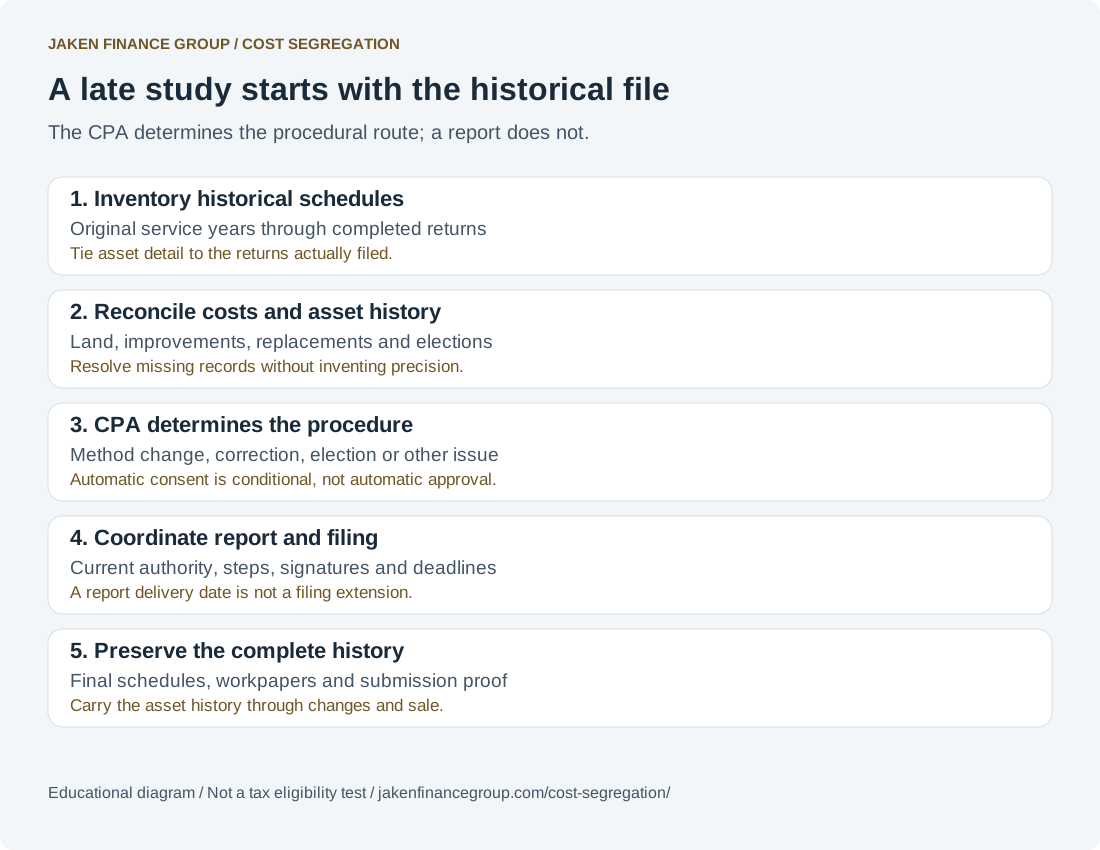
Open the full-size existing-property review infographic.
Preserve the new schedule through the eventual exit
After implementation, keep the final report, reconciled asset ledger, adjustment workpapers, election information and proof of the applicable filing steps. The next preparer should be able to understand what changed and why. A study PDF without its implementation history may leave the next year’s return difficult to reconcile.
The history also matters when assets are replaced, the property’s use changes or the property is sold. IRS Publication 544 explains disposition and recapture concepts. A study can leave several asset categories to track, so do not discard the supporting allocation after receiving the first tax result.
Review the ownership plan with the CPA before committing to the project. A near-term sale, uncertain loss use or extensive missing records can materially change the economics. The right next action may be gathering evidence or clarifying scope rather than immediately ordering a report.
Bring an answerable question to each professional
Ask the provider how it will support allocations and reconcile the historical costs. Ask the CPA which method history, filing procedure, adjustment and loss-use analysis are appropriate. Ask the financing team about loan requirements separately if a refinance is also planned. Each professional should work from consistent facts without being assigned another party’s responsibility.
The Maven links below offer an external estimate and study-service information with the referral relationship disclosed. A calculator result is not a prior-year schedule reconstruction or an accounting-method engagement. Use the packet to turn a broad question about “missed deductions” into a documented review of the actual property and returns.