Blog
Is Cost Segregation Worth It for a Rental Property?
By Jaken Finance Group · Principal, Jaken Finance Group
10 minute read
Compare study fees, usable deductions and sale consequences. Use a free decision workbook and sensitivity calculator to evaluate a rental with your CPA.
Cost segregation is worth investigating when the value of moving eligible deductions earlier exceeds the study and implementation costs over your expected ownership period. That depends on the property’s actual components, your ability to use deductions, the fee and eventual sale consequences. A purchase-price threshold or a large projected write-off cannot answer those questions alone.
The strongest decision starts with two schedules: depreciation without the proposed study and depreciation with it. It then asks when the difference can affect your taxes. This guide shows how to compare those schedules, get a useful proposal and avoid confusing a first-year tax illustration with a complete investment return.
Download the cost segregation study decision workbook (PDF) to record quotes and assumptions. The on-page calculator below accepts CPA-supplied incremental deductions; it does not estimate asset allocations from a property price. Federal sources were checked November 3, 2026. This is educational information, not a personalized recommendation to order a study.
Why property price is an incomplete screening test
Two rentals purchased for the same amount can have different depreciable costs. One may include substantial land, while the other includes more building and site improvements. Their components, improvement history and existing schedules can differ as well. A study evaluates actual costs and classifications rather than assigning the same percentage to every acquisition.
Tax circumstances can create an even larger difference. An investor with usable passive income may view an accelerated deduction differently from an owner whose losses are suspended. Another investor may plan a near-term sale. The same physical study can therefore have different economic value for different owners without either result being contradictory.
A quoted fee also depends on what the engagement includes. Do not compare a limited model with a detailed property-specific engagement as if only their prices differ. Ask what evidence supports the allocations and how the final report reconciles to the costs your preparer will use. An inexpensive unsupported number can be costly to correct.
Start with a feasibility discussion, but keep its output in the right category. A preliminary estimate is a reason to ask more questions, not proof of a tax benefit. For the rules behind component classification and bonus eligibility, read the bonus depreciation guide.
Define the alternative before measuring the benefit
The correct baseline is what your return would reasonably show without the new study. It is not always an assumption that every depreciable dollar belongs to a 27.5-year building. Existing schedules may already include appliances, equipment, land improvements or prior studies. The proposed report must avoid counting those deductions again.
Ask your CPA for the baseline year-one deduction and the proposed year-one deduction using the same basis, dates and accounting assumptions. Subtract the baseline from the proposed amount to find the incremental deduction. Then examine later years as well. Larger deductions today can mean smaller deductions later on the same costs.
IRS Publication 946 explains methods, recovery periods, conventions and bonus depreciation. Those details matter because a September opening and a January opening do not have identical first-year building deductions. Comparing one schedule using a full year with another using the correct convention can manufacture a benefit that is partly a calculation error.
Document the baseline explicitly. Write down who prepared it, what costs it includes, the service dates, the convention and whether existing separately depreciated assets are included. A written comparison makes it easier to detect inconsistent assumptions when a proposal changes or another provider offers a different projection.
Separate deduction, usable amount and tax effect
A deduction is not a check from the government. Your preparer must determine how it interacts with income, losses and other limitations. IRS Publication 925 discusses passive activity and at-risk rules. These can delay the tax effect of a deduction that otherwise exists on a depreciation schedule.
For a rough first-year sensitivity, begin with the incremental deduction, apply an explicitly assumed usable share, and then apply an assumed marginal tax rate. Subtract the full quoted fee to see a simplified result after that cost. This sequence is useful for exposing assumptions, but it is not a complete return calculation.
The usable share is an input from your CPA’s review, not an estimate inferred from income or profession. A tool should allow zero. If the owner cannot use the incremental deduction this year, the simplified current tax effect is zero even if a provider’s allocation estimate is large. That does not establish that a suspended loss has no future value.
The assumed tax rate also needs context. Your effective tax rate from a prior return is not necessarily the rate applicable to the next deductible dollar. Federal and state effects may differ. Multiple brackets and other return interactions can make a single-rate estimate too simple for a significant decision.
Three scenarios with the same hypothetical study
Assume a CPA projects $80,000 of incremental first-year deductions after comparing two valid schedules. Assume a $4,000 study fee and a 32% marginal rate. These are invented inputs for arithmetic, not a provider quote, typical fee, estimated allocation or statement that a particular property qualifies.
| Assumed current use | Usable incremental deduction | Simplified tax effect | Less $4,000 fee |
|---|---|---|---|
| 100% | $80,000 | $25,600 | $21,600 |
| 50% | $40,000 | $12,800 | $8,800 |
| 0% | $0 | $0 | −$4,000 |
The table excludes any deduction for the fee, future depreciation differences, the value of suspended losses, state effects and sale taxes. It also assumes the fee is the only implementation cost. A preparer engagement or additional accounting work could change the current cost. Labeling these exclusions prevents the positive rows from being mistaken for lifetime profits.
The zero-use scenario is especially important. The owner pays for the study now while the assumed current benefit is absent. A future usable loss may change the lifetime analysis, but the owner needs to model when and under which rules that happens. Do not use the table to declare the study either automatically good or permanently worthless.
WORK THROUGH YOUR ASSUMPTIONS
Study-fee sensitivity calculator
Use incremental deductions supplied by your CPA, not the total bonus deduction. This simplified first-year comparison excludes state effects, future deductions, sale taxes and any deduction for the study fee.
Entries stay on this page. Nothing is submitted, saved or sent to Maven.
Use break-even calculations carefully
With a 32% rate and a 50% usable share, each assumed incremental deduction dollar produces 16 cents of simplified current tax effect. A $4,000 fee therefore requires $25,000 of incremental deductions to cover that fee in this narrow first-year model: $4,000 divided by 0.16. This is arithmetic, not a qualification threshold for real properties.
If the usable share or tax rate is zero, the model has no finite deduction amount that covers the fee through a current tax effect. The calculator reports that directly instead of dividing by zero. If the fee is zero, a zero break-even figure still does not establish a supported allocation or an appropriate filing method.
Break-even becomes more complicated when benefits arrive over several years. A future dollar is generally valued differently from a dollar available today, and financing or investment alternatives affect the owner’s opportunity cost. Use a professional after-tax model when the timing differences are material. The simple tool intentionally leaves those judgments to the owner and advisors.
Compare the complete holding period
Cost segregation usually changes timing rather than creating unlimited additional depreciation on the same basis. Under an accelerated schedule, the owner may deduct more early and less later. A useful ownership model includes those later differences instead of stopping at the most attractive first-year screenshot.
Add a sale scenario consistent with the investment plan. IRS Publication 544 explains how asset dispositions and depreciation recapture can affect tax outcomes. Different asset classes can have different treatment. Do not assume every depreciation dollar is recaptured at one flat rate, or that a future transaction will erase every consequence.
A short hold can require particular care because the initial deduction and later disposition occur relatively close together. A longer hold can change the timing comparison, but it does not remove the need to consider future deductions and tax assumptions. Ask for a base holding period and a shorter alternative that reflects a realistic early sale or refinance strategy.
Refinancing is a separate event from selling. It changes financing costs and proceeds without automatically resetting depreciable basis. The BRRRR guide explains that distinction through one reconciled project ledger. Avoid using expected refinance proceeds as a proxy for the tax benefit of a study.
Get comparable provider proposals
A useful request for proposals gives providers the same property description, acquisition records, improvement information and existing schedules. If one provider receives complete records and another sees only the purchase price, their estimates are not comparable. Ask each to state unresolved assumptions rather than hiding them inside an allocation percentage.
Request a written scope describing methodology, any site work, required documents, report contents, delivery expectations and fee. Clarify whether the provider will reconcile costs to the CPA’s basis schedule and how later questions will be handled. A quoted delivery time should identify when the clock begins and what happens if the file is incomplete.
Support promises need specific terms. Ask what examination assistance includes, whether there are limits or extra fees, who prepares responses and how long support remains available. “Audit support” should not be treated as a guarantee that an examiner will agree with every allocation. Preserve the engagement terms alongside the final study.
The IRS Cost Segregation Audit Technique Guide offers useful context on documentation and study evaluation. It is an examination guide, not IRS approval of a provider. Use it to ask concrete questions about evidence and methodology rather than asking whether a marketing label appears on the cover.
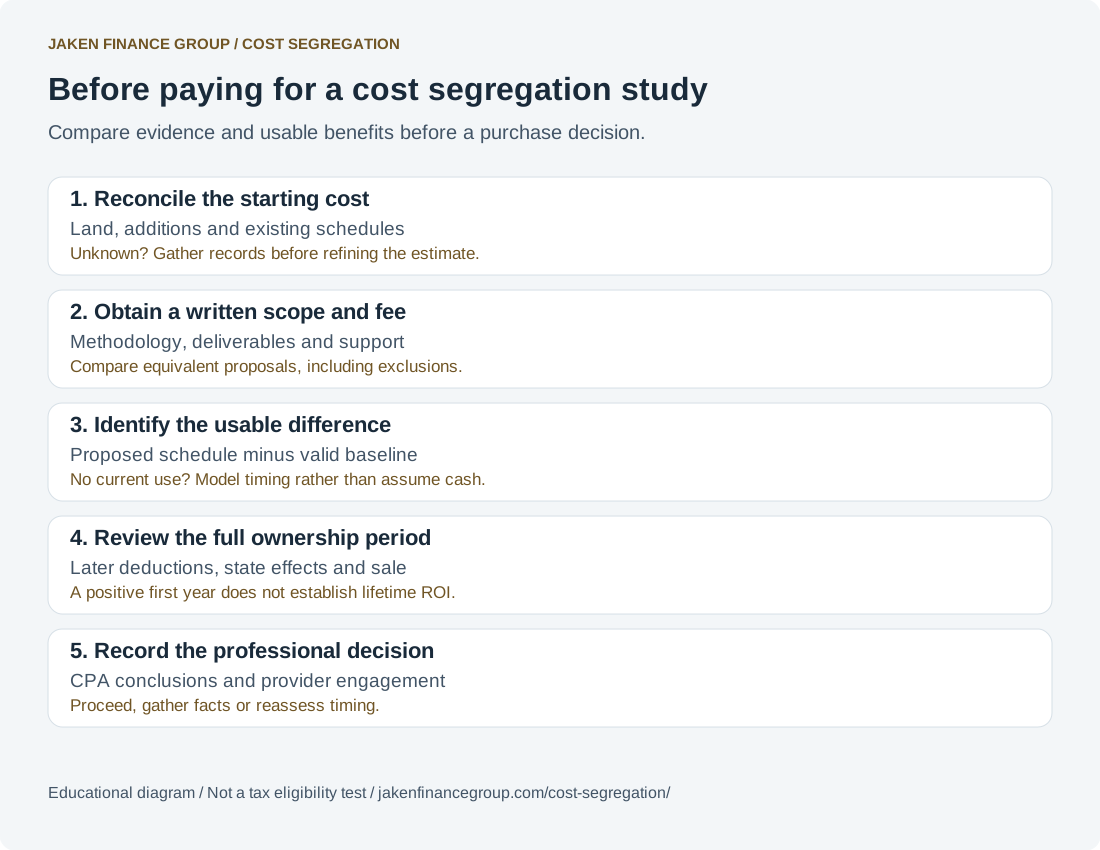
Open the full-size study decision infographic.
When gathering more facts is the better next step
Pause the purchase decision when the depreciable cost is unresolved, prior schedules are missing or the provider cannot explain the baseline comparison. A feasibility estimate built on uncertain inputs may be useful as a range, but it should not become a precise return assumption. Resolve the records that most affect the result before paying for unsupported precision.
A second reason to pause is uncertainty about using the loss. Ask your preparer for a current-year and future-year view rather than guessing a usable percentage because the projected deduction is appealing. An owner can still investigate a study while deciding that immediate filing or a particular year of implementation needs more work.
A third reason is a pending sale, change in use or complex ownership history. Those facts can change both the economics and filing procedure. If the property already appeared on returns, use the existing rental guide to organize the prior-year review. A report alone does not choose the procedural route.
These pauses are specific action steps, not a conclusion that cost segregation is unsuitable. The goal is to spend the next dollar on the information that improves the decision. A well-scoped CPA question can be more valuable than comparing another unqualified calculator estimate.
Keep the rental’s operating case independent
Underwrite rents, vacancy, expenses, capital needs and debt payments before adding any tax effect. A property with weak operating cash flow does not become able to pay its lender merely because a depreciation projection is large. The tax benefit may arrive later, be smaller than assumed or remain suspended.
Use the DSCR calculator to examine coverage under the relevant lending assumptions. Use the investor resource library for operating and capital planning files. Then keep a separate after-tax analysis with the study fee and CPA assumptions visible. This gives the investor a clearer explanation of why the deal works.
When requesting financing, describe the property and loan purpose accurately. When requesting a study, provide the cost and use records. The lender, study provider and tax preparer have different responsibilities. Coordination helps them work from consistent facts without assigning one party decisions that belong to another.
Turn the research into a decision file
The final file should contain an agreed basis starting point, baseline and proposed schedules, a current written proposal, a CPA loss-use assessment and an ownership-period comparison. Record unresolved questions and who will answer them. Retain the version of the assumptions used when the decision was made.
A preliminary calculator can help frame that conversation. Maven’s links below lead to its estimate tool and service website. Jaken Finance Group may receive referral compensation; the disclosure explains that relationship. Compare the proposal and your CPA’s conclusions on their merits rather than treating an affiliate relationship as proof of the study’s value.