Blog
Short-Term Rental Cost Segregation: What to Check
By Jaken Finance Group · Principal, Jaken Finance Group
10 minute read
Separate STR depreciation, participation rules and usable losses. Get a free evidence guide, preparation checker and infographic before planning a deduction.
Cost segregation can change depreciation timing for an eligible short-term rental, but it does not automatically make a loss deductible against wages. An STR owner must separate three questions: how the property and components depreciate, how the activity is treated under passive-activity rules, and whether the resulting loss is currently usable on the owner’s return.
Those questions depend on different facts. A report about building components cannot establish how much work the owner performed. A reservation calendar cannot by itself determine the building’s recovery period. A favorable participation conclusion does not eliminate every other limit on deductions. Keeping the evidence separate makes the eventual CPA review more reliable.
Use the STR cost segregation evidence organizer (PDF) to prepare the file. This guide discusses federal concepts using IRS sources checked November 3, 2026. It is educational information, not a certification that a particular operation or taxpayer qualifies for a deduction.
Start with three independent tax questions
The first question concerns the property. What costs are depreciable, which components belong in shorter recovery periods, which service dates apply and whether eligible assets qualify for bonus depreciation? Those are the same foundational questions other property owners face, with additional classification issues depending on the STR’s actual use.
The second question concerns the activity. IRS Publication 925 describes exceptions to the general definition of a rental activity for passive-activity purposes. Short average customer use or particular services can matter here. Those rules are not a universal definition of residential rental property for every provision of the tax law.
The third question concerns the taxpayer. If material participation is relevant, can the owner support an applicable test? How do basis, at-risk, personal-use and other limitations interact with the resulting loss? An investor needs the complete chain of analysis before treating a projected deduction as a reduction in this year’s tax on other income.
A good preparer can explain which facts answer each question. Ask for that explanation in plain language. If a proposal jumps from “short stays” directly to “W-2 savings,” ask what analysis is missing between those statements. A tax estimate should reflect the actual operation rather than a desired marketing outcome.
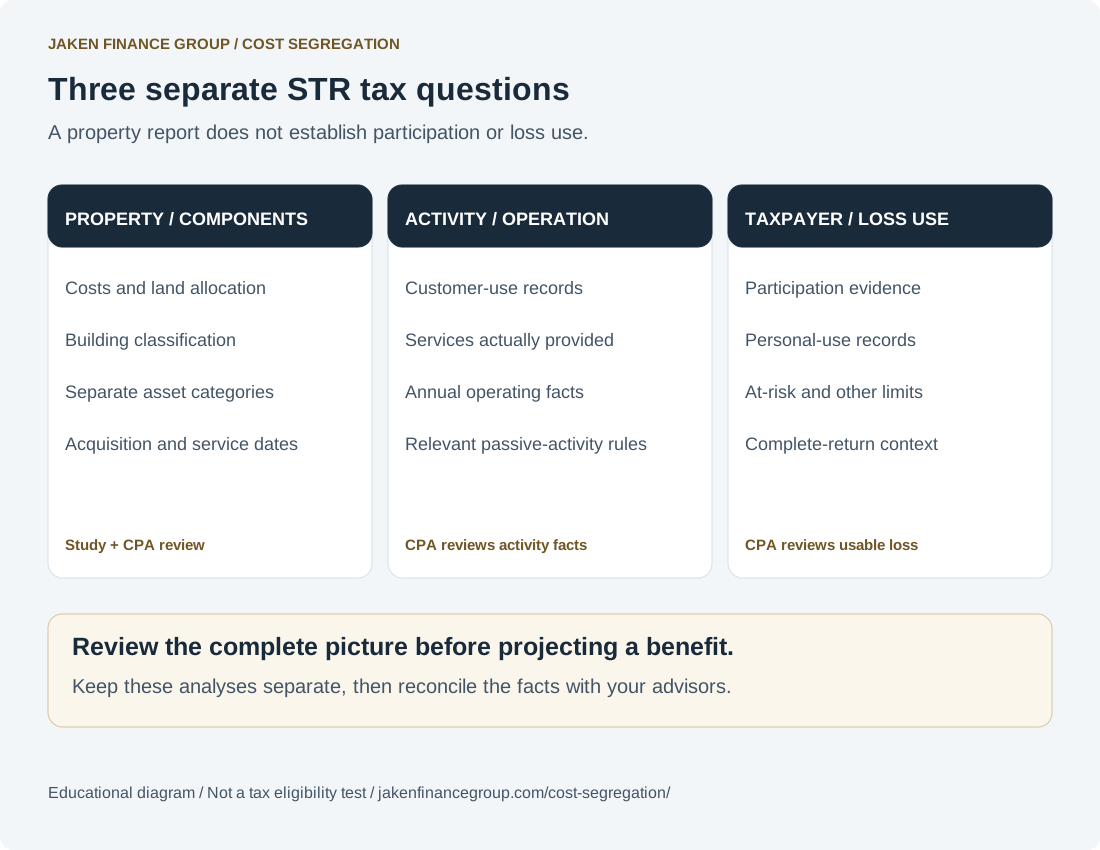
Open the full-size STR tax questions infographic.
Average customer use requires actual reservation records
Publication 925 says an activity is not a rental activity under those passive-activity rules when the average period of customer use is seven days or less. It describes the average using total days in rental periods divided by the number of rentals during the tax year, with additional rules when more than one property class is involved.
That is an average based on the applicable records, not a label chosen on a listing platform. A property advertised for weekend stays can still have longer bookings. Conversely, a few long bookings do not necessarily describe the complete annual average. Give your preparer the full reservation-level data and explain cancellations, changes and gaps.
The publication also describes an exception when average use is 30 days or less and significant personal services are provided. Whether services are significant depends on facts and circumstances. Do not assume ordinary turnover arrangements settle that question. Ask the CPA to review what is provided during the customer’s use, by whom and under what arrangement.
Keep the annual calculation with its underlying reservation export. A dashboard screenshot may not explain changed dates, multiple units or how the average was derived. If a manager or platform supplies a summary, obtain enough detail to reconcile it to the operation being reported. Identify which entity owns the property and which entity conducts the activity.
Participation is a separate evidence problem
Material participation has several tests rather than one universal minimum-hour threshold. Publication 925 includes a more-than-500-hour test, a substantially-all-participation test, and a test requiring more than 100 hours with participation at least as much as any other individual. Each test has its own context and restrictions.
The existence of several tests does not mean the owner should select whichever slogan sounds easiest. A manager’s and contractors’ participation can matter to particular comparisons. The nature of the owner’s work matters as well. Some investor-type activities are treated differently from work in the operation. Ask which test the preparer believes is relevant and what evidence supports it.
A useful activity log identifies the date, work performed, property or activity, duration and supporting evidence. Messages, invoices, work orders, calendars and management records can help explain the entry. Avoid vague descriptions such as “worked on rental” repeated every day without a connection to actual tasks.
Do not backfill invented hours after seeing the projected tax benefit. If records are incomplete, tell the preparer what is known and what is missing. A professionally designed worksheet can organize facts; it cannot make facts true. The goal is a supportable record of the operation, not a spreadsheet that reaches a preferred number.
Understand what outsourcing changes and what it does not
Using a property manager does not answer every participation question automatically. The actual division of work matters. An owner might perform significant operational tasks while a manager handles bookings, or the manager might perform nearly all operational work. Those are different fact patterns even if the management agreements have the same title.
Ask for records describing the manager’s scope and the work actually performed. Contractor invoices, cleaning schedules, maintenance tickets and guest-service logs may provide context. The owner should keep their own records rather than assuming someone else’s incomplete time log proves the owner’s participation by subtraction.
Spousal participation can be relevant under the passive-activity rules, but it should be reviewed with the actual ownership and filing facts. Do not simply combine hours from friends, employees or unrelated co-owners. The preparer needs to know whose work is being counted and why that treatment is appropriate.
Finally, outsourcing decisions should make operational sense. A tax objective should not lead an owner to provide poor service, neglect maintenance or record work that someone else performed. Compare management costs and the owner’s capacity independently from the tax analysis. The rental still needs to function as a viable business or investment.
Building recovery periods do not follow a platform label
IRS Publication 946 defines residential rental property using the relevant gross rental income and dwelling-unit framework. It excludes certain hotel, motel or other establishments where more than half the units are used on a transient basis. Applying those definitions requires more than seeing the word “short-term” on a listing.
This is different from the seven-day average-use exception in the passive-activity discussion. One rule addresses activity treatment; the other addresses depreciation classification. Do not assume that satisfying a passive-activity exception automatically puts the building on a 39-year schedule, or that a 27.5-year schedule resolves whether a loss is passive.
The components still need their own classification. Furniture, appliances, site improvements and the building structure do not necessarily share one recovery period or service date. A cost segregation study can support component allocations, while the CPA reviews their application to the operation and return.
Ask the provider and preparer to reconcile the study to a single cost starting point. If the study assumes one building classification and the preparer applies another, resolve that difference before filing. A consistent report and schedule are more useful than two independently impressive calculations that do not agree.
Personal use needs its own calendar
IRS Publication 527 discusses vacation homes, personal use and rental expense allocation. Owner stays, certain family use, below-market arrangements and other facts can affect the analysis. A reservation platform may omit days when the owner simply blocked the calendar, so platform data alone may be incomplete.
Keep a calendar showing the purpose of blocked dates, who used the property, whether a fair rental price was paid and the evidence supporting the entry. Do not assume every day at the property was a repair day or every empty day was personal use. Provide the facts and let the CPA apply the rules.
Mixed personal and rental use can affect the costs and deductions being modeled. A calculator that assumes full business use may overstate a particular owner’s result. The study’s physical allocation and the taxpayer’s allowed depreciation can therefore differ without the difference being a simple arithmetic mistake.
Personal-use questions should be settled early enough to inform the estimate. Otherwise, an owner may pay for a study based on a full-business-use illustration that never matched the operation. A clear calendar makes it easier to explain the distinction before a proposal turns into a filed schedule.
Two owners, similar properties, different questions
Consider two hypothetical owners who each purchase a furnished vacation rental. Assume both have the same total purchase price and broadly similar physical components. No allocation percentage or deduction is assumed here, because the example concerns the evidence needed before anyone estimates a currently usable benefit.
Owner A provides complete booking records, dated operational work records, manager information and a personal-use calendar. The CPA can analyze average customer use, the services provided and any relevant participation tests. Complete records do not guarantee a favorable result, but they make the questions answerable.
Owner B provides a purchase statement and a tax calculator screenshot. A manager handles the property, the owner sometimes stays there, and participation records are missing. The physical property may still be suitable for a study, but the preparer lacks facts needed to evaluate the taxpayer’s use of a resulting loss.
A large preliminary deduction would not close the evidence gap for Owner B. The next step is to gather records and clarify the operation, rather than borrow more money on the assumption of a tax refund. The study decision guide explains how to model a zero-current-benefit case without declaring that future value is necessarily zero.
WORK THROUGH YOUR ASSUMPTIONS
STR evidence preparation checker
Check the evidence you have assembled. This organizer does not determine material participation, a recovery period or whether a loss offsets other income.
Entries stay on this page. Nothing is submitted, saved or sent to Maven.
Organize property costs and service dates
Furnishing an STR often produces several groups of invoices with different dates. A building acquisition, a renovation and a later furniture installation should not be collapsed into a single unexplained total. Identify what was bought, which owner bought it and when each asset became ready for its intended use.
Land remains outside depreciation. The provider should understand whether the starting number includes land or already excludes it. Avoid subtracting land twice or allowing different parties to use different acquisition totals. Reconcile the study, improvement ledger and existing depreciation schedule to the same supporting documents.
Bonus eligibility also requires more than the report’s completion year. The IRS bonus depreciation guidance addresses qualifying acquisitions after the statutory cutoff and the related rules. Ordering a study in 2026 does not automatically give an older acquisition the percentage applicable to a new qualifying acquisition.
For detailed timing examples, use the federal bonus depreciation guide. Keep the STR-specific activity and participation file beside that cost-and-date file. The two files should support one coherent explanation of the property rather than compete for the most favorable assumption.
Do not forget state rules and the eventual exit
A federal result does not establish a state deduction. Identify the relevant state returns and ask the preparer whether separate schedules or adjustments are needed. The property location, taxpayer and ownership structure can all matter to the actual return. This guide does not promise any particular state’s conformity.
Plan the sale as well as the first deduction. IRS Publication 544 explains asset dispositions and depreciation recapture. Selling furnishings, the building and other components can raise different questions from selling a single undifferentiated asset. Keep the final study and schedules available through the exit.
A planned change from STR to long-term rental or personal use deserves review before it happens. Changes in use can affect the tax analysis and future schedules. Tell the CPA about the business plan rather than assuming a study remains a fixed answer regardless of how the property is later operated.
Connect tax planning to a workable rental plan
Underwrite income, cleaning, utilities, management, maintenance, vacancy, reserves and debt service independently of projected tax benefits. An STR can produce appealing gross revenue while requiring substantial operating work and costs. A projected deduction does not pay those bills, and a suspended loss does not replace a cash reserve.
Use the investor resource library for rental planning files and keep your financing assumptions consistent with the actual permitted use. If refinancing is part of the plan, ask the financing team which income evidence and property characteristics the loan review requires. Tax classification does not by itself establish loan eligibility.
Once the records are organized, request a written study scope and fee, then have the CPA evaluate the resulting proposal. The Maven links below provide an external estimate and service information with the referral relationship disclosed. Neither clicking the link nor completing the evidence checker establishes a W-2 offset, a recovery period or a tax benefit.