Blog
Cost Segregation for BRRRR: Basis, Rehab and Refinance
By Jaken Finance Group · Principal, Jaken Finance Group
10 minute read
Coordinate BRRRR rehab records, rental readiness and cost segregation. Use a free CPA handoff kit and cost bridge to separate basis from refinance value.
For a BRRRR investor, cost segregation belongs beside the acquisition, rehab and rental records, not inside the refinance appraisal. It can affect depreciation timing for eligible property components, but it does not turn appraised value or cash-out proceeds into tax basis. The refinance changes the financing; the CPA determines the property’s cost and depreciation treatment.
A successful buy, rehab, rent, refinance and repeat strategy therefore needs three reconciled views of the same project: where cash went, what value and income support the loan, and which costs belong on the tax schedules. The views overlap, but their totals do not have to be identical because they answer different questions.
Download the BRRRR cost segregation CPA handoff kit (PDF) before assembling the study file. This guide uses hypothetical arithmetic and IRS sources checked November 3, 2026. It is educational information, not a tax basis determination, study allocation or financing commitment.
Maintain three ledgers from the beginning
The project cash ledger records actual sources and uses: purchase funds, loan advances, owner contributions, vendor payments, holding costs and refinance proceeds. It should reconcile to bank and closing records. This is the best place to answer how much cash the investor contributed and how much remained after each stage.
The lender’s analysis focuses on collateral, permitted use, eligible income, expenses, debt service, leverage and repayment. An appraisal may show a completed value substantially above the project’s cost. That can matter to a loan request without changing what the owner paid for depreciable assets. The loan still depends on the program’s actual rules.
The tax asset ledger classifies costs, separates land, identifies service dates and tracks adjustments such as depreciation. IRS Publication 527 describes residential rental costs and basis. A good CPA handoff provides evidence for those categories rather than labeling the entire cash ledger “depreciable investment.”
Keep a common property identifier and document index across all three views. That makes it possible to trace an invoice or draw without forcing the same number into every model. A difference should have an explanation, such as an appraisal uplift or a financing cost, rather than being hidden as a rounding adjustment.
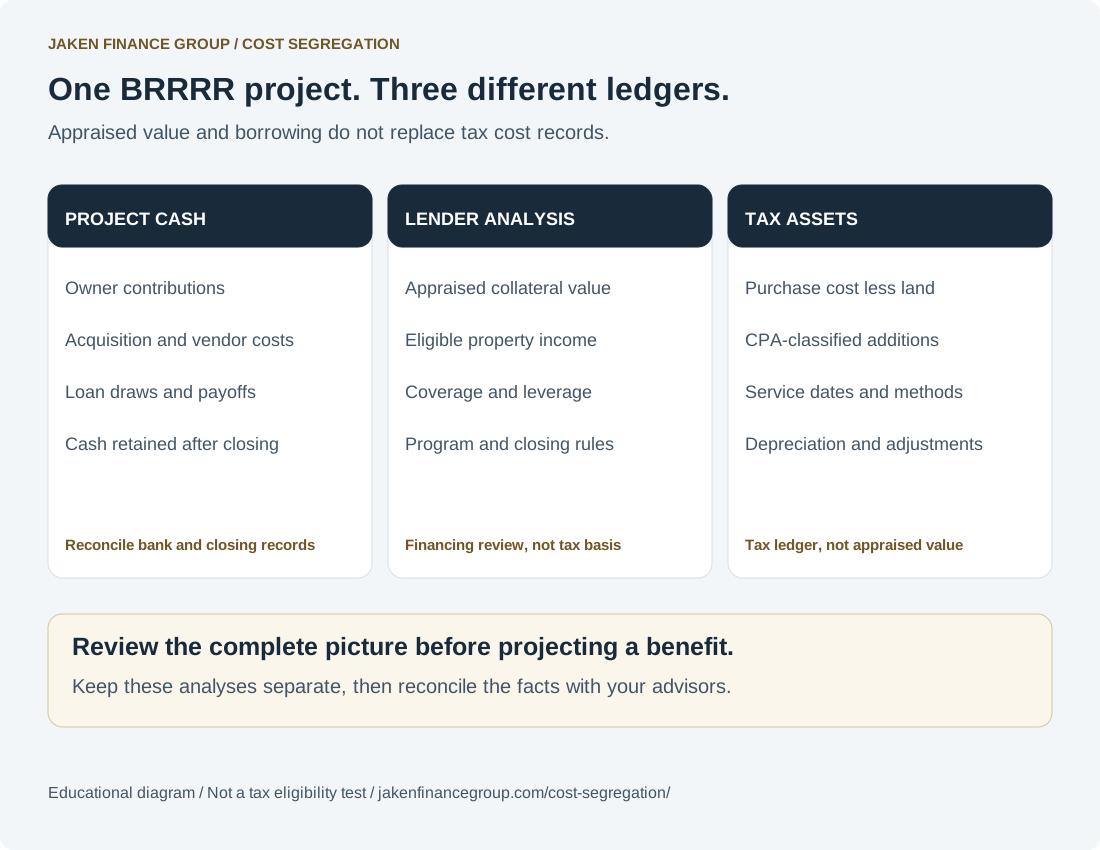
Open the full-size BRRRR ledger infographic.
Begin with the purchase file and land allocation
Retain the executed purchase contract, settlement statement, ownership information and support for the allocation between land and depreciable property. Land is not depreciable. The cost segregation provider and preparer should begin from a consistent amount rather than using different purchase figures from an early offer and the final closing.
Where the acquisition includes furniture, equipment or other separately identified assets, document the allocation and supporting facts. Do not add those items again when the provider analyzes the same purchase. A complete reconciliation must account for every cost once, without duplicating it across a building amount and a personal-property schedule.
Ask the CPA which acquisition-related charges belong in the relevant asset costs and which receive separate treatment. The closing statement is a source document, not a tax classification schedule. Two line items appearing next to each other on that statement may have different treatment and different recovery rules.
If the purchase involved unusual ownership history, personal-to-rental conversion, related parties or a prior exchange, flag it early. The simple new-purchase bridge below may not apply. The provider needs accurate starting facts, and the CPA needs to determine the appropriate rules before a generic acquisition number becomes a projected deduction.
Organize rehab costs by what actually happened
A rehab budget is a plan. The tax file needs the actual work, cost and supporting evidence. Keep invoices, change orders, payment records, the property or unit involved and completion information. A lender’s draw inspection may help document progress, but it is not a complete substitute for cost records and tax classification.
Have the CPA distinguish repairs, capital improvements, land-related work and other expenditures. Do not assume all rehab is immediately deductible, or that all rehab belongs in one building asset. Conversely, do not label every expense a capital improvement merely because it occurred during a renovation. The facts and applicable rules determine the treatment.
Vendor descriptions need enough detail to make that review possible. A single invoice for “rehab complete” is harder to analyze than an itemized scope tied to the property. Ask for practical detail while the work is current. Reconstructing categories months later can require extra time and may still leave unsupported assumptions.
Keep replaced assets and prior work in view. A renovation can involve assets already on depreciation schedules, so the new study must coordinate with existing records. Tell the CPA about removals and replacements rather than assuming the new costs simply stack on top of every prior asset without further analysis.
Separate completion, readiness and first rent
Property generally becomes depreciable when it is ready and available for its intended income-producing use. First rent can occur later. A planned completion, inspection, permit approval, listing date and lease start are evidence to evaluate, not interchangeable dates that always produce the same answer.
For a multi-unit project, units or improvements may become usable at different times. Give the CPA the actual completion and availability records. A single project-level milestone may obscure important differences if one unit was available while another remained under construction. Ask how the asset and unit facts should be reflected in the schedules.
The study delivery date is another separate milestone. A report completed after readiness does not automatically move the service date to the report year. If a study affects previously filed years or an adopted accounting method, the existing-property guide explains the records to gather before the preparer determines the procedure.
A financing schedule can help fund work, but it cannot guarantee the tax date. Plan inspections, completion and documentation realistically. Do not choose a readiness date simply because it produces a favorable year-end estimate. The bonus depreciation guide provides convention-sensitive examples and a separate date organizer.
A reconciled BRRRR cost example
Assume a hypothetical investor purchases a rental for $300,000. The CPA supports a $60,000 land portion within that purchase cost and identifies $80,000 of additional depreciable capital work. For this limited example, ignore other acquisition adjustments and assume the entered costs are entirely attributable to the income-producing property.
The simplified initial depreciable cost is $320,000: $300,000 minus $60,000 plus $80,000. Suppose the CPA later supplies $12,000 of relevant prior depreciation adjustments. The simplified amount after that entered adjustment is $308,000. Neither amount is itself a first-year deduction or a proposed cost segregation allocation.
| Item in this illustration | Amount | Role |
|---|---|---|
| Purchase cost assigned to bridge | $300,000 | Starting acquisition cost |
| Land included in purchase cost | $60,000 | Excluded once |
| CPA-classified capital additions | $80,000 | Added to this limited cost bridge |
| Initial depreciable cost | $320,000 | Before entered depreciation adjustment |
| Entered prior depreciation | $12,000 | Subtracted for the simplified adjusted figure |
| Simplified adjusted amount | $308,000 | Other adjustments could change actual tax basis |
The example deliberately excludes financing charges, current repairs, mixed personal use, dispositions and other adjustments. A real tax asset ledger must account for the facts that apply. The purpose is to show the structure of a reconciliation without suggesting that every property fits four inputs.
WORK THROUGH YOUR ASSUMPTIONS
BRRRR cost and basis reconciliation
Enter only purchase costs and additions your CPA has assigned to this simplified bridge. This is not a tax schedule and omits other basis adjustments. Appraised value and refinance proceeds are deliberately separate.
Entries stay on this page. Nothing is submitted, saved or sent to Maven.
Why a higher appraisal does not create a deduction
Now assume the hypothetical property’s completed appraisal is $500,000. That value may be relevant to collateral review, but it does not replace the $320,000 simplified depreciable cost in the previous example. The difference can reflect market conditions, the investor’s execution, appraisal assumptions and other factors. It is not an invoice for additional depreciable assets.
Suppose a proposed refinance loan is $350,000. That is a borrowing assumption, not a promise that the property qualifies for that loan or a statement that $350,000 becomes basis. Actual net proceeds would also depend on payoffs, fees, escrows and other closing items. The tax ledger must still trace actual costs and adjustments.
If the owner uses borrowed funds for later improvements, the actual expenditures raise new classification and timing questions. The borrowing alone does not answer them. Keep loan proceeds in the sources-and-uses file, then document how funds were spent and which costs the CPA assigns to assets or other categories.
This separation is essential to the “repeat” stage of BRRRR. An investor can recover some contributed cash through refinancing while retaining a tax history based on applicable cost rules. Reusing the next property’s purchase price, the prior property’s appraisal and the cash-out amount in one undifferentiated basis calculation creates confusion across the entire portfolio.
Study timing should follow the quality of the file
A provider can discuss feasibility before every record is final, but the engagement should identify what is still assumed. Ask which documents are needed for a completed report and how later change orders or improvements will be handled. The report should reconcile to the costs that ultimately reach the CPA’s schedule.
Provide existing depreciation schedules before the provider finalizes allocations. An asset already separately depreciated should not quietly appear a second time in the proposed study. If the property has been through several rehab phases, explain which phase each cost belongs to and whether a prior report covered it.
The IRS Cost Segregation Audit Technique Guide discusses cost allocation methods and study evaluation. It is useful background for scope questions, not an approval of a provider or a substitute for governing law. Ask for supportable methodology and a reconciled report rather than relying on a marketing percentage.
Confirm who implements the result. The study provider may identify assets while the CPA determines elections, return treatment and loss limitations. If separate accounting-method work is needed, clarify that engagement, cost and timing before assuming the original study fee covers everything.
Bonus eligibility is an asset-and-date question
IRS Notice 2026-11 addresses the restored 100% bonus framework for qualifying property acquired and placed in service after January 19, 2025. A BRRRR project can contain several sets of facts: acquisition of an existing building, newly purchased equipment and separately completed improvements. One project label does not establish one answer for all costs.
Written binding contracts, qualifying used-property rules and other requirements can matter. Provide the contracts and ownership details rather than only the refinance date. A report ordered in the current year does not convert an earlier acquisition into a new qualifying purchase.
IRS Publication 946 explains the broader depreciation framework. Have the preparer coordinate methods, conventions, elections and any required alternative treatment. An estimate that assumes every shorter-life allocation receives the same deduction without reviewing those rules is too simple for the actual return.
Keep coverage, cash reserves and taxes separate
The rental’s debt service must be supported under the lender’s actual underwriting rules. A tax deduction does not increase eligible rent, reduce property taxes or change the mortgage payment. Use the DSCR calculator for coverage and ask the financing team which income and property documents the loan review requires.
The cash plan needs its own stress case. Construction delays can extend interest carry, postponing rent and refinance timing. A larger projected tax deduction does not supply the cash needed during that delay. Use the BRRRR calculator and the investor resource library to organize capital, payoffs and reserves independently.
Then add a separate after-tax view using assumptions the CPA has reviewed. Publication 925 explains limitations that can delay loss use. A deduction that becomes a suspended loss should not be counted as current cash available to fund the next acquisition.
Prepare the final handoff and eventual exit
Give the tax team an indexed file with purchase records, the land allocation for review, itemized capital work, readiness evidence, existing schedules and the final report. Keep the lender’s appraisal and refinance documents in the same project folder but label their purpose clearly. This lets each reviewer trace the relevant facts without confusing value with cost.
Ask the CPA to model sale consequences alongside the holding plan. Publication 544 discusses dispositions and recapture. A future sale can involve several asset categories after a study, so preserve the allocation and schedule history through the exit. The first deduction is only one part of the ownership analysis.
Once that file is ready, request a written study scope and compare its fee with usable benefits and future consequences. The study economics guide provides that decision framework. Maven’s external resources below can start a provider conversation, with the referral relationship disclosed beside the links.