Blog
Chicago Infill Construction: Why 100% LTC Still Needs Cash
By Jason Taken · Principal
12 minute read
See why Chicago infill construction can need cash despite 100% LTC. Compare cost and value caps, land equity, draw timing, reserves, and a worked budget.
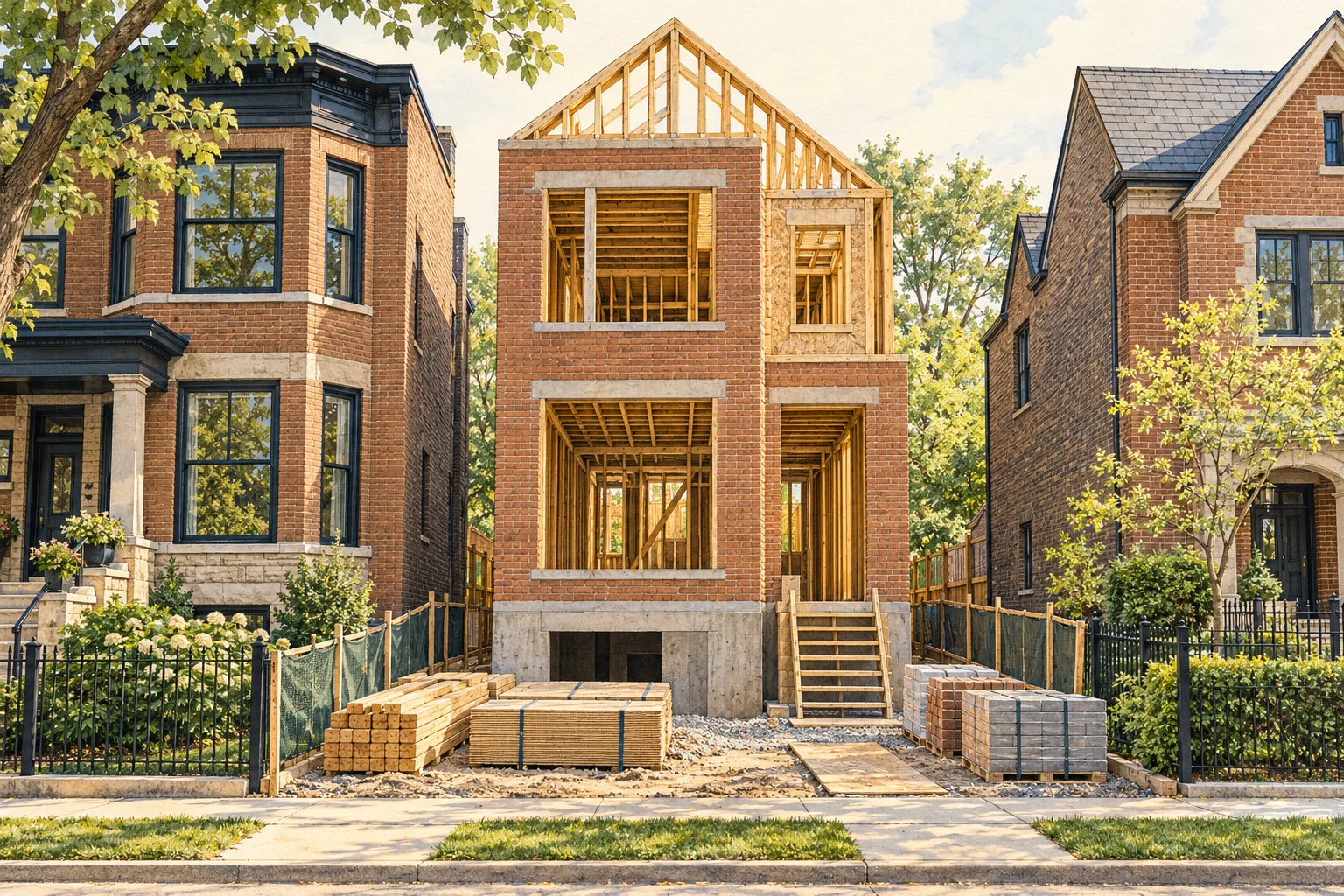
A Chicago infill project can need owner cash even when a loan program offers up to 100% loan-to-cost. The value cap may allow less debt. Some bills may fall outside the loan budget. Draws may arrive after bills are due. You may also need cash reserves when the loan covers all approved work costs.
Loan-to-cost, or LTC, compares debt with the costs the lender accepts. It does not cover every dollar spent or tell you when funds arrive. Before buying a teardown or lot, make three lists. Show all project costs, the loan funds released at each stage, and the owner cash needed between those stages.
This guide uses a made-up Chicago infill house that the owner will not live in. Prices, costs, values, and loan terms are chosen inputs. They are not a bid, appraisal, forecast, or promise to lend. The example shows where a cash gap can arise and what to check before buying the lot.
What does the current construction offering actually mean?
Jaken Finance Group’s luxury and jumbo construction financing lists Up to 100% LTC on qualified files up to $2.5M, subject to Up to 75% ARV (flip) or 75% LTARV (construction) — fund the lower number. Published terms describe a qualified-file maximum. The review still considers the property, total project size, sponsor, budget, experience, available cash, and exit. Ask for a proposal tied to your actual scope.
If a lender offers full cost funding, ask for a list of costs it accepts. How does it count the land? Does it include design and demolition? Does the loan fund a reserve for changes, or must the owner bring that cash? These answers set the cost base used in the LTC test.
Ask what happens to debt already on the land. The new loan may have to repay it before funding work. If you paid cash for the lot, the lender may count some land equity toward your share. If you borrowed to buy it, that same land value is not cash you have paid into the deal.
A headline maximum also says little about deposits and draw timing. A supplier may want money before producing windows. A lender may release funds after inspected work is complete. The project can have enough total loan dollars and still need a temporary cash bridge between those two dates. Budget that gap explicitly.
Separate eligible costs from the full cash plan
Start with acquisition and site work. Include the purchase price, demolition scope, debris removal, utility work, grading, and any site-specific work the design requires. Do not assume a seller’s description settles the condition of foundations, service lines, or neighboring walls. Obtain the inspections and professional advice appropriate to the proposed work.
Then add hard costs: labor, materials, and the physical work that creates the building. Break them into trade and stage. A single total from a contractor gives less control than a scope that identifies quantities, allowances, exclusions, and payment dates. Make sure the lender and contractor use the same version of that budget.
Soft costs need their own lines. Design, engineering, surveys, permits, legal work, inspections, and financing charges may follow different funding rules. Record whether each cost is already paid, due before closing, funded by a draw, or paid by the owner. This prevents a bill from disappearing because it does not fit the hard-cost category.
Finally list reserves separately from spending. An unspent cash reserve is not a completed construction cost. It is money kept available for uncertainty. A lender-held reserve may reduce funds you receive at closing. A reserve kept in your bank account may restrict what you can deploy elsewhere. Both affect liquidity, but in different ways.
A worked Chicago construction funding gap
Assume eligible land cost of $250,000, hard costs of $600,000, and soft costs of $75,000. The eligible project budget totals $925,000. An assumed 100% LTC limit would allow that amount if the cost test were the only constraint. It is not. The completed-value test must also be satisfied.
Assume an accepted finished value of $1.1 million and a 75% completed-value limit. That produces an $825,000 value-based ceiling. The lower figure controls, leaving $100,000 of eligible costs outside the modeled loan. A higher cost percentage cannot remove that gap while the value assumption and value cap stay the same.
Add $45,000 of costs outside the funded budget and a $60,000 unspent reserve budget. With no accepted land equity already contributed, the owner needs $205,000 beyond the loan in this model. That includes $145,000 of cost funding and $60,000 kept available. It is not all money spent on closing day.
| Hypothetical funding item | Amount |
|---|---|
| Eligible land, hard and soft costs | $925,000 |
| Cost-based limit at assumed 100% LTC | $925,000 |
| Value-based limit at assumed 75% of $1.1 million | $825,000 |
| Modeled loan commitment | $825,000 |
| Eligible cost gap | $100,000 |
| Outside costs plus reserve budget | $105,000 |
| Owner funding and reserve need | $205,000 |
Explore the worked example
Test the Chicago construction funding gap
Compare the cost cap with the completed-value cap, then add outside costs and reserves.
Illustrative results for the starting values. All editable loan terms are assumptions.
- Modeled total loan commitment
- $825,000
- Owner funding beyond land equity
- $205,000
| Eligible land, hard costs and soft costs | $925,000 |
|---|---|
| Cost-based limit | $925,000 |
| Completed-value limit | $825,000 |
| Outside costs plus unspent reserve budget | $105,000 |
- Land equity must be lender-accepted equity already contributed, not the entire land value if a loan remains. Do not count borrowed land funds as paid-in cash.
- The result is a total commitment, not cash released at closing. Draw timing, deposits, reimbursements and holdbacks can create further temporary cash needs.
- Cost eligibility and all caps are assumptions for this illustration. A maximum advertised LTC does not establish eligibility or approval.
What changes if you already own the land?
Suppose the lender accepts $150,000 of land equity already contributed within the same cost basis. That equity can reduce the owner’s remaining funding need in the model. It does not mean a lender will wire that amount back. Nor does it mean the owner has $150,000 ready to pay the next contractor invoice.
Trace the land contribution carefully. Record purchase price, improvements already paid, current debt, and the lender’s accepted basis. A recent estimate of land value may differ from the amount credited to the project. Ask how seasoning and prior ownership affect the review. Do not assume appreciation can always replace a fresh cash contribution.
Keep the original cash investment visible when comparing profit. Land paid for years ago still has an economic cost. Omitting it from the project result can make construction appear more profitable than it is. The calculator subtracts accepted contributed land equity only from the remaining cash need; it does not erase the land cost.
Also test whether the proposed loan pays off land debt at closing. If it does, that payoff consumes part of the commitment. The remaining holdback must be enough for the funded construction scope. Review a sources-and-uses statement that shows both uses of the loan, then compare it with the actual draw schedule.
Draw timing can create a second cash gap
Imagine a trade needs a $30,000 deposit before materials can be ordered. The lender’s process may require an inspection or proof of work before reimbursement. The owner must cover the deposit during that interval. If another trade needs a deposit at the same time, the temporary gap grows even without a budget overrun.
Create a weekly schedule for the earliest stages and a monthly schedule for the rest. Show payments to the contractor, draw requests, inspection dates, expected reimbursements, and any retainage. Use the loan documents to confirm the process. Ask who can request a draw and what evidence must accompany it.
Do not plan to spend a draw before it is approved and received. A missing invoice, lien waiver, inspection item, or change order can delay release. Discuss how disputed work affects the schedule. Keep enough cash to avoid stopping critical work merely because an otherwise valid draw takes longer than the best-case estimate.
Interest can also change with the draw structure. A loan charged on outstanding principal differs from one with minimum interest or commitment-based charges. Use the actual proposal when estimating carry. For a staged illustration, the DC major rehab draw guide shows how changing balances affect a project cash schedule.
Check Chicago permits before treating the schedule as fixed
Chicago’s building permit instructions explain that permits are required before most construction, demolition, and repair work. Start the local review before finalizing your construction calendar. A financing estimate does not establish permission to demolish, enlarge, or build the design shown in your budget.
Ask the design team to confirm the property’s zoning and the approvals needed for the exact scope. A teardown and a major renovation may follow different requirements. Use the city’s online construction code resources to identify the applicable rules with your professionals. Avoid treating a nearby completed project as proof that yours is permitted.
The site itself can change the sequence. Narrow access, shared walls, overhead utilities, tree protection, and material storage may affect means and methods. Those are questions for the design and construction team. Get the answers into the bid before comparing loan options. A cheaper budget that omits required site work is not a cheaper project.
If the scope retains or renovates an older home, ask whether lead-safe work requirements apply. The EPA renovation, repair and painting program addresses covered work in pre-1978 housing. Its requirements should be assessed for the actual job. Do not assume demolition, renovation, and new construction share identical compliance steps.
Test an overrun without assuming the loan increases
Increase the hard-cost budget by a sample $60,000 while keeping completed value fixed. If the value cap already controls, the modeled loan stays at $825,000. The owner funds the entire extra cost unless a separately approved change provides more debt. A lender’s review of a change order is not a promise to raise the commitment.
Next reduce the completed value. At a sample $1 million value and 75% limit, the value-based ceiling drops to $750,000. The original eligible cost gap rises to $175,000 before outside costs and reserves. That is why the appraisal and the total cash plan should be considered before you remove purchase contingencies.
Test time separately from construction cost. A delay can add interest, taxes, insurance, utilities, security, and storage without changing the building itself. It can also move completion into a less convenient selling period. Price those months directly. Do not bury them in a generic contingency that has already been allocated to construction changes.
Define who can authorize overruns. If you have partners, agree on approval limits and additional capital obligations before closing. If a contractor allowance is exceeded, decide whether the response is more cash, a different finish, or a scope revision. The financing plan should identify that decision process before the project needs it.
Compare a sale exit with a rental exit
A sale exit starts with supported comparable sales and a realistic marketing period. Subtract debt payoff, selling costs, closing costs, and unpaid project expenses from the expected price. Then subtract all owner cash contributed to find project profit. A large difference between construction cost and finished value is not the same as money the owner keeps.
A rental exit requires a second analysis. Supported rent must cover the proposed permanent payment under the new lender’s standards. A high-end house can have a strong sale value without enough rent to refinance the full construction balance. Review that mismatch before using a rental hold as the only backup to a sale.
The two-flat BRRRR cash-recovery guide demonstrates this distinction for a smaller rental. Apply the same discipline to infill: calculate the new loan, subtract the construction payoff and refinance costs, and identify any extra cash needed. A future refinance remains subject to its own valuation, income, and borrower review.
Keep both exits current as work proceeds. If costs rise, update the sale margin and rental cash gap. If the scope changes, update comparable properties and expected rent. A backup plan only helps when its inputs still match the building you are constructing and the loan balance you will actually need to repay.
Use a cash calendar before ordering long-lead materials
Take one large purchase and follow it from order to final payment. Suppose a supplier needs a deposit now, a second payment before shipment, and the rest after delivery. Put all three dates on the calendar. Then show when the lender can release funds for that item. The largest gap between those dates is a cash need.
Do not count the same money twice. If $25,000 sits in your account to cover that deposit, it cannot also fund an unrelated project’s closing that week. Keep a running bank balance under the work schedule. Start with cash you can use, add funds only when they arrive, and subtract each bill when it must be paid.
Try a simple delay test. Move the expected draw two weeks later while leaving the contractor’s bill on its original date. If the running cash balance falls below zero, the plan needs more owner funds or a revised payment agreement. This problem can exist even when the total project budget is fully covered by the approved loan.
Agree on how to handle changed work before it begins. A field decision can affect a trade’s price, the permit, and the lender’s budget at once. Keep the written change, new price, and funding source together. Work that has already been done may be much harder to remove from the scope if more loan funds are denied.
Track unused contingency as its own amount. When you spend part of it, reduce the balance in the next report. Do not keep showing the original reserve as available while also adding the completed extra work to the budget. A simple monthly cost-to-finish review should show paid costs, open bills, work still due, and cash left.
This cash calendar also helps you judge the next deal. A project with high expected profit may still tie up most of your ready cash during a few busy months. Wait until you can see those peaks before committing funds elsewhere. A sound construction plan protects the current job’s ability to finish, even when another purchase looks appealing.
Prepare a construction review package
Submit the address, purchase contract or ownership details, plans, itemized budget, contractor information, and proposed schedule. Include site and permit findings, comparable sales, estimated rent if a rental exit is possible, and the current land payoff. Clearly separate costs already paid from costs still due and reserves you intend to retain.
Show relevant completed projects and your role in them. Managing a cosmetic rehab differs from managing a teardown and new build. Explain who handles design, permits, general contracting, draw requests, and financial control. A clear team and responsibility chart helps the lender understand how the proposed work will be carried out.
Use the project submission form to request a review from Jaken Finance Group. Ask for the approved cost basis, value cap, initial advance, draw conditions, reserve requirements, and exit expectations together. Those details turn an advertised maximum into a usable financing plan and reveal the cash you must have before work begins.