Updated
Finance an existing DFW self-storage facility from the income it can document today, then assess expansion as a separate cash and construction plan. Empty land or space for more units can be useful, but it does not pay debt until approved work is complete and customers begin paying at supportable rates.
Buying a stable storage site may fit a direct commercial loan. A site with weak income may need a bridge and more owner cash while the owner fixes the business. Adding units brings a third set of risks. The owner must get the work approved, build it, and fill the new space before it earns rent.
Jaken Finance Group reviews storage scenarios through self-storage facility financing and self-storage construction financing. This guide uses hypothetical DFW examples to compare those paths. It does not assert local rent growth, a standard lease-up period, or guaranteed loan terms. The actual address, records, sponsor, and project control the review.
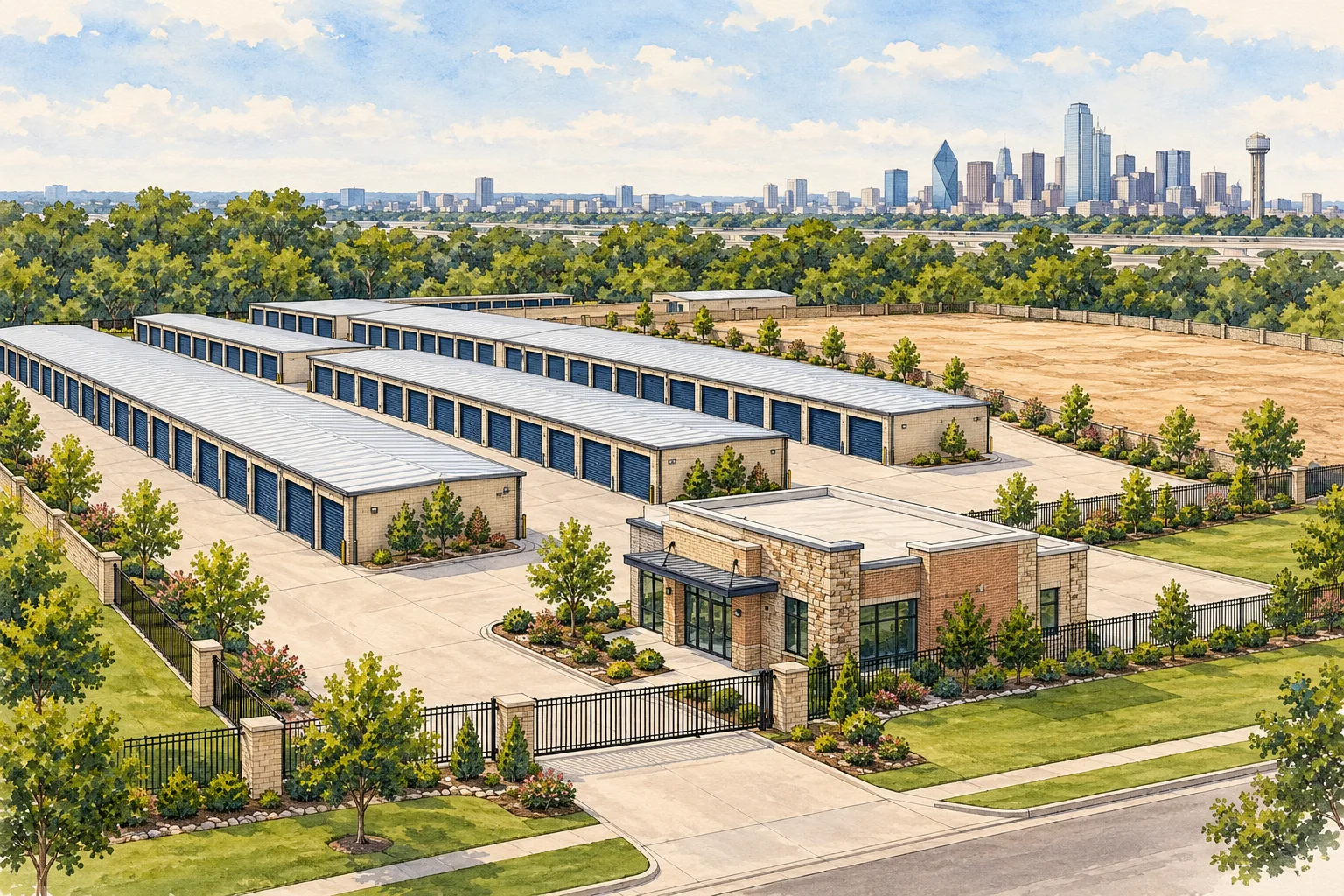
Identify which business plan you are actually financing
For a stable site, check whether proven income and the building condition support the price and loan. For a weak site, ask what must change. Rates, unpaid rent, staff, ads, or upkeep may be the issue. For new units, also ask what can be built, what it will cost, and when customers can move in.
Keep those plans in separate columns. The seller may price the site as if the extra units were already built and full. Ask how much of the price pays for the current business. How much pays for the chance to grow? Decide whether that chance is worth the added cost and risk before choosing the loan.
An empty unit does not always need work. Some units may be damaged; others may simply cost more than customers will pay. The fix could be repairs, a new price, better service, or a different unit mix. Find the cause first. A construction loan will not solve a lack of demand by itself.
A full site does not prove that new units will fill fast. Current customers may pay lower rates or rent smaller units than those planned. Study what they use and what they pay. Base the new plan on demand for those new units. A high share of occupied space is only one part of the evidence.
Reconcile physical occupancy with cash collected
List each unit, its size, type, billed rent, discounts, unpaid balance, and cash received. Mark which units have customers and which pay rent on time. Also mark owner-used units and those closed for repairs. One occupancy figure can hide all of these differences. The loan review needs to see what turns into cash.
Take a made-up site with 300 units and an average posted rent of $100 a month. Full annual rent would be $360,000. If 270 units have customers, the site is 90% occupied by unit count. But if it collects $288,000 a year, it receives 80% of that potential rent. These measures answer different questions.
The example explains the measures; it is not a DFW market survey. Real sites have units of different sizes and prices. The share of rented floor area can differ from the share of rented units. State which measure you use. A change between those two measures is not evidence that demand grew or fell.
Match the billing system to bank deposits and books. Explain refunds, prepaid rent, fees, and any other differences. Keep one-time receipts out of the income used to support long-term debt. The lender should be able to start with customers’ payments and follow the numbers through to the annual income in the model.
Review operating costs as a business owner would
Storage sites pay for staff, management, ads, software, security, power, repairs, taxes, and insurance. Heated or cooled units may cost more to run than basic units. Build the budget from this site’s systems and plan. A fixed expense share borrowed from another property may miss a large bill here.
If the seller works without pay, decide who will do those tasks after the sale. A buyer who lives far away may need paid staff or a manager. That lowers net operating income, or NOI, even if rent stays the same. Include the cost of the work rather than assuming the buyer can get it for free.
Separate small repairs from major work. Gates, roofs, pavement, drains, and HVAC can need large checks. Some work is due now; some can wait. The tool subtracts an annual reserve when it tests debt coverage. That reserve is not a bid for today’s repairs and does not put cash in the bank to pay them.
Check tax records for the actual parcel. The Texas Comptroller’s value guide explains the appraisal district’s role. A site in Dallas, Tarrant, Collin, or Denton County needs its own review. Do not copy the tax budget from another property just because both addresses are in DFW.
Size the existing facility before adding new units
Assume a $2.2 million price, $288,000 annual income after vacancy and discounts, and $120,000 of running costs. NOI is $168,000. Subtract a $12,000 annual reserve to leave $156,000 for the debt test. These are made-up figures. For a real purchase, use records that match the books and the lender’s review.
At a sample 7% cap rate, NOI implies $2.4 million of value. A 70% value limit would allow $1.68 million of debt. A separate 1.25 debt service coverage ratio, or DSCR, limits annual loan payments to $124,800. At 7.25% over 25 years, that supports about $1,438,835. The lower limit controls.
With $50,000 closing costs, the purchase needs about $811,165 of owner cash before added work or reserves. That is $2.2 million plus $50,000, less the modeled loan. The calculator uses the payoff/project-cost field for the purchase price and sets prior owner cash to zero. Change those inputs when testing a refinance instead.
Explore the worked example
Test self-storage acquisition debt
Start with current facility income. Run expansion as a separate future case with its own cost and income inputs.
Illustrative results for the starting values. All editable loan terms are assumptions.
- Modeled commercial loan ceiling
- $1,438,835
- Net proceeds after payoff and costs
- -$811,165
- Owner cash still invested / needed
- $811,165
- Annual cash flow after modeled debt
- $31,200
| Annual NOI before replacement reserves | $168,000 |
|---|---|
| Annual cash flow used for debt coverage | $156,000 |
| Income-based property value | $2,400,000 |
| Value-based loan limit | $1,680,000 |
| Coverage-based loan limit | $1,438,835 |
- Income means collected or explicitly assumed effective annual income after vacancy, concessions and credit losses, including supported reimbursements. Keep costs paid through reimbursements in expenses.
- For a purchase, use the price plus work budget as the payoff input and set cash already spent to zero. For a refinance, use the real payoff and owner cash invested.
- Negative net proceeds are a closing cash requirement. Replacement reserves are deducted for coverage but not in the NOI used to estimate value here; an appraisal or lender may use a different convention.
- This simplified permanent-loan screen excludes debt-yield limits, loan-size caps, recourse, lease tests and lender adjustments. A future income case is not current borrowing capacity.
Compare better operations with a physical expansion
Better pricing and service may need less cash than new buildings, but results still take time. Higher prices can lead some customers to leave. More ads cost money before new rent arrives. Track each change by unit type and customer group. Do not count a posted rate increase as cash until the evidence supports it.
New units need their own cost schedule. Include land work, buildings, systems, design, permits, fees, and a reserve for changes. Add the cost to hold empty units as they fill. Keep the existing site’s bills and debt in the same monthly plan. Growth should not quietly spend the cash needed to run the current business.
Ask whether the work blocks access, hides signs, weakens security, or disrupts customers. If so, current rent may fall while new units are being built. Show that loss in the cash plan for the work period. A later year with more rent does not pay the bills due before those new units are ready.
Where feasible, compare one large build with several smaller phases. A first phase may let the owner test demand before adding every unit. The design, permits, and loan must allow that plan. Smaller phases can reduce the cash at risk, but they may cost more in total. Price both routes before choosing one.
Test expansion value against the cash required to create it
Now assume the owner pays $600,000 for new units, $20,000 in related costs, and $80,000 to carry the space as it fills. The owner adds $700,000 in cash. This is a sample budget, not a cost per unit. Bids, unit sizes, permits, and the work schedule must support a real budget.
For a later full year, assume income rises to $420,000 and running costs rise to $165,000. NOI is $255,000. Subtract an $18,000 reserve to leave $237,000 for the debt test. With the same loan terms, this supports about $2.186 million. The value limit and the lender’s other rules still apply.
Compare that later loan with the debt it must repay. Assume the old payoff is still about $1.439 million and new closing costs are $50,000. The new loan would return about $697,000. That is close to the $700,000 of cash added for the work. It is not profit, and it cannot be spent before the refinance closes.
If a new loan pays for the added units, include that debt in the later payoff. Do not show the same cash payout while leaving out the construction loan. Borrowing changes how much cash the owner puts in and how much debt must be paid back. Both sides of the comparison must describe the same plan.
Stress slower collections before relying on the refinance
Reduce future effective income to $360,000 while keeping the expanded expense and reserve budget. Cash flow available for coverage falls materially. The supported loan also falls, leaving much less cash to repay expansion funding or return equity. This test shows the cost of slower or weaker collections without assuming that the physical units disappear.
Separate the first year from a later stabilized year. New units may begin renting at different times. Introductory discounts may end at different dates. Build a monthly collection forecast from unit openings, move-ins, rates, concessions, and move-outs. A single full-year rent figure can hide the largest cash need during lease-up.
Use local comparable facilities thoughtfully. Compare unit size, climate control, access, security, location, and actual available offers. A low advertised introductory rate may not match a customer’s later bill. A high posted rate may not show the discount needed to fill units. Document what each comparable figure represents before using it as revenue support.
Also check new supply within the relevant customer area. Verify proposed or underway projects through credible local records and direct market work. Avoid relying on a national growth claim to support one site. The financing question is whether this facility’s new units can earn the modeled net revenue within the funded time and cash budget.
Confirm the land and use approvals before pricing the loan
An adjoining pad is not automatically buildable. Review zoning, access, drainage, utilities, setbacks, fire requirements, and the proposed storage use with the responsible municipality. Obtain a site plan and professional cost advice. A drawing of new units should not be treated as an approved project or a source of immediate collateral value.
For property in Dallas, the city’s certificate of occupancy guidance explains use and floor-area changes that require review. Other DFW municipalities have their own processes. Confirm which authority handles the parcel and whether the proposed expansion changes existing approvals, access, or operating conditions.
Review environmental history and any required reports before closing or starting work. Storage conversions and vacant land can raise different questions from an operating facility. The EPA All Appropriate Inquiries overview provides context for professional environmental diligence. The appropriate scope depends on the actual site and transaction.
Put approval milestones into the funding schedule. A loan closing, permit issuance, construction start, and first customer payment are different events. Ask what must occur before each loan advance. Keep owner funds available for costs that arise before the lender can release money, and test what happens if an approval takes longer than planned.
Review SBA separately from the commercial income model
Do not assume a self-storage facility qualifies for SBA financing simply because the buyer will manage it. The actual business, ownership structure, services, project, and use of funds need current eligibility review. The commercial calculator above does not test those rules and should not be presented as an SBA loan estimate.
The SBA 504 program guidance restricts passive and speculative activities and sets conditions for eligible uses and refinancing. Ask the proposed SBA lender or Certified Development Company to assess the specific storage transaction before relying on that exit. A generic owner-operator description does not settle eligibility.
Compare any eligible SBA path with direct commercial debt and a bridge plan on the same project budget. Include fees, timing, owner cash, and the conditions needed before funding. If SBA eligibility is uncertain, keep an independently viable repayment plan. A bridge should not mature before an unverified takeout assumption has been resolved.
For a broader structure comparison, see SBA, bridge, and CMBS storage financing. Use that resource to frame questions, then confirm current requirements with the actual lenders. Product labels do not replace a review of this facility’s income, condition, business operations, and proposed use of proceeds.
Keep the management handoff in the acquisition budget
A storage acquisition includes records and systems as well as real estate. Plan the transfer of billing, access controls, customer communications, and vendor accounts with qualified advisers and the seller. Identify who resolves balances, deposits, credits, and prepaid rent. A weak handoff can interrupt collections even when the physical facility is unchanged.
Ask for a reconciliation at closing that matches customer accounts to the purchase agreement. Distinguish revenue earned before and after the transfer. Confirm the treatment of unpaid accounts and any enforcement actions with counsel. The loan model should not assume that every billed amount will be collected immediately by the new owner.
Budget training and setup costs if the operating system or manager changes. Do not assume the new platform instantly produces better occupancy or lower payroll. Measure those changes after they occur. The first months after purchase should have enough cash to maintain service while the owner verifies the records and implements the plan.
Keep a monthly report that shows current collections, expenses, occupancy by a stated measure, capital spending, and cash left. Compare it with the acquisition and expansion cases. This makes it easier to decide whether to start the next phase, pause work, retain more reserves, or revise the permanent financing request.
For a storage property in DC, Maryland, or Virginia, use the DMV self-storage financing guide for that region. Keep its local review separate from the DFW examples here. Permits, land use, taxes, and demand need support for the actual address.
Submit current operations and expansion as distinct cases
Provide the contract or payoff, unit mix, billing and collection reports, operating statements, tax and insurance records, and condition reports. Include management plans and supported market comparisons. For expansion, add site plans, approvals, bids, a draw schedule, lease-up assumptions, and evidence of cash available beyond the proposed loan.
Use the commercial loan request to have Jaken Finance Group review the DFW facility. Ask which income supports the initial loan, which costs can be funded, and what the later refinance must prove. A sound storage plan can carry the existing operation while funding growth without treating new doors as rent already collected.