Blog
DFW Luxury Infill: Renovate or Rebuild?
By Jason Taken · Principal
12 minute read
Compare renovation and rebuild financing on the same DFW lot. Test cost limits, completed value, owner cash, draw timing, reserves, and the sale exit.
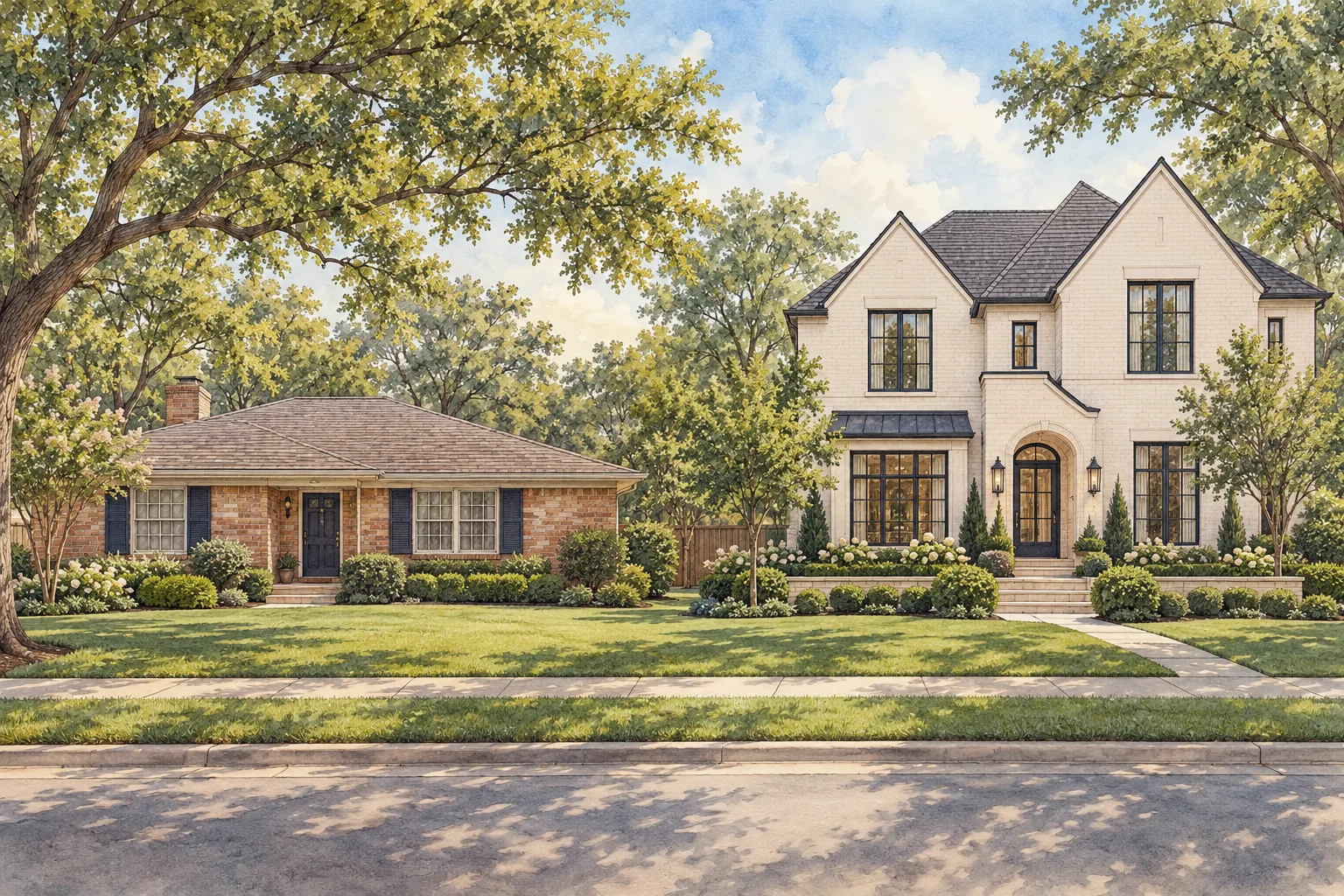
Compare a DFW renovation with a rebuild using the same cost for the lot. Give each plan its own scope, dates, finished value, loan limits, and cash reserve. A new house may sell for more. It can still tie up more cash and leave less room for a delay or price cut.
The question is not just how much a lender will advance. It is whether the work you can execute, finance, and sell produces an acceptable result. A smaller project may fit your cash and experience better. A larger project may make sense when the design, demand, budget, and financing all support it.
This guide compares two made-up plans for one $450,000 DFW purchase. Neither is a local bid, appraisal, or forecast. The owner will not live there. Review DFW luxury construction loans and DFW luxury renovation loans to see which program fits each scope. The address, budget, and buyer still need a full review.
Keep the lot cost the same in both options
Start both plans with the same purchase cost. Do not charge the whole price to the rehab plan while calling the lot free in the rebuild plan. You may tear down the house, but you still paid to buy it. That money remains part of the project cost and the cash you have at risk.
If you already own the site, show both historical cost and the basis the lender accepts. Also show any current debt. Land value, land cost, and paid-in land equity are different figures. A new loan may need to repay existing debt before any funds support work. That payoff must stay visible in the funding plan.
Compare the cost of keeping the current structure with the cost of removing it. An inspection may find a sound frame but obsolete systems. It may find foundation or layout issues that make a major renovation difficult. Ask qualified professionals to assess the actual building rather than choosing the scope from a target sale price.
Also price the option of not buying. A project that fails at the seller’s price does not become sound because you can borrow most of its costs. The acquisition decision comes before the financing choice. Keep enough time in due diligence to test both scopes and walk away if neither produces a result you can accept.
Define the renovation in enough detail to bid
Write a scope that separates retained work from replaced work. Identify walls, structure, roof, mechanical systems, windows, kitchens, baths, and site improvements. A luxury finish allowance does not answer whether the underlying systems can support the plan. Have the design and construction team resolve those questions before treating the budget as complete.
Get bids on the same scope. One contractor may include permits, debris removal, and general conditions while another leaves them out. Compare exclusions and allowances line by line. The lowest total is not useful if it omits work that will be required after closing. Keep a clear record of which bid assumptions remain open.
Review the layout with likely buyers in mind. More expensive finishes may not solve a poor room plan, low ceiling, awkward access, or limited parking. Use comparable completed homes to test the proposed product. A sales comparison should reflect the actual finished size and quality, not the best nearby house regardless of its differences.
If the project retains older materials, review applicable work rules. The EPA lead renovation program covers qualifying work in pre-1978 housing. Ask the team how the rules apply to the actual scope. Treat any required work methods and costs as part of the plan rather than a last-minute budget surprise.
Define the rebuild before assigning its finished value
A rebuild needs more than a larger square-foot estimate. Establish the permitted building envelope, design, site access, utilities, drainage, and demolition scope. The accepted design should lead the cost and value review. A model built on a home that cannot be permitted on the lot is not a financeable plan.
For Dallas property, the city’s residential permit page provides separate resources for new construction, additions, and remodels. Use the correct local authority for the parcel. Dallas-Fort Worth contains many municipalities; one city’s checklist should not be treated as the rule for every address in the region.
Ask the designer and builder to identify decisions that affect price early. Foundation design, structural spans, exterior materials, glazing, and utility work can change both cost and lead time. Resolve the major items before ordering an appraisal based on the proposed finished home. Later design changes may require updated bids and lender review.
Do not assume a teardown has a cleaner budget simply because the building will be new. Demolition can reveal site conditions. New utility connections or service upgrades may be needed. The budget should identify the responsible party and evidence for each major site cost, with an appropriate contingency for items that cannot yet be fully resolved.
Apply the program caps to each scope separately
Jaken Finance Group’s luxury program lists Up to 100% LTC on qualified files up to $2.5M; larger files quoted individually, subject to Up to 75% ARV (flip) or 75% LTARV (construction) — fund the lower number. Its published maximum loan amount is $10,000,000. Qualified-file and project-size conditions apply. Use the luxury construction eligibility guide to review those conditions with the actual project details.
Calculate the cost-based amount, then the completed-value amount, then any applicable loan-size cap. The lower approved limit controls. A 100% cost percentage cannot override a lower value cap. Likewise, a high finished value does not make every fee or reserve part of the eligible construction budget.
The calculators below use a sample 100% cost limit and 75% completed-value limit to illustrate that interaction. These inputs are not an approval. The lender decides which costs qualify and what value it accepts. It also reviews sponsor experience, liquidity, credit, property type, location, and the proposed exit.
Separate the commitment from the initial advance. Part of a construction loan may be held for future work. A large total commitment therefore does not mean the same amount is available on purchase day. Ask for the initial funding amount and draw conditions before deciding how much cash you need to close and start work.
Option one: renovate the existing house
Assume $450,000 purchase cost, $350,000 hard costs, and $50,000 eligible soft costs. The eligible total is $850,000. Assume a supported finished value of $1.2 million. At the sample percentages, the cost limit is $850,000 and the value limit is $900,000. The lower cost limit controls this version of the example.
Add $60,000 of outside costs and a $70,000 unspent reserve budget. With no accepted land equity already contributed, the model shows $130,000 of owner funding and reserves beyond the loan. That figure does not address temporary draw gaps. Deposits due before reimbursement could require additional ready cash during the work.
The apparent spread between the $1.2 million value and the eligible budget is not final profit. Outside costs, interest, property carry, selling costs, and other charges still need review. Some may already sit in the $60,000 allowance. Build a detailed cost ledger so each expense is included once and reserve money is not treated as spent.
Explore the worked example
Compare the DFW renovation budget
Keep the same lot cost in both examples. Change the work and supported completed value.
Illustrative results for the starting values. All editable loan terms are assumptions.
- Modeled total loan commitment
- $850,000
- Owner funding beyond land equity
- $130,000
| Eligible land, hard costs and soft costs | $850,000 |
|---|---|
| Cost-based limit | $850,000 |
| Completed-value limit | $900,000 |
| Outside costs plus unspent reserve budget | $130,000 |
- Land equity must be lender-accepted equity already contributed, not the entire land value if a loan remains. Do not count borrowed land funds as paid-in cash.
- The result is a total commitment, not cash released at closing. Draw timing, deposits, reimbursements and holdbacks can create further temporary cash needs.
- Cost eligibility and all caps are assumptions for this illustration. A maximum advertised LTC does not establish eligibility or approval.
Option two: demolish and rebuild
Keep the same $450,000 purchase cost. Assume $900,000 hard costs and $150,000 eligible soft costs, including the scope’s approved demolition and site items. Eligible cost is now $1.5 million. Assume a $1.8 million completed value. The sample 75% value limit permits $1.35 million, below the cost-based amount.
That leaves a $150,000 eligible cost gap. Add $90,000 of outside costs and a $120,000 unspent reserve budget. The resulting owner funding need is $360,000 before draw-timing gaps, with no prior land equity contribution. The rebuild’s higher sale value comes with substantially more cash tied to the project.
The two options also need different calendars. Do not use the renovation’s expected completion date for the rebuild merely to make the comparison look stronger. Ask the team for a schedule tied to design, approvals, material orders, inspections, and sale. The loan term must leave time for the real exit after physical work ends.
Explore the worked example
Compare the DFW rebuild budget
This separate estimate includes the larger scope and reserve budget. Neither option is an appraisal.
Illustrative results for the starting values. All editable loan terms are assumptions.
- Modeled total loan commitment
- $1,350,000
- Owner funding beyond land equity
- $360,000
| Eligible land, hard costs and soft costs | $1,500,000 |
|---|---|
| Cost-based limit | $1,500,000 |
| Completed-value limit | $1,350,000 |
| Outside costs plus unspent reserve budget | $210,000 |
- Land equity must be lender-accepted equity already contributed, not the entire land value if a loan remains. Do not count borrowed land funds as paid-in cash.
- The result is a total commitment, not cash released at closing. Draw timing, deposits, reimbursements and holdbacks can create further temporary cash needs.
- Cost eligibility and all caps are assumptions for this illustration. A maximum advertised LTC does not establish eligibility or approval.
Compare cash profit after every sale cost
Start with the expected sale price for each option. Subtract selling costs, closing charges, loan payoff, and any unpaid project bills. That gives cash returned at sale. Then subtract all owner cash spent to find profit before income tax. Keep loan principal out of the expense total if you already subtract it in the payoff.
Unspent reserves return to the owner without creating profit. If you set aside $120,000 and spend only $40,000, the remaining $80,000 was never a project expense. Track reserve spending as it occurs. This makes the final profit calculation different from the maximum cash balance required to carry out the project.
Use a specific selling-cost assumption for each case. A percentage allowance can help screen the deal, but a real sale budget should reflect the expected transaction. Include concessions where supported. A higher gross price may bring higher selling costs in dollars, even if the assumed percentage is the same for both houses.
Compare profit with both cash at risk and time. A project that earns more dollars over a much longer hold may be less attractive than a smaller, faster project. Avoid presenting a short hold’s cash return as an annual rate without explaining the method and reinvestment assumptions. Use a simple dated cash schedule for the initial decision.
Stress the value cap and the work budget together
Lower the rebuild’s finished value from $1.8 million to a hypothetical $1.6 million. At a 75% cap, the modeled loan drops to $1.2 million. With the original costs and reserves, owner funding rises to $510,000. This is a sensitivity test, not a forecast of DFW prices or a prediction about an appraisal.
Now raise hard costs while leaving value unchanged. When the value cap already controls, the new cost does not automatically create more debt. The owner may need to fund the increase. Before work starts, agree with partners and the builder on who approves changes and where added cash will come from.
Apply the same tests to the renovation. Its initial cost-based limit leaves some room under the assumed value cap, but that room is not a promise of added funding. A lender must approve any change. The revised scope may also affect value, permits, completion time, and the risk of keeping the existing structure.
Run a combined downside case. Use a lower sale price, a longer hold, and an overrun that could occur together. The purpose is to find the point at which you would reduce scope, change the purchase price, or decline the deal. A plan that works only when every assumption goes right needs more margin or more cash.
Build a draw plan around real payment dates
Ask the builder for the payment schedule behind the bid. Identify deposits, progress payments, final payments, and retainage. Then compare those dates with the lender’s inspection and release process. A cost that is eligible for funding may still need to be paid by the owner before the draw is approved.
For example, a window order may require money before delivery. The lender may need evidence that materials are onsite or installed. Find out how that mismatch is handled before placing the order. A rushed deposit paid from the project’s last reserve can leave too little cash for interest or other work while reimbursement is pending.
Keep draw records tied to the budget. Each request should show the work completed, amount previously paid, amount now requested, and cost still to finish. Track approved changes separately. The goal is to see whether remaining loan funds and owner cash can finish the actual scope, not merely whether the last invoice can be paid.
The Chicago construction cash-gap guide provides a second worked example of cost caps and draw timing. Local permits differ, but the funding distinction is the same: eligible costs, available loan funds, and cash available today are three different things. Your DFW plan needs all three to remain aligned.
Match the sponsor and team to the chosen project
A lender will want to understand who can complete the work. Show projects of similar scope and explain your role. Owning a renovated rental is different from managing a new luxury build. If a partner or builder supplies key experience, describe that role and the agreement that keeps the person involved.
Confirm who manages design, permits, contractor payments, inspections, and sales decisions. A project can lose time when each party assumes someone else has handled a task. Put responsibilities and deadlines in writing. The lender should be able to see a practical route from purchase through completion and repayment.
Keep cash evidence current. A large net worth may be tied up in assets that cannot quickly pay a bill. Show funds available for the project and identify money committed elsewhere. If a contribution depends on another sale or refinance, treat it as contingent until it closes and the cash is usable.
Review the builder’s exclusions, insurance, schedule, and change process with your advisers. Financing approval does not certify the builder’s performance. A loan can fund an approved budget while the owner remains responsible for managing the project and resolving disputes. That responsibility should be clear before a larger rebuild is chosen.
Treat a rental hold as a separate backup plan
A luxury home’s rent may not rise in proportion to its sale value. Test supported rent against the full permanent housing payment, including taxes and insurance. Then compare the rent-supported loan with the construction payoff and refinance costs. A high appraisal does not guarantee that the new loan returns all owner cash or clears the old debt.
Use the DFW rental cost calculator guide to see how recurring costs affect debt capacity. The rental plan also needs vacancy, management, repairs, and future capital allowances. A home that meets a lender’s coverage test can still have weak owner cash flow after those expenses.
Review the future tax basis and insurance use. The Texas Comptroller’s valuation guide is a starting point for understanding official property values. Ask the appropriate professionals how the completed improvements affect the expense estimate. Do not use the old house’s carrying costs unchanged for a much larger finished home.
If renting would require a large cash contribution at refinance, identify that source before taking the construction loan. If a sale is the only workable exit, budget enough time and reserves for it. Calling a rental hold a backup does not make it feasible. The numbers and the separate lender review must support that choice.
For a rental exit, test the tax and insurance budget in the DFW rental DSCR guide. The Houston cash-out example shows how payoff and fees reduce cash received. Use local rent and property costs for the actual DFW address; the Houston figures are only a worked example.
Submit both options before committing to the larger scope
Send Jaken Finance Group the address, purchase terms, plans, separate itemized budgets, contractor details, value support, and schedules. Identify which parts of the existing building remain in the renovation option. Include the site review, permits, cash available, and any land debt. Mark unresolved scope items instead of hiding them inside a broad allowance.
Use the project request to compare the financing paths. Ask for the accepted cost basis, total commitment, initial advance, draw conditions, required owner funds, and exit requirements for each option. The better DFW infill plan is the one that combines a supported finished product with enough cash and time to complete it.