Blog
How to Finance a BOXABL Casita (Investors)
By Jaken Finance Group · Principal, Jaken Finance Group
How to finance a BOXABL Casita as an investor—construction IO, DSCR takeout, file checklist, appraiser requirements, and non-owner-occupied rules.
How to finance a BOXABL Casita as a real estate investor is a two-loan story: construction or bridge while the unit is ordered, set, and CO’d — then DSCR permanent when the combined property rents. BOXABL’s order page shows consumer payment examples starting around $895/mo on Studio turnkey promos. That is BOXABL partner financing for homeowners. Jaken Finance Group finances non-owner-occupied investment property at 8.99%–13.5% interest-only during construction and 5.75%–10.5% on DSCR takeout — capped at 75% of as-completed combined value on qualified files.
Disclosure: Jaken Finance Group may earn a commission if you order a BOXABL Casita.
This guide maps BOXABL’s order flow onto investor capital stacks, lists the file checklist appraisers and underwriters expect, and explains why owner-occupied backyard Casitas belong on a different desk. For all-in cost and rent math, see BOXABL Casita cost and rental income. For model selection, see BOXABL Casita models investor guide.
Non-owner-occupied only — read this first
Jaken Finance Group does not finance Casitas behind houses you live in. An owner-occupied ADU is consumer credit — bank, HELOC, or BOXABL’s finance partners. An investment-property Casita behind a rental you hold in an LLC is our ADU construction loan desk.
| Scenario | Jaken Finance Group stack? |
|---|---|
| Casita behind rental SFR in LLC | Yes — construction → DSCR |
| Casita behind 2–4 you hold as rentals | Yes — combined rent roll |
| Casita behind house you occupy | No — consumer path |
| Baby Box RV in backyard | No — personal property |
| Unpermitted unit, no CO | No — income does not count |
The partnership announcement explains how product and capital connect. Construction-to-DSCR takeout financing is the permanent exit playbook.
BOXABL order flow — what happens before the lender funds
BOXABL’s published order path (September 2026):
- Order fee — $250 after initial property qualification review
- Feasibility study — virtual site check, preliminary report
- Production deposit — $2,500 to enter factory queue
- Permit approval — BOXABL turnkey manages; unit-only is on you
- Site prep — foundation, utilities stubbed
- Delivery and set — crane, unfold, tie-down (~24 hours on site)
- Final touches — MEP connections, inspection, CO
Your construction loan should align draws to these milestones — not fund the full factory invoice on day one unless the file structure allows it. Submit the BOXABL contract and draw schedule with your newbuild application.
You can order a BOXABL Casita once zoning and capital path are confirmed.
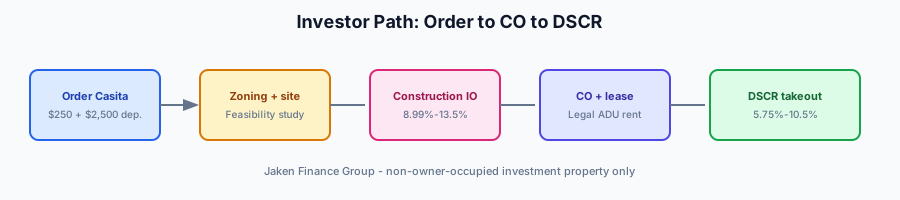
Phase 1: Construction and bridge financing (8.99%–13.5% IO)
During order, set, and CO, qualified investors use new construction or fix-and-flip / bridge pricing:
| Parameter | Jaken Finance Group qualified file |
|---|---|
| Rate | 8.99%–13.5% interest-only |
| Leverage | Up to 75% of as-completed combined value |
| Term | 12–18 months typical — match realistic CO date |
| Close speed | 10–14 business days with complete file |
| Min FICO | None on select construction programs |
As-completed value means the appraised worth of primary dwelling + Casita after CO — not land alone, not factory invoice. If the primary is a $400,000 rental and the Casita adds $120,000 in appraised value, combined $520,000 supports $390,000 at 75% — but only if the appraiser reconciles modular ADU comps.
Construction interest example: $135,000 average balance at 11% IO for 8 months = ~$9,900 carry. Budget in your pro forma from BOXABL cost guide.
What construction underwriting weighs
- Zoning letter — ADU permitted, setbacks, max sq ft
- Budget realism — unit-only vs turnkey paths differ
- Exit clarity — DSCR on combined rent, not flip unless documented
- Experience — first-time sponsors need tighter contingencies
- HOA / CC&R — ADU ban kills the file before order
Compare to ground-up construction loan vs fix-and-flip when the primary also needs work.
Phase 2: Certificate of occupancy and lease-up
DSCR takeout requires a legal, rentable asset:
| Requirement | Why |
|---|---|
| Certificate of occupancy | Proves habitability — no CO, no permanent |
| Separate address or unit designation | Lease and appraisal clarity |
| Executed lease or market rent 1007 | DSCR numerator |
| Landlord insurance updated | Replacement cost includes Casita |
| Taxes reassessed | PITIA denominator |
Vacant takeout with market rent from appraisal is possible on some 1–4 programs — see DSCR below 1.0 with market rent — but leased is cleaner pricing.
Seasoning: Many DSCR programs want 90 days on title post-CO. Model timeline in your DSCR loan requirements guide.
Phase 3: DSCR takeout (5.75%–10.5%)
Permanent investor financing qualifies on rent ÷ PITIA — not your W-2.
| Parameter | Jaken Finance Group qualified file |
|---|---|
| Rate | 5.75%–10.5% fixed or ARM |
| Leverage | 75% LTV typical on combined value |
| DSCR minimum | 1.0 for best tiers — higher is better |
| Term | 30-year fixed or ARM |
| Close | ~14 business days with complete package |
Formula: DSCR = monthly gross rent (actual or appraiser market) ÷ monthly PITIA (principal, interest, taxes, insurance, HOA if any).
Use the DSCR calculator before you apply. Read how a DSCR loan works for tier math.
Worked financing example (composite)
| Stage | Detail |
|---|---|
| Property | Rental SFR + One-Bedroom Casita (722 sf) |
| As-completed appraised value | $515,000 |
| Construction loan funded | $138,000 at 10.5% IO, 7 months |
| Construction interest | ~$8,500 |
| Combined gross rent | $3,650/mo |
| DSCR takeout loan | $386,250 (75% LTV) at 7.875%, 30-year |
| PITIA (illustrative) | ~$2,890/mo |
| DSCR | 1.26 |
Construction pays off from takeout proceeds; sponsor equity returns per your equity structure. Cash-out above construction payoff is optional — model conservatively if appraisal variance is ±10%.
Appraiser requirements — what makes or breaks value
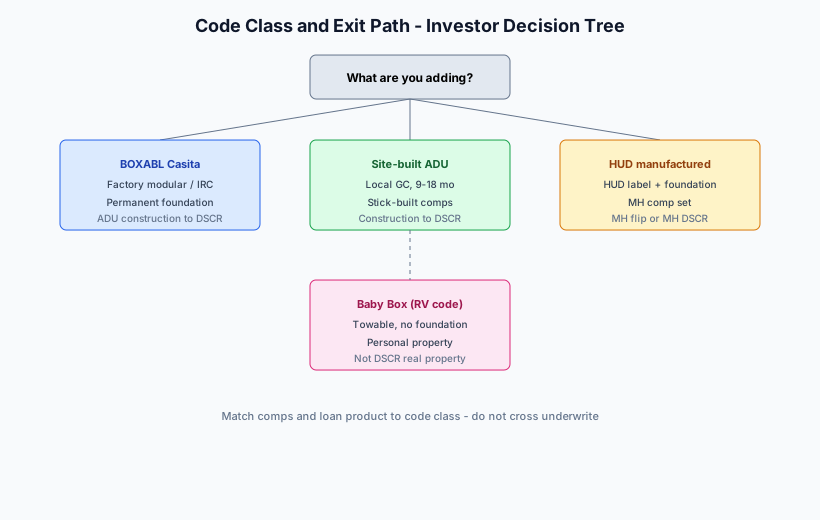
Appraisers must reconcile modular / factory-built ADU comps — not default to stick-built SFR only.
Appraiser deliverables lenders expect
| Item | Detail |
|---|---|
| As-completed appraisal | Primary + Casita as one legal parcel |
| Modification / factory docs | BOXABL installation records, tie-down |
| Foundation inspection evidence | Permanent foundation — not skirting |
| CO copy | City-issued |
| Rent schedule (Form 1007) | ADU comps within reasonable distance |
| Photos | Set, foundation, interior, meters |
| Remaining economic life | Modular treated as real property when affixed |
If the appraiser cannot find modular ADU sales, they may use cost approach or paired sales — expect variance. That is why we stress 75% leverage cap, not max push. See BOXABL vs site-built ADU vs manufactured home for code-class context and manufactured home ARV and comps for why HUD-label comps differ.
Do not assume Casita equals stick-built ARV premium. Some markets pay parity; others discount until sales history builds.
Complete file checklist
Before order
- Entity docs (LLC operating agreement, EIN)
- Proof primary is non-owner-occupied (lease, insurance)
- Zoning letter or ADU eligibility confirmation
- Site survey or plat
- Utility capacity letter (electric, water, sewer)
- BOXABL model selection and quote (unit-only or turnkey)
- Feasibility notes from BOXABL advisor
Construction loan submission
- Newbuild application or submit scenario
- Purchase agreement / BOXABL contract
- Detailed construction budget (line-item)
- GC or installer bid (license, insurance)
- Plans and engineering (BOXABL package + local stamps)
- Draw schedule aligned to factory and site milestones
- Exit pro forma — combined rent, DSCR, 75% LTV sensitivity
- Insurance quote (builder’s risk → landlord)
- Title commitment showing no ADU restrictions
DSCR takeout submission
- Certificate of occupancy
- Final appraisal (as-stabilized combined)
- Executed lease(s) — primary and Casita if separate
- Landlord insurance binder
- Tax bill (updated assessment)
- Payoff statement from construction lender
- Entity still holds title — no owner-occ change
Missing zoning or CO is the top delay. Unpermitted work never reaches DSCR — same rule as DC ADU rules and Chicago ADU ordinance.
Matching BOXABL milestones to your capital stack
Investors lose deals when factory timing and lender draws misalign. BOXABL controls factory queue; you control zoning and lender readiness. The winning sequence:
Week 0: Pull zoning and utility capacity before the $250 order fee. Confirm ADU zoning basics or your local equivalent if the parcel is in a restricted RS or HOA district.
Week 1–2: Pre-qualify construction with a combined as-completed pro forma — not a Casita-only spreadsheet. Attach primary lease, tax bill, and insurance dec page.
Week 2–4: Pay BOXABL production deposit; close construction loan with draw schedule that funds factory invoice after foundation inspection on unit-only paths.
Month 2–4: Permits run parallel to factory build. Escalate jurisdiction delays early — every idle month burns IO.
Set day: Lender inspector verifies foundation tie-down, crane set, and weatherproofing before releasing the largest draw.
CO + 30 days: Order appraisal update, finalize landlord insurance, execute Casita lease, submit DSCR takeout package.
This rhythm is the same whether you choose Studio ($140,000 turnkey promo) or Two-Bedroom ($200,000 turnkey promo) — only dollar amounts change.
Primary lease continuity during construction
The primary rental must stay performing through construction. Lenders underwrite combined DSCR on exit — but construction-phase risk includes:
- Tenant disruption from crane access, utility trenching, and noise
- Insurance liability during active job site
- Cash-flow dip if primary tenant breaks lease mid-build
Mitigate with construction access clauses in the primary lease, temporary rent concessions disclosed to the lender, and a reserve for one month primary vacancy. If the primary is vacant at construction close, some desks treat the file as full vacant takeout — harder pricing. Keep the primary leased when possible.
Rate and leverage tiers on DSCR exit
Permanent pricing is not a single number. On qualified investor files at 5.75%–10.5%:
| DSCR tier | Typical leverage | Rate band (indicative) |
|---|---|---|
| 1.25+ | 75% LTV | Lower half of band |
| 1.10–1.24 | 70–75% LTV | Mid band |
| 1.0–1.09 | 65–70% LTV | Upper half of band |
| Below 1.0 | Case-by-case | Add-on pricing — avoid |
Stronger guarantor credit may widen LTV slightly — but the property ratio drives the file. A Casita that adds $400/mo net to DSCR after PITIA often pays for itself in permanent rate tier improvement versus a sub-1.0 primary-only refi.
Use short-term rental DSCR rates only where STR is legal — not standard ADU cities.
Third-party reports lenders order
Beyond appraisal, budget soft costs for:
| Report | When required |
|---|---|
| Title update and ALTA endorsement | Every close |
| Flood certification | FEMA zones — common in Florida |
| Survey | Setback verification on tight lots |
| Zoning compliance letter | Some DSCR investors require at CO |
| Phase I environmental | Prior commercial use on lot |
Modular set does not eliminate flood or enviro risk. Coastal Miami ADU files may need elevation certificate updates after foundation.
Guaranty and recourse expectations
Construction and DSCR files on LLC-held rentals typically require personal guaranty from the sponsor unless you qualify for non-recourse commercial terms on larger balance sheets. Understand:
- Bad boy carve-outs — fraud, bankruptcy triggers full recourse
- Completion guaranty — you finish the Casita if contractor fails mid-set
- Carve-out for environmental — rare on residential infill but disclose prior use
Bring two years entity and personal bank statements if the desk asks for liquidity proof — standard on first modular ADU files without track record.
Post-close: scaling to a second Casita
Some investors add multiple ADUs where ordinance allows. Chicago caps affordability requirements when you add two or more new units — see Chicago ADU ordinance. California allows multiple ADUs on many lots per HCD guidance.
Second Casita financing stacks equity from the first DSCR refi — do not assume automatic 85% LTV stacking. Each addition needs fresh as-completed appraisal on all improvements. Scale with how to scale a rental portfolio with DSCR discipline.
Capital stack alternatives
All cash for Casita, DSCR on combined property later
Some sponsors pay unit-only or turnkey from liquidity, then cash-out DSCR refi on combined value after CO. Works when construction loan timing does not match BOXABL factory queue.
Investment-property HELOC
Jaken Finance Group investment-property HELOC may cover part of the equity stack on non-owner-occupied holdings — program CLTV and lien position rules apply. HELOC plus construction IO is common; HELOC alone rarely covers full vertical on larger turnkey packages.
BOXABL consumer financing
BOXABL’s site cites partner financing from ~$895/mo on Studio turnkey — consumer product, not our investor construction paper. Do not confuse advertised consumer payments with 8.99%–13.5% IO or 5.75%–10.5% DSCR.
Financing paths that fail
| Path | Why it fails |
|---|---|
| Owner-occ FHA 203(k) on Casita ADU | Wrong occupancy — Jaken Finance Group does not broker this |
| Chattel loan on Casita | Casita on permanent foundation is real property when permitted — chattel is Baby Box / HUD without land |
| DSCR on STR pro forma | ADU STR banned in many cities |
| Max LTV without appraisal support | 75% cap binds on combined value |
| Unpermitted garage conversion + Casita | Planning risk — lender stops |
For HUD double-wide contrast, read DSCR loans for manufactured homes and chattel vs real property for mobile home flippers.
Timeline coordination: lender ↔ BOXABL
| Week | BOXABL | Lender |
|---|---|---|
| 0–2 | Order fee, feasibility | Pre-qual, zoning review |
| 2–4 | Production deposit | Construction loan close, first draw holdback |
| 4–12 | Factory build | Permit tracking, site prep draws |
| 12–16 | Delivery scheduled | Foundation draw, set draw |
| 16–20 | CO support | Final draw, lease-up |
| 20–24 | — | DSCR takeout application |
Pad 4 weeks for appraisal and title on takeout. Total 5–9 months is realistic — match your IO term.
Geographic notes
ADU financing rules vary by city — product is national, entitlement is local:
- Los Angeles ADU zoning basics — large ADU market, permit volume
- Chicago ADU ordinance 2026 — RS opt-in required in single-family districts
- DC ADU rules — row home English basements vs detached Casita rare
- Miami ADU zoning — hurricane and flood certs may add soft costs
Pull local ADU ordinance before construction close — not after set day.
Construction draw schedule — line by line
Lenders release funds against documented completion, not factory invoices alone. A typical BOXABL Casita draw map on a unit-only file:
| Draw # | Milestone | Typical % of loan | Documents |
|---|---|---|---|
| 1 | Loan close — soft costs | 10–15% | Budget, plans, zoning letter |
| 2 | Foundation complete | 20–25% | Inspection, photos |
| 3 | Factory deposit / unit production | 25–35% | BOXABL invoice, production slot |
| 4 | Delivery and set | 20–25% | Crane receipt, set photos |
| 5 | MEP final / CO pending | 10–15% | Utility sign-offs |
| 6 | Retainage release | 5–10% | CO copy, final inspection |
Turnkey BOXABL purchases may consolidate draws — the lender still inspects foundation and CO. Never assume 100% advance on factory payment without program confirmation. Submit the draw schedule with your newbuild application so the closer matches BOXABL’s billing cadence.
Entity structure, title, and vesting
Hold both the primary and Casita in the same LLC vesting that matches your loan guaranty structure. Splitting title — primary in LLC A, Casita pad in LLC B — breaks DSCR combined collateral unless you have a recorded lease between entities (messy, often declined).
| Structure | Lender view |
|---|---|
| Single LLC owns land + all improvements | Clean — standard |
| Individual owns primary, LLC owns Casita | Problem — cross-collateral gap |
| Land trust with LLC beneficiary | Case-by-case — disclose early |
| New LLC mid-project | Requires title endorsement — delays |
Bring operating agreement, EIN, and certificate of good standing to construction close. DSCR takeout uses the same entity — no mid-stream flip to a new LLC without lender consent.
Liquidity and reserve requirements
Construction lenders expect sponsor liquidity beyond equity in the deal:
| Reserve type | Typical ask |
|---|---|
| Interest reserve | 3–6 months IO sometimes capitalized in loan |
| Contingency | 5–10% of hard costs outside loan |
| DSCR takeout reserves | 6–12 months PITIA on some programs |
| Boxabl deposits | $2,750 minimum before draws |
If your entire stack is 75% LTC with zero cash reserves, one permit delay pushes you into extension fees. Keep $15,000–$25,000 liquid on a $180,000 Casita project as a practical floor.
Why conventional mortgages rarely fit the investor Casita path
Owner-occupants sometimes ask about FHA 203(k) or Fannie Mae ADU programs for Casitas behind a primary residence. That is not the Jaken Finance Group desk. Investors on non-owner-occupied property use private construction credit because:
- Conventional delivery requires CO on the entire property before permanent — construction phase needs IO
- Manufactured home overlays do not apply to IRC modular Casitas — but appraisers still ask code questions (see code class guide)
- GSE rent roll rules lag modular ADU comp depth in many counties
- LLC vesting excludes most agency loans entirely
Agency ADU programs are evolving — track FHFA and GSE bulletins for owner-occ only. Investors stay on 8.99%–13.5% construction IO → 5.75%–10.5% DSCR.
Construction loan extensions and exit pressure
If CO slips past your IO maturity:
| Option | Cost |
|---|---|
| One-term extension (30–90 days) | 0.25–1 point + continued IO |
| Refinance to bridge | New origination — higher rate possible |
| Payoff from sponsor cash | Liquidity drain |
Model two months of slippage in every pro forma. Permits in Los Angeles and Chicago RS districts routinely exceed optimistic timelines.
Appraiser red flags that delay DSCR
| Red flag | Lender response |
|---|---|
| No modular comps within market area | Value haircut or cost approach |
| Skirt foundation instead of stem wall | Stop — bring to code |
| Unpermitted electrical tie-in | No takeout until resolved |
| Primary listed as 1-unit on tax card post-CO | Require assessor update |
| Rent comp from dissimilar stick-built ADU only | 1007 challenged — lower market rent |
Order the appraisal after CO with photos of tie-down, meter, and separate entrance. Pre-CO “subject to completion” appraisals help construction sizing but rarely serve as final DSCR collateral without update.
FAQ for your broker and closing attorney
Before you wire BOXABL deposits, ask your closing team:
- Does title show ADU restrictions or CC&R bans? If yes, stop — no lender proceeds.
- Will the lender require a completion assignment on the BOXABL contract? Some desks take assignment of the purchase agreement as collateral.
- Is a separate meter required for the Casita lease? Utility separation simplifies appraisal and tenant billing.
- Does the county tax card need a unit count update at CO? Mismatch delays DSCR.
- Who orders the final inspection — BOXABL turnkey or your GC? Draw releases depend on the answer.
Your attorney does not replace lender underwriting — but early title and CC&R review saves $2,750 in non-refundable deposits on ineligible lots.
Consumer vs investor financing — side by side
| Feature | BOXABL consumer partner loan | Jaken Finance Group investor construction → DSCR |
|---|---|---|
| Occupancy | Often owner-occ focused | Non-owner-occupied only |
| Rate band | Partner quoted (~$895/mo promos) | 8.99%–13.5% IO → 5.75%–10.5% |
| Qualification | Personal income / credit | Rent roll, as-completed value, exit DSCR |
| Collateral | Casita package | Combined parcel |
| Takeout | Partner permanent | DSCR on stabilized combined property |
Pick the column that matches your hold structure before you order a BOXABL Casita.
Start your file
- Model all-in cost and DSCR — BOXABL Casita cost and rental income
- Pick model — BOXABL Casita models investor guide
- order a BOXABL Casita when zoning clears
- Submit construction file — newbuild · submit scenario
- Call (833) 264-7776 to align BOXABL milestones with draw schedule
Sources
- BOXABL order flow and pricing pages, accessed September 2026
- Jaken Finance Group ADU construction loans and construction-to-DSCR takeout product pages
- American Planning Association — ADUs
- California HCD — ADU policy
- HUD manufactured housing standards (contrast only) — HUD Manufactured Home program
How to Finance a BOXABL Casita — next step
Align BOXABL order milestones with 8.99%–13.5% construction draws and 5.75%–10.5% DSCR takeout at 75% combined LTV. Non-owner-occupied only.
Submit scenario · Pre-qualify · (833) 264-7776.