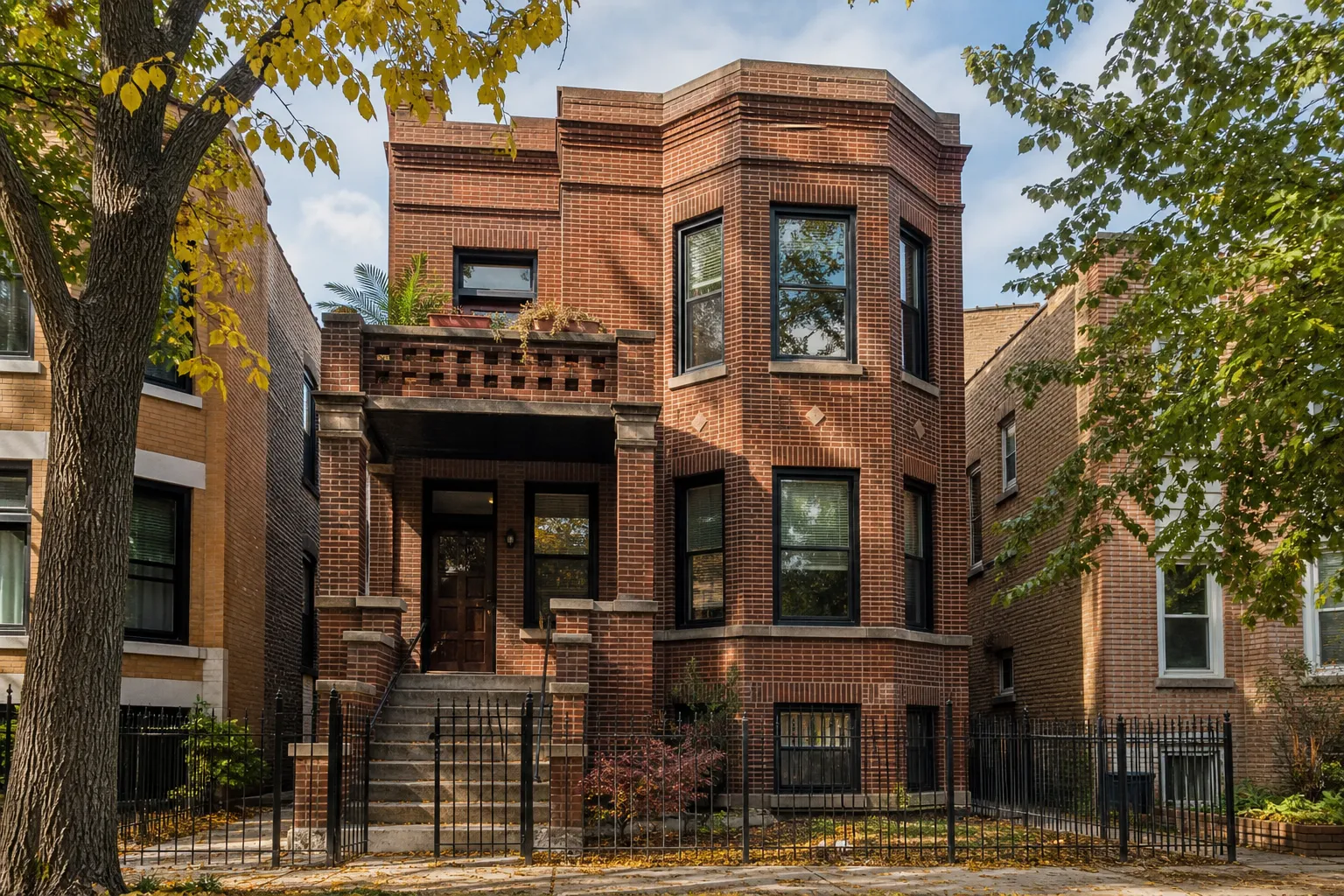
South Shore is Chicago’s lakefront south — Jackson Park, Metra Electric access, and vintage multifamily at lower basis per door than Logan Square. DSCR loans in South Shore fund permanent debt after repositioning — converting 12–18 months of hard money carry into long-term rental debt.
Acquisition bridge: hard money loans South Shore · Jeffery three-flat acquisition example on that page — this page uses a six-flat refi file.
South Shore DSCR by asset class (2026)
| Asset | Stabilized gross | Appraised value | DSCR at 70–72% LTV |
|---|---|---|---|
| Two-flat (interior) | $2,000–$2,700/mo | $310K–$380K | 1.05–1.15 |
| Three-flat (renovated) | $3,600–$4,800/mo | $480K–$560K | 1.10–1.25 |
| 6-flat courtyard | $7,500–$11,000/mo | $850K–$1.2M | 1.14–1.28 |
Parent hub: DSCR loans Chicago
Six-flat DSCR refi — file requirements beyond duplex
South Shore courtyard six-flats need deeper diligence than two-flat refis:
| Document | Why |
|---|---|
| Full rent roll (6 units) | Partial stabilization fails ratio |
| Phase I (if prior commercial use) | Environmental delay at refi |
| Boiler plant documentation | Central systems affect opex |
| Unit-by-unit CO | Partial CO blocks permanent debt |
| 12–18 mo scope summary | No-seasoning proof of reposition |
Timeline: 14–21 business days vs 7–14 on two-flats.
No-seasoning refi on six-flat reposition
Six-flat sponsors on 14-month hard money depend on no-seasoning DSCR — permanent debt sized to $972K appraised, not $628K purchase. Underwriters require draw history, scope summary, and lease commencement dates for all six units — partial stabilization fails ratio even when five units perform.
Jaken Finance Group South Shore DSCR parameters
- Rates: 5.75%–10.5% · LTV: up to 85% purchase and rate-and-term, 80% cash-out, in select markets for qualified borrowers (70–72% common on six-flats)
- DSCR minimum: 1.0+; 1.15+ on larger assets for best tier
- No-seasoning: select programs post full stabilization
Worked example: 75th Street courtyard six-flat DSCR exit
Property: 1920s six-flat on interior street north of 75th — acquired distressed, 4 units vacant, 2 occupied (RLTO transition completed months 1–3).
Bridge (closed prior): $628,000 acquisition + $236,000 reposition — unit-by-unit kitchen/bath, boiler replacement, roof, tuckpointing Timeline: 14-month reposition including tenant transitions Stabilized gross: $1,425/mo × 6 units = $8,550/mo (mix of 2BR and 3BR) Appraised value: $972,000 Modeled opex: 34% (RLTO, lakefront insurance premium, 7% vacancy, management) DSCR refi at 70% LTV: $680,400 @ 8.75% DSCR ratio: 1.17 — returns ~$140K equity after bridge payoff for second south-side acquisition
Block diligence: Comps drawn quarter-mile radius on renovated six-units — not South Shore Drive co-op sales.
Two-flat refi profile (interior streets)
Modest $240K all-in two-flats grossing $2,450/mo often refi at 74% LTV on $355K appraisal → 1.08 DSCR — viable for first south-side hold exit with 33% opex load. Lower equity extract than six-flat but faster 7–10 day refi timeline.
Metra Electric and employer anchors
Metra Electric at 75th–79th supports UIC and downtown commuter tenant pool on interior streets — not lakefront co-op tenants. Comp leased renovated units on Jeffery and Coles corridors; University of Chicago spillover from Hyde Park affects 71st–75th micro-markets only when block stability supports it.
Jackson Park vs South Shore Drive — comp confusion at refi
Appraisers and sponsors routinely mix lakefront co-op sales with interior rental multifamily comps — producing refi surprises on six-flat files.
| Comp source | Use for DSCR refi? | Why |
|---|---|---|
| Interior courtyard six-flat (Jeffery/Coles) | Yes | Matches rental income approach |
| South Shore Drive co-op resale | No | O-O ownership, fee structure differs |
| Hyde Park condo sales | No | Different tenant pool and basis |
| Renovated two-flat (71st–75th interior) | Yes (smaller assets) | Same rental exit buyer |
Rule: Pull leased renovated multifamily within 0.25–0.5 mi on the same block character — not lakefront envelope sales with $400+/mo HOA lines that rental six-flats do not carry.
Six-flat RLTO transition — stabilization calendar
When two or more units arrive occupied at acquisition, RLTO governs turnover before those units count at 1007 market rent:
| Month | Action | Refi impact |
|---|---|---|
| 1–2 | RLTO notice on occupied units; begin vacant unit rehab | Only vacant units lease at market |
| 3–5 | Complete vacant units; partial rent roll | Ratio sized to partial gross |
| 6–8 | Turnover occupied units per RLTO timeline | Full rent roll eligible |
| 9+ | 1007 ordered; appraisal with 6-unit lease file | No-seasoning refi window opens |
The 75th Street six-flat in the worked example completed RLTO transitions in months 1–3 on two units while repositioning four vacant sides — 14-month total timeline is normal, not exceptional. Hard money terms must cover RLTO delay + reposition, not cosmetic flip calendars.
South Shore DSCR risks
Block-level diligence — walk at day and evening; comp renovated only. Lakefront envelope — roof/parapet deferred maintenance tightens LTV. RLTO relocation on occupied units delays stabilization. Speculative premium trap — do not model Presidential Center rent growth into ratio.
Underwriting checklist
- Rent roll + leases all units · CO each unit
- LLC docs · Tax +15% stress · Insurance (multifamily + lakefront)
- Hard money payoff · Scope/reposition summary
Insurance and lakefront peril on refi
South Shore six-flats near South Shore Drive carry higher property insurance quotes than interior streets — underwriters apply $180–$250/mo premium delta vs Jeffery corridor comps. Missing insurance bind at refi adds 7–10 days to close.
Related
For address-specific due diligence, start with the City of Chicago building permit and inspection records. Check the current property condition and required work separately; a published financing example does not verify the subject building.
County prices, metro jobs, and the South Shore appraisal
Headlines quote the county, not your block. The FHFA all-transactions house price index for Cook County was 197.56 in 2025, up from 187.22 in 2024. The index is 2000 = 100 and is not seasonally adjusted. That is about a 5.5% countywide rise. Source: FRED series ATNHPIUS17031A, updated March 31, 2026.
The Chicago-Naperville-Evanston division index was 296.21 in the second quarter of 2026, versus 278.91 a year earlier. The base is the first quarter of 1995. That is about a 6.2% year-over-year move. Source: FRED series ATNHPIUS16984Q.
Unemployment in the Chicago-Naperville-Elgin metro was 4.9% in August 2026, smoothed and seasonally adjusted. Source: FRED series CHIC917UR, from the Bureau of Labor Statistics.
A mid-single-digit jobless rate supports Metra Electric commuters on interior streets. It does not let you write a future rent into today’s ratio. Use the leases in the file. Keep comps on renovated courtyard buildings within about a quarter mile. Leave South Shore Drive co-op resales out of the set.
Permits issued in community area 43
Chicago community area 43 is South Shore. The city building-permit file shows 800 permits issued there from January 1, 2025, through October 1, 2026. Renovation and alteration permits were 144, with a reported cost of $97,707,978. New-construction permits were 10, with a reported cost of $4,394,000. Express-program permits were 571. Source: Chicago Building Permits.
Reported cost is the figure on the application. It is not an appraisal, and it is not a Jaken Finance Group loan amount. The mix still matches this market. Sponsors are altering older buildings. A no-seasoning refinance still needs a certificate of occupancy and a full six-unit rent roll. An issued permit is not a leased unit.
Cook County as a whole, from January through August 2026, permitted 795 single-family units, 29 two-unit buildings (58 units), and 125 buildings with three or four units (393 units). Buildings with five or more units numbered 70 and contained 1,958 units. Source: U.S. Census Bureau Building Permits Survey, January–August 2026 year-to-date county file.
Those counts cover all of Cook County. Do not treat them as a South Shore pipeline. They do show that small multifamily is still being permitted in the county that holds this collateral.
Family incomes behind a South Shore rent roll
Chicago’s ACS 5-year community-area file for 2023 counts 46,276 people in South Shore. The five family-income bands on that row sum to 9,423 families. 2,299 are under $25,000, and 2,082 fall from $25,000 to $49,999. Those two bands are 4,381 families, about 46.5% of the sum. 1,563 families, about 16.6%, are at $125,000 or more. Source: most recent ACS community-area file.
The city allocates census tracts that cross community-area lines, so read the counts as an estimate. Its notes set the file’s Chicago total at 2,647,621, against an ACS 2023 city population of 2,664,452, a 0.632% gap. Source: how Chicago builds the community-area file.
The six-flat example rents a unit at $1,425. That payment has to clear in a community where about 46.5% of families are under $50,000. Jaken Finance Group still underwrites the executed leases, the tax bill, and the insurance quote. Enter those three figures in the DSCR calculator before you order the appraisal.
Illustration: interest-only versus a 30-year payment
Example only. Purchase price, rent, and loan amount stay the 75th Street figures above.
Gross rent is $8,550 a month. A 34% expense load leaves $5,643 of monthly net operating income. On a $680,400 loan at 8.75%, interest-only debt service is about $4,961 a month. Coverage is about 1.14. The same loan on a 30-year amortizing payment is about $5,353 a month. Coverage is about 1.05.
The 1.17 ratio in the file summary is a bit stronger than interest-only math at a full 34% load. If the term sheet amortizes, use about 1.05, not 1.17. Jaken Finance Group prices DSCR loans from 5.75% to 10.5%. Cash-out is up to 80% of value. Purchase and rate-and-term are up to 85%, in select markets for qualified borrowers. This sketch stays at 70%, which is common on South Shore six-flats even when the program cap is higher.
A complete file often funds in about 14 business days. A courtyard building misses that window when one item is still open: a partial certificate of occupancy, a missing Phase I, a roof invoice the insurer asked for, or an interior-street insurance quote pasted onto a lakefront address.
Call (833) 264-7776 or send the six-unit rent roll before you book the appraisal. If you also hold houses outside the city, read the Illinois DSCR overview beside this lakefront file.
South Shore DSCR — RLTO turnover gates (2026)
South Shore refi fails when in-place RLTO rent substitutes for post-turnover market rent — 0.06–0.10 DSCR swing; lakefront envelope tightens LTV until roof/parapet documented.
- Two-flat: $2,450/mo on $355K → 74% LTV ~1.08 DSCR
- Six-flat: $8,550/mo courtyard → 70% LTV ~1.17 — Phase I when warranted
- Insurance: South Shore Drive $180–$250/mo premium vs interior streets
- Path B: Turnover adds 60–120 days but unlocks 73% vs 68% LTV
Underwriting anchor: replay the DSCR math and worked example on this page with your own lease, tax, and insurance inputs before application. DSCR 5.75%–10.5% · Chicago hub · (833) 264-7776.
Stabilized South Shore multifamily? Pre-qualify for DSCR refi or call (833) 264-7776.