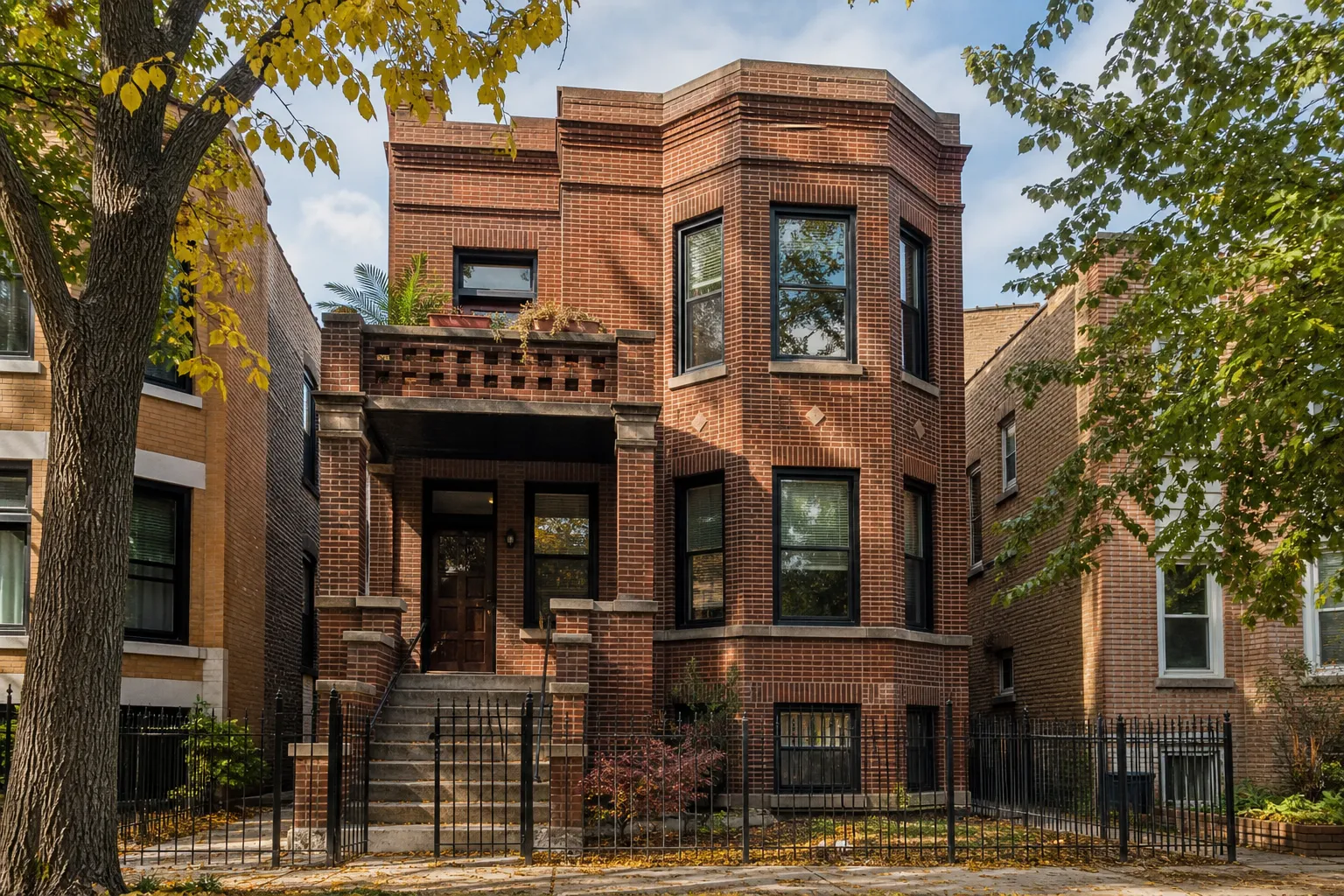
Austin is Chicago’s largest community area by population — a West Side corridor stretching from the city limits near Oak Park to Cicero Avenue, sliced by the Green Line at Central, Laramie, and Cicero stations. For forty years the headline was disinvestment: redlining legacy, vacant blocks, crime statistics that scared suburban capital away. The headline in 2026 is more complicated. Opportunity and risk sit on the same parcel — a brick two-flat you can buy at $150K with rents that support a BRRRR exit, on a block where one fire-damaged building sits two doors down and city demolition orders move slowly. Hard money loans in Austin fund investors who can hold both truths in their underwriting model.
Austin is not Englewood and not Logan Square. It is its own West Side economy: homeowners who have stayed for generations, new residents priced out of Humboldt Park pushing west, and institutional buyers who finally map Green Line transit access the way they once mapped the Bloomingdale Trail. Hard money fills the speed gap when a seller at a judicial sale or an exhausted landlord needs certainty — not a buyer whose community bank will reject the roof in week four.
Green Line access and block-level opportunity
The Green Line stations anchor micro-markets. Blocks within a ten-minute walk of Central or Laramie see stronger rental demand from commuters who work downtown but cannot afford Wicker Park rents. Blocks farther west toward Austin Boulevard offer lower basis with less foot traffic — higher yield potential, slower appreciation.
Investors with Austin experience segment the community area roughly:
| Corridor | Two-flat buy (2026) | Rehab | Gross rent after rehab |
|---|---|---|---|
| Green Line adjacency | $165K–$240K | $75K–$125K | $2,400–$3,200/mo |
| Central residential interior | $130K–$195K | $65K–$105K | $2,000–$2,700/mo |
| Far west / Oak Park border | $180K–$260K | $80K–$130K | $2,500–$3,400/mo |
Disinvestment history means title, violation, and inheritance complexity is normal — not exceptional. Budget attorney hours and violation clearance into every pro forma. A $140K acquisition with $25K in hidden scavenger fines and water shutoffs becomes a $200K problem fast.
Balancing opportunity and risk
Austin rewards investors who:
- Underwrite block conditions, not just building condition — scan for vacancy clusters, city-owned lots, and recent demolitions
- Work with West Side contractors who show up and finish — same vetting discipline as Englewood
- Manage tenants professionally under RLTO — Austin renters know their rights
- Hold realistic exit timelines — appreciation is block-specific; cash flow carries the deal
Jaken Finance Group structures Austin acquisitions through hard money lenders in Chicago with:
- Up to 100% of cost on qualified files
- Capped at 75% of after-repair value — fund the lower number
- 6–12 month interest-only terms at 8.99%–13.5%
- 7–10 business day closes when the file is clean
Resale operators use fix and flip loans in Chicago. Hold sponsors exit into DSCR loans in Chicago. Portfolio builders crossing Austin with Humboldt Park or North Side holds diversify across uncorrelated Chicago micro-markets.
Worked example: Laramie Avenue two-flat near the Green Line
An investor with prior West Side closes bought a two-flat three blocks south of the Laramie Green Line station — one unit vacant, one month-to-month at $850, building needed mechanical updates but structurally sound.
Acquisition: $178,000 Rehab: $94,000 — boiler replacement, electrical panel, two kitchen/bath renovations, rear porch repair, lead-safe paint certification Total project cost: $272,000 Financing: 88% LTC — $156,640 on purchase, $94,000 holdback Close: 8 business days Stabilized rents: $1,425/mo vacant unit, $1,350/mo renewed lease at market — $2,775/mo gross Refi at 12 months: Appraised $355,000; DSCR at 75% LTV — ~$266,250 debt, returning most cash while yielding 9%+ on remaining equity
The Green Line proximity justified the refi appraisal — a similar building a mile west without transit walkability appraised lower in the same quarter. Opportunity and risk balance meant the sponsor also carried higher insurance premiums and installed security lighting during rehab — small costs that protect carry on a vacant-adjacent block.
Austin-specific diligence checklist
- Pull water and scavenger violations before earnest money — they transfer with the deed
- Confirm lead paint compliance path for pre-1978 stock
- Interview property managers with active Austin units — not North Side managers ” expanding west”
- Review city demolition lists on the block — adjacent teardowns affect parking and perception
- Model insurance and security as line items, not afterthoughts
Disinvestment history also means community relationships matter. Investors who treat Austin as a extraction zone face tenant pushback, vandalism, and permit friction. Operators embedded in West Side churches, business chambers, and block clubs report smoother projects.
See the Illinois hard money hub for statewide programs and our Chicago hard money hub for metro terms.
Frequently asked questions
How does Austin compare to Englewood for yield?
Similar basis bands on many blocks, but Green Line adjacency in Austin can support higher appraised values on refi. Englewood has different community development catalysts. Run separate comps — do not blend South and West Side data.
Is Austin too risky for a first Chicago deal?
For most first-timers, Albany Park or Avondale offer gentler execution. Austin suits sponsors with West Side contractor relationships or a local property manager already in place. We review first-time deals case by case when the file is strong.
Can hard money fund a vacant building with open violations?
Yes — when you have a violation clearance budget and timeline in the rehab scope, and experience or local counsel to navigate DOB. Tell us upfront; surprises kill draws.
Balancing Austin opportunity with West Side execution risk? Find the right loan for your deal or call (833) 264-7776 for proof of funds on your next Green Line corridor acquisition.
Austin — west-side block file gates (2026)
Austin files fail when Oak Park or Garfield Park comps price Austin block ARV without corridor adjustment, or when city violation backlog is discovered post-EMD. Block vacancy above 25% on facing street haircuts rent $100–$175/mo.
- Basis: $178K acquisition typical on interior SFR value-add
- Carry: Reserve 6–9 months IO — west-side DOM runs longer than North Side
- Scope: Match finish to block ceiling — over-improvement kills sub-$200K ARV flips
- Title: Cook County tax sale and water liens cleared before hard money wire
Bridge 8.99%–13.5% IO · Chicago rankings · (833) 264-7776.
Underwriting anchor: An investor with prior West Side closes bought a two-flat three blocks south of the Laramie Green Line station — one unit vacant, one month-to-month at $850, building needed mechanical updates but structurally sound. — model Austin Chicago sold comps, carrier quote, and reassessment on this parcel before IO term.
West Side voucher rents and the metro price index
HUD’s FY 2026 small-area rents put Austin below the Northwest Side, which is the point of the basis (schedule):
| ZIP | Area | 2-bedroom | 3-bedroom |
|---|---|---|---|
| 60644 | Austin | $1,450 | $1,870 |
| 60651 | Austin / west Humboldt edge | $1,530 | $1,970 |
| 60618 | Avondale | $1,990 | $2,560 |
The Chicago metro fair market rent is $1,781 for two bedrooms and $2,294 for three (FY 2026 FMR schedule). A stabilized two-flat at $2,775 gross can clear those Austin ZIP benchmarks if each unit is a real two-bedroom. It does not clear them if one unit is a studio and the pro forma used a three-bedroom voucher rent. Fair market rent is a ceiling check, not the lease.
The S&P Cotality Case-Shiller index for Chicago was 238.61 in July 2026, versus 223.30 in July 2025, about 6.9% (FRED). That is a metro reading. A block with a demolition two doors down will not get the metro gain. Unemployment in the Chicago metro was 5.2% in August 2026 (FRED). Underwrite the tenant’s actual job, not the index.
Transfer tax on a $178,000 Austin purchase
Chicago taxes the privilege of transferring title at $5.25 per $500 of price, or fraction thereof. The city portion is $3.75 per $500, generally the buyer’s charge. The CTA portion is $1.50 per $500, generally the seller’s charge (Chicago transfer tax).
Illustration: $178,000 is 356 units of $500. Buyer portion: 356 × $3.75 = $1,335. Seller portion: 356 × $1.50 = $534. Combined: $1,869. Exemptions exist, including certain foreclosure deeds. Read the exemption before you assume a tax deed or a related-party deed pays nothing. Cook County and Illinois transfer charges can sit on top of the city tax. Ask the title company for the full stamp stack on this PIN.
Five-day demand, then the loan cap
Illinois lets a landlord demand rent and warn that the lease ends unless the tenant pays within the time in the notice. That time cannot be less than five days after service, under 735 ILCS 5/9-209. On the Laramie example, the month-to-month unit at $850 is not free possession. Serve a proper notice or buy the tenant out. Chicago’s residential landlord ordinance adds city rules on deposits, notices, and fees. Use the Chicago landlord guide before you model a fast vacancy. The two-flat and three-flat guide covers shared heat and stacks.
Example: the published Austin stack is $178,000 plus $94,000 of rehab, all-in $272,000, with an appraisal of $355,000. Seventy-five percent of that after-repair value is $266,250. One hundred percent of cost is $272,000. Jaken Finance Group funds the lower figure, $266,250, on a qualified file. At 11% interest-only, monthly interest is about $2,441. Five months is about $12,203. If the appraisal falls to $320,000, 75% is $240,000, and you need more cash in the deal.
Rates on this program are 8.99%–13.5% for 6–12 months, closing in 7–10 business days. A later Chicago DSCR loan is 5.75%–10.5%. Cash-out there is up to 80% in select markets for qualified borrowers. There is no minimum FICO on select hard-money programs. The collateral, the scope, and the exit still have to work.
(833) 264-7776 if the violation list and the water bill are already in the file.
Austin file list before the wire
Pull water, scavenger, and building violations on the PIN before earnest money goes hard. Those balances can follow the deed. A $178,000 contract with $8,000 of open water debt is a different purchase price.
Match finishes to the block. A $94,000 mechanical rehab can appraise. A designer kitchen on a vacant-heavy street often does not earn the extra dollars back inside 75% of after-repair value. The Chicago hard money hub states the metro rules. The Green Line walk is the local one.
Hold six months of interest in the bank statement you send. At about $2,441 a month, that is roughly $14,600, plus the transfer stamps and the first insurance premium. Credit is flexible on select programs, with no minimum FICO. The exit still has to be a sale or a leased Chicago DSCR refinance. Tell Jaken Finance Group about open violations on the first call, at (833) 264-7776.