Indiana has become one of the most popular states in the Midwest for out-of-area rental investors, and the reasons are not complicated. Prices are still reasonable, rents cover debt service at today’s rates on many properties, the legislature has preempted local rent control, and the state constitution caps property taxes on rentals at 2 percent of assessed value. What catches new Indiana landlords off guard is the insurance bill, because Indiana sits squarely in tornado and hail country. This guide explains what landlord insurance really costs across the state, which perils drive the premium, what your DSCR lender needs to see, and how to run the premium through a full PITIA calculation before you commit to a property.
Start with the investment property insurance guide if you are new to how landlord policies differ from homeowners coverage. Our landlord insurance cost calculator gives you a quick estimate. To get an actual Indiana quote, send the rental property insurance request or call (833) 264-7776.
The Indianapolis investor corridor
Most of the Indiana rental activity we underwrite falls along a corridor that runs from Indianapolis through Marion County and out into Hamilton, Hendricks, Johnson, and Hancock counties, with a second cluster in Fort Wayne and a third in the Northwest Indiana towns that serve Chicago commuters. Indianapolis proper has deep inventory of 1950s to 1970s ranch homes and bungalows priced from the low $100,000s to the mid $200,000s, which is exactly the kind of property a DSCR lender likes because the rent-to-price ratio works.
Those same houses create predictable insurance questions. Many have original aluminum wiring or a Federal Pacific panel, a 20-year-old architectural shingle roof, and a detached garage. Carriers writing in Marion County will ask about all three, and the answers can swing a quote by $600 to $900 a year. Investors who buy in bulk through the Indianapolis turnkey market should plan to insure each property on its own merits rather than assume a portfolio average.
Indiana also requires rental registration in several municipalities, including Indianapolis under its Rental Registration Program. Registration is not an insurance requirement, but carriers and lenders sometimes ask for proof, and a registered property with a recent inspection tends to quote cleaner.
Tornado and hail: the perils that set Indiana premiums
Indiana ranks consistently in the top half of states for tornado frequency per square mile, and the central and southern counties see repeated severe convective storms every spring. The Insurance Information Institute tracks severe thunderstorm and tornado losses nationally, and these events have become the largest single category of insured catastrophe loss in the United States over the past several years. Indiana’s share of that is meaningful: the Indianapolis metro has recorded damaging tornadoes in Johnson County, Hendricks County, and inside Marion County within the past decade.
Hail is the quieter cost. A tornado makes the news; a hailstorm that drops 1-inch stones across the north side of Indianapolis generates far more claims in total. Roofs are the target, and an asphalt shingle roof past 15 years is the one carriers scrutinize. Expect to see one of three treatments on an Indiana quote:
- Replacement cost on the roof with a flat deductible, usually available only on roofs under 10 to 15 years old.
- A percentage wind-and-hail deductible, often 1 or 2 percent of the dwelling limit, which lowers the premium but shifts $2,000 to $5,000 of a roof loss to you.
- Actual cash value roof schedule, where the carrier pays depreciated value on a hail claim. This is now common on older Indianapolis roofs and can leave a landlord short on a full replacement.
Winter freeze is a secondary peril. Indiana winters are milder than northern Illinois but still produce burst-pipe claims in vacant or under-heated units, particularly in older Fort Wayne and South Bend housing stock. Most carriers include freeze coverage as long as heat is maintained or the water is shut off and drained.
Typical Indiana landlord insurance premiums
Indiana premiums sit below the national average for dwelling fire coverage, which is one reason the state attracts investors. The NAIC Dwelling Fire and Homeowners Insurance Report provides state-level average premiums on dwelling fire policies, and the Indiana Department of Insurance publishes consumer guides and complaint data that are worth reading before you choose a carrier. Based on that data and current investor quotes, the Indiana market looks like this:
| Property type | Area | Typical annual premium | Main cost drivers |
|---|---|---|---|
| Single-family rental, built after 2000 | Hamilton, Hendricks, Boone counties | $900 to $1,600 | Newer roof and systems, lower crime scores |
| Single-family rental, 1950s to 1970s | Indianapolis / Marion County | $1,300 to $2,600 | Roof age, panel type, prior claims on the address |
| Single-family rental, pre-1940 | Fort Wayne, South Bend, Evansville | $1,500 to $2,900 | Knob-and-tube, plaster, older plumbing |
| Duplex or double | Indianapolis near-east and south side | $1,800 to $3,400 | Two units, shared systems, liability limit |
| Small multifamily, 3 to 4 units | Indianapolis, Fort Wayne, Bloomington | $2,500 to $5,000 | Unit count, ordinance-or-law coverage, sprinklers |
| Northwest Indiana rental | Gary, Hammond, Lake County | $1,400 to $3,000 | Lake-effect freeze, vacancy risk, protection class |
These assume DP-3 open-perils coverage at replacement cost, a $2,500 deductible, $300,000 liability, and 12 months of loss-of-rent coverage. A $5,000 deductible or a 1 percent wind-and-hail deductible can reduce the premium 8 to 15 percent.
One Indiana quirk: the state’s property tax caps mean the tax line in your budget is more predictable than in neighboring Illinois, which makes insurance proportionally more important as the variable you can still manage. On a $200,000 Indianapolis rental, taxes are capped at $4,000 but usually run $2,000 to $2,800, while insurance can range from $1,300 to $2,600 depending on the roof. Insurance is the swing line.
Flood exposure in Indiana
Flood is excluded from every landlord policy, and Indiana has more flood-prone rental stock than investors assume. The White River runs through Indianapolis, the Wabash crosses the state, and Fort Wayne sits at the confluence of three rivers. Check the FEMA Flood Map Service Center for every address. Properties in Zone A or AE will need a flood policy to close with any lender. Properties in Zone X can usually buy a preferred-risk NFIP policy, and on a $180,000 Indianapolis rental the annual cost is often reasonable relative to the exposure. Request a quote through the flood insurance request.
What a DSCR lender requires in Indiana
DSCR loans qualify on the property’s rent against its PITIA, so the lender treats the insurance policy as part of the collateral. The complete requirements list is in our rental property insurance lender requirements guide. For Indiana files the points that matter most are:
- Dwelling coverage at full replacement cost or at least the loan amount. On lower-priced Indianapolis homes, replacement cost frequently exceeds the purchase price because rebuild costs do not scale down with neighborhood values. Lenders accept the carrier’s replacement-cost estimator.
- DP-3 open-perils form. A DP-1 named-perils or actual-cash-value-only policy will typically be rejected.
- Loss of rents for 6 months minimum, 12 months preferred.
- Liability of $300,000; $500,000 preferred on doubles and small multifamily.
- Mortgagee clause with the lender’s exact name, ISAOA/ATIMA language, and loan number.
- Deductible limits, generally no more than 5 percent of dwelling coverage or $10,000. A 2 percent hail deductible on a $220,000 dwelling limit is $4,400 and passes easily.
- Flood where the FEMA map requires it.
- No vacancy exclusion gap if the property will be empty at closing. A vacant dwelling endorsement or a dated lease solves this.
Because Indiana is a non-escrow-mandatory state for most non-owner-occupied loans, servicers vary. Federal escrow rules from the Consumer Financial Protection Bureau apply to how escrow accounts are analyzed when they exist, and most DSCR servicers escrow taxes and insurance by default. If you prefer to pay the premium annually yourself, raise it at application.
For stabilized Indiana rentals, see DSCR loans in Indiana at 5.75% to 10.5%. For a property you are renovating before leasing, fix and flip loans in Indiana at 8.99% to 13.5% require a builder’s risk or vacant dwelling policy during the rehab; use the fix and flip insurance request for that coverage.
Worked example: Indianapolis single-family PITIA and DSCR
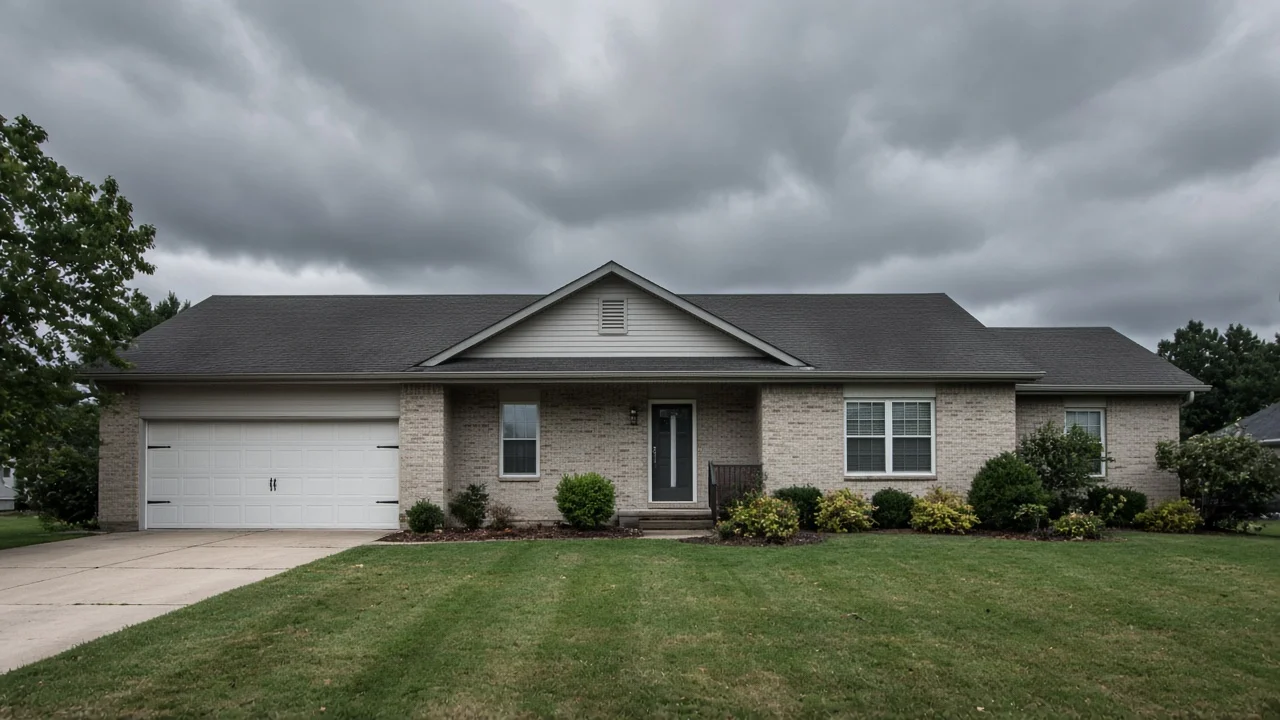
Take a 3-bedroom, 1.5-bath brick ranch on the south side of Indianapolis in a stable rental neighborhood.
| Line item | Figure |
|---|---|
| Purchase price | $215,000 |
| Loan amount at 80 percent LTV | $172,000 |
| Rate (30-year fixed DSCR) | 7.50 percent |
| Monthly principal and interest | $1,203 |
| Marion County property tax (annual $2,580, under the 2 percent cap) | $215 per month |
| Landlord insurance (annual $1,500) | $125 per month |
| Association dues | $0 |
| Total PITIA | $1,543 per month |
Market rent for this property is $1,750.
DSCR = $1,750 / $1,543 = 1.13
That is just under a common 1.15 threshold, which means the lender may reduce leverage or adjust pricing. Now see how insurance changes the outcome. If the roof is 18 years old and the only quote you can bind is $2,100 a year, the insurance line rises to $175 per month, PITIA climbs to $1,593, and DSCR falls to 1.10. The property has not changed; the insurance quote moved the loan terms.
Reverse it. If you replace the roof for $9,000 before closing and bind a $1,200 policy, insurance drops to $100 per month, PITIA is $1,518, and DSCR improves to 1.15. The roof replacement pays for itself in insurance savings over several years and makes the property easier to finance and refinance. Test these scenarios in the DSCR calculator.
Ways to bring an Indiana premium down
- Document the roof. Age, material, and the installer’s invoice. A roof under 10 years is the biggest single credit in Indiana.
- Replace Federal Pacific or Zinsco panels. Several carriers will not write them at all; others surcharge heavily. A new 200-amp panel costs far less than years of surcharges.
- Choose a $5,000 all-peril deductible and keep the reserve to cover it. Lenders accept it.
- Consider a 1 percent wind-and-hail deductible only if you have cash reserves for a roof. On a $200,000 dwelling limit that is $2,000 out of pocket per hail claim.
- Buy an umbrella. A $1,000,000 umbrella over a portfolio of Indianapolis rentals is less expensive than raising liability on each policy.
- Install water-leak and freeze sensors, especially in Fort Wayne and Northwest Indiana rentals.
- Schedule multiple properties on one policy once you reach three or more. Scheduled policies often price 10 to 20 percent lower per door and simplify lender paperwork.
- Compare at least three carriers. Indiana’s dwelling fire market is competitive and quotes vary widely on the same address.
Indiana landlord insurance pre-closing checklist
- Confirm the FEMA flood zone and order flood coverage if the map requires it.
- Collect three DP-3 quotes with replacement-cost dwelling coverage and 12 months loss of rents.
- Verify the roof coverage basis and the wind-and-hail deductible amount.
- Confirm liability meets the lender minimum, or add an umbrella.
- Add the lender’s mortgagee clause exactly as written.
- Confirm the property’s tax bill under Indiana’s non-homestead cap, not the seller’s homestead bill.
- Run full PITIA and verify DSCR clears the lender’s floor with the actual bound premium.
- Deliver the binder and paid receipt to the title company at least 5 business days before closing.
Need an Indiana quote or a second look at a declarations page before closing? Submit the rental property insurance request or call (833) 264-7776.