Insurance is the carry cost DC investors most often guess at. Purchase price gets negotiated, rehab gets bid, taxes get pulled from the OTR record, and insurance gets penciled in at some round number from a different market. On a 100-year-old rowhouse with a tenant in the English basement and a block that backs up to the Anacostia, that guess can be off by thousands of dollars a year, and the difference flows directly into whether the deal clears a DSCR loan.
This page covers what landlord insurance actually costs in the District, which features of DC housing stock move the quote, how flood exposure along the Potomac and Anacostia changes the picture, what lenders require before closing, and a worked example that shows the premium hitting the coverage ratio. For a general primer on coverage types, start with our investment property insurance overview, and run your own numbers in the landlord insurance cost calculator.
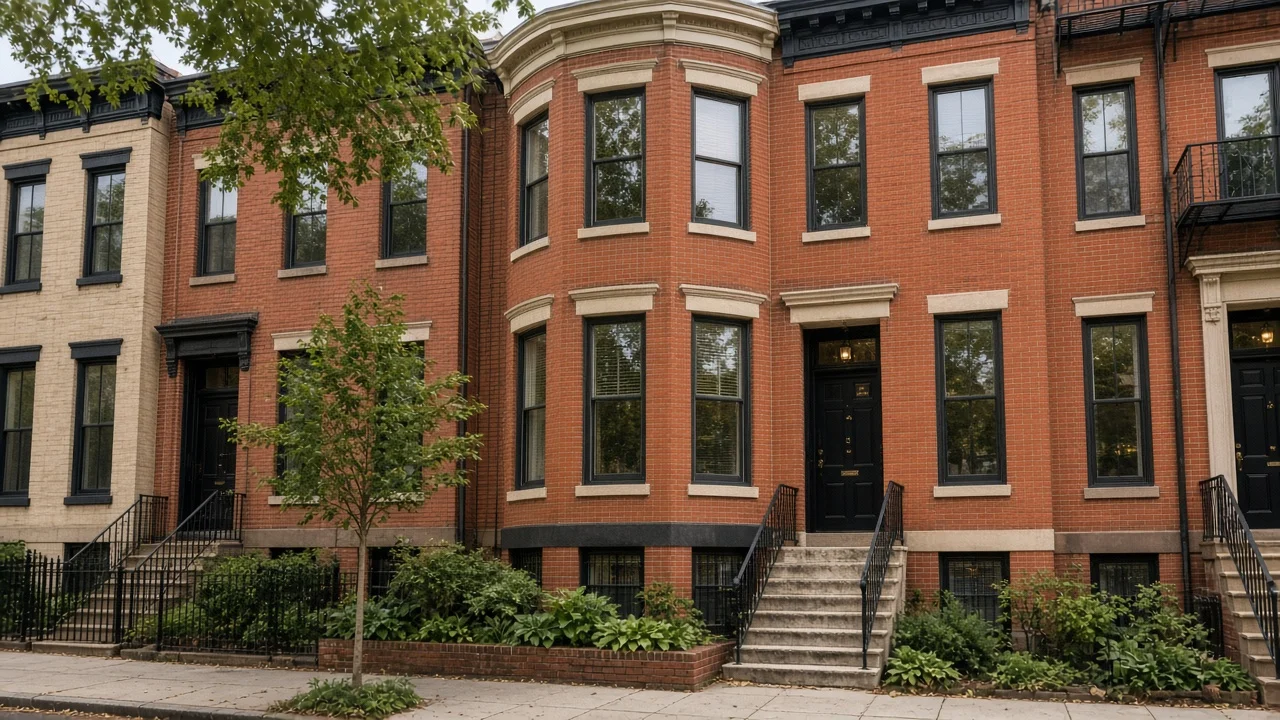
What landlord insurance costs on a DC rowhouse
A standard landlord policy, usually written on a DP-3 dwelling fire form, covers the structure on an open-perils basis, offers liability protection, and typically includes a loss-of-rents provision that pays when a covered loss makes the unit uninhabitable. The Insurance Information Institute notes landlord policies generally run higher than a comparable homeowners policy because the owner is not on site and tenant occupancy carries more risk.
For DC specifically, a typical rowhouse quote in 2026 tends to land between $1,800 and $3,600 per year for the base landlord policy, consistent with the range we use in our DC insurance and vacancy cost math guide. Where you fall inside that band depends on a handful of variables that carriers weigh heavily in older urban housing:
- Age and systems. Much of the District’s rowhouse stock dates to 1890–1940. Carriers ask about electrical (fuse panels and knob-and-tube wiring are frequent decline or surcharge triggers), plumbing material, heating type, and roof age. A flat or low-slope roof past 15–20 years is a common reason for a higher premium or an actual-cash-value roof endorsement.
- Replacement cost. DC rebuild costs per square foot run well above national averages, and a party-wall rowhouse carries extra demolition and shoring complexity. Underinsuring to save premium can trigger coinsurance penalties at claim time.
- Claims history. A prior water or theft claim on the property or in your name, reported through the CLUE database, follows the address for several years.
- Unit count and occupancy. A legal two-unit (main house plus basement) prices differently from a single-family rental. Short-term or mid-term rental use needs separate disclosure and often a different form.
- Liability limits. Most lenders accept $300,000, but with tenants on multiple floors and a street-level entrance, many investors carry $500,000 or $1 million, or add an umbrella.
The District’s insurance regulator is the DC Department of Insurance, Securities and Banking (DISB), which licenses carriers and agents and handles consumer complaints. Its consumer pages are a reasonable place to verify a carrier or broker before you bind.
The English basement variable
The English basement is DC’s signature income unit and its most frequent insurance surprise. A below-grade apartment carries three distinct exposures carriers care about: water intrusion from grading and foundation seepage, sewer and drain backup from the combined sewer system, and liability tied to egress and tenant safety.
Three practical rules:
- Disclose the unit. If the policy is written for a single-family rental and the carrier later learns a tenant lives downstairs, you have handed them a misrepresentation argument on any claim. The policy should reflect the actual number of units.
- Buy the sewer and drain backup endorsement. Standard dwelling forms exclude water that backs up through sewers or drains. This endorsement is inexpensive relative to a finished-basement loss, but limits are often capped at $5,000–$25,000 unless you ask for more. In Bloomingdale, LeDroit Park, and parts of Petworth and Columbia Heights, where storm surcharge in the combined sewer system has flooded basements historically, treat this as mandatory.
- Separate the legality question from the insurance question. A flood quote does not make a basement a legal rental. Our DC English basement ADU financing guide covers certificate of occupancy, egress, and ceiling-height requirements, and the basement flood risk underwriting guide walks through modeling the downside.
Carriers price these units with the rest of the building, so the effect shows up as a higher base premium plus the endorsement cost rather than a separate line item. Budget conservatively.
Flood exposure near the Anacostia and Potomac
DC has two flood problems that do not overlap neatly. The first is riverine and tidal flooding along the Potomac and Anacostia, which FEMA maps as Special Flood Hazard Areas. Low-lying sections of Southwest, Navy Yard and Buzzard Point, parts of Anacostia and Kingman Park near the river, and Federal Triangle carry mapped risk. The second is interior stormwater flooding, where heavy rain overwhelms drainage well away from either river. The District’s Department of Energy and Environment maintains its own Flood Risk Tool precisely because FEMA maps do not capture all of that stormwater exposure.
What this means for cost:
- Inside a mapped high-risk zone (Zone A or AE), any federally regulated or insured lender must require flood insurance, and most DSCR lenders apply the same rule. The FEMA Flood Map Service Center is the place to pull the official determination. Pricing under the National Flood Insurance Program’s Risk Rating 2.0 is building-specific, so two rowhouses on the same block can quote differently based on elevation and first-floor height. NFIP residential coverage is capped at $250,000 for the building and $100,000 for contents, which may be below replacement cost on a DC rowhouse; private flood can fill the gap.
- Outside the mapped zone, flood coverage is optional but worth pricing. A preferred-risk NFIP policy on a moderate-to-low-risk property is often the cheapest water coverage you can buy, and a finished, tenant-occupied basement is the exact asset it protects.
- Flood and sewer backup are not the same coverage. Flood policies respond to surface water from outside. Sewer backup endorsements respond to water coming up through the drains. A DC basement can need both, and neither is included in a base landlord form.
If you need flood coverage placed quickly ahead of a closing, use our flood insurance request form.
What DC lenders require
Whether you close with a bridge loan, hard money, or a 30-year DSCR product, the insurance conditions look similar. Expect the following before funds release:
- Dwelling coverage at replacement cost, at or above the loan amount or the full insurable value of the structure, whichever the program specifies.
- Lender named as mortgagee with a standard mortgagee clause and loss-payee language, plus 30-day cancellation notice.
- Liability coverage with a stated minimum, commonly $300,000 per occurrence on 1–4 unit files.
- Loss of rents coverage, often six to twelve months, since the lender’s repayment source is the rent.
- Flood insurance when the property is in a Special Flood Hazard Area, with the lender named.
- Builder’s risk or vacant dwelling coverage if the property is unoccupied or under renovation at closing. Standard landlord forms restrict or void coverage after a vacancy period, usually 30 or 60 days. Our fix-and-flip insurance request form handles this for rehab files.
If a borrower lets coverage lapse, the servicer can buy force-placed insurance and charge it back, almost always at a much higher premium with narrower coverage. The Consumer Financial Protection Bureau has rules governing how servicers must notify borrowers before doing that, but the practical lesson is to keep the policy continuous and send the renewal declarations page to the lender every year.
For DC-specific loan programs where these conditions apply, see our pages on DSCR loans for DC multi-family, hard money lenders in Washington DC, and bridge loans in Washington DC. To request a landlord policy quote directly, use the investment property insurance request form.
Rent control and the premium you cannot pass through
Insurance in DC interacts with rent regulation in one specific way: on a rent-stabilized unit, a premium increase cannot simply be pushed to the tenant. Under the Rental Housing Act, annual increases on covered units are capped by formula, and most buildings built before 1976 that are not held by a qualifying small landlord fall under those caps. Properties owned by natural persons with four or fewer rental units in the District, and buildings with a certificate of occupancy after 1975, are among the common exemptions, but the exemption must be registered with the Rental Accommodations Division to count.
The consequence for underwriting: on a non-exempt building, a $1,000 insurance increase is a $1,000 NOI decrease, full stop. On an exempt building, you have the option to adjust rent at turnover or renewal. Our DC rent control exemptions guide for small landlords explains how the LLC ownership structure can accidentally forfeit the small-landlord exemption, which is worth reading before you title the property.
Worked DSCR example: Petworth rowhouse with basement unit
Assume a two-unit rowhouse in Petworth, purchased and stabilized, with the following figures. Rates and terms below are illustrative; Jaken Finance Group DSCR loans currently price from 5.75% to 10.5% depending on leverage, credit, and property.
- Value: $750,000
- Loan: 75% LTV, $562,500, 30-year fixed at 7.25%
- Rents: $3,400 main house plus $1,900 English basement, $5,300 total
- Property tax: Class 1 rate of $0.85 per $100 on a $700,000 assessment, about $5,950 per year ($496 per month)
Scenario A: base landlord policy, no flood exposure. Premium $2,800 per year ($233 per month). Principal and interest on $562,500 at 7.25% is roughly $3,837 per month. PITIA comes to about $4,566. DSCR = $5,300 ÷ $4,566 = 1.16.
Scenario B: older systems, sewer backup endorsement, higher liability. Premium $4,200 per year ($350 per month). PITIA rises to about $4,683. DSCR = 1.13.
Scenario C: Scenario B plus a flood policy. Add $1,200 per year for an NFIP or private flood policy ($100 per month). PITIA is about $4,783. DSCR = 1.11.
Between A and C the rent did not change, the price did not change, and the loan did not change, yet the coverage ratio fell by five hundredths. On a program with a 1.15 minimum at 75% LTV, Scenario A clears and Scenarios B and C do not. The lender’s response is to cut leverage until the ratio works, meaning more cash at closing. Running the insurance quote before you lock the offer price, not after, is how you avoid that call two weeks before settlement.
This is the same math we walk through in the DC rowhouse DSCR hold guide. Use the landlord insurance cost calculator to test your own premium assumptions against rent and payment.
Ways DC investors lower the premium without thinning coverage
- Raise the deductible. Moving from $1,000 to $2,500 or $5,000 often produces a meaningful cut, and most investors self-insure small losses anyway to protect the CLUE record.
- Document system updates. A four-point style inspection showing updated electrical, plumbing, HVAC, and roof can move a property from surplus-lines pricing to a standard carrier.
- Fix the water path. Regrading, a backwater valve on the sewer lateral, a sump with battery backup, and window-well covers reduce both the risk and, with some carriers, the price. They also strengthen a flood underwriting file.
- Bundle the portfolio. Investors with several DC doors often do better on a commercial package or a master landlord policy than on individual DP-3s.
- Shop through a broker with surplus-lines access. Older rowhouses with basement units sometimes land in the excess and surplus market, where pricing varies widely by carrier. The National Association of Insurance Commissioners consumer resources explain how surplus lines differ from admitted carriers and what protections you give up.
Where to start
Pull the FEMA map and the DOEE flood layer for the address, get a landlord quote with the basement unit disclosed and the sewer backup endorsement priced, confirm the rent control status of the building, and only then finalize your DSCR sizing. If you want a quote placed alongside your loan file, submit the investment property insurance request and our team will coordinate the mortgagee clause and binder with the closing.