Missouri rewards investors who do their homework on the expense side, and insurance is where that homework matters most. The state offers two of the country’s most affordable large metro rental markets in St. Louis and Kansas City, a legal framework that favors lenders and landlords, and rent-to-price ratios that still make DSCR math work. It also sits in the heart of the severe weather belt, which means the landlord insurance premium on a Missouri rental can be a larger share of your operating budget than it would be on a similar property in a calmer region. This guide walks through what Missouri landlord insurance costs, which perils push the premium, what your lender needs to see on the policy, and how it all flows through a St. Louis two-family PITIA calculation.
If you want the fundamentals first, read the investment property insurance guide. For a fast estimate, try the landlord insurance cost calculator. To get a real Missouri quote, submit the rental property insurance request or call (833) 264-7776.
The St. Louis brick two-family
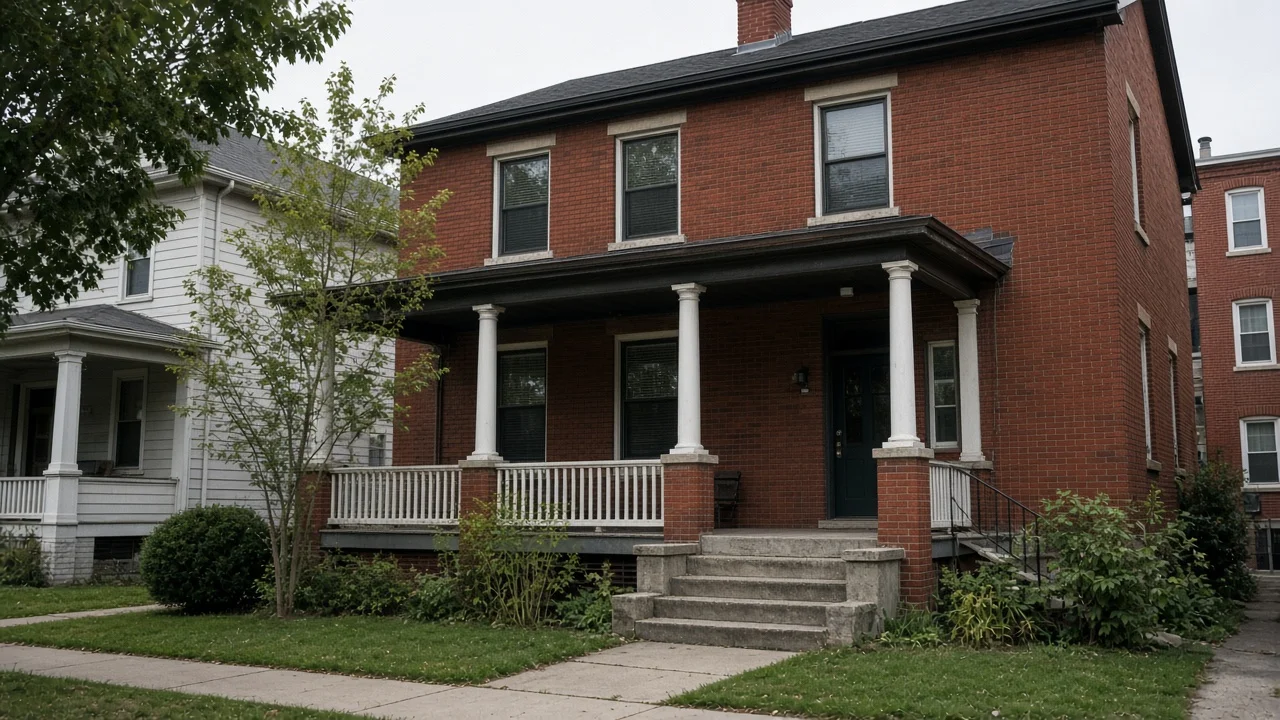
No property type defines Missouri rental investing like the St. Louis brick two-family. Built mostly between 1890 and 1930 across South City, the Central West End, Tower Grove, Dutchtown, and the near north side, these buildings are side-by-side or stacked duplexes with solid masonry walls, flat or shallow-pitched roofs, and basements that were never designed to be dry. Investors love them because they can be bought for $150,000 to $350,000 depending on the neighborhood and often rent for $1,000 to $1,400 per unit.
Carriers see a different set of facts. A 120-year-old masonry structure has a replacement cost that routinely exceeds its market value, sometimes by a wide margin. The flat roof is a membrane or built-up system with a shorter service life than pitched shingles. Plumbing is often a mix of original galvanized, mid-century copper, and newer PEX. Electrical may include a 60-amp or 100-amp service that needs upgrading. And there are two tenant households sharing walls, a basement, and a rear yard, which raises liability exposure.
None of this makes a two-family uninsurable. It does mean the premium will be higher than a frame single-family rental in St. Louis County and that the underwriter will ask detailed questions about roof age, service panel, and whether the units are separately metered. Have the answers ready and the quotes come back cleaner.
Missouri perils: tornado, hail, and water
Missouri averages dozens of tornadoes per year and has produced several of the most destructive single tornadoes in modern U.S. history, including the 2011 Joplin storm. The Insurance Information Institute reports that severe convective storms have become the dominant source of insured catastrophe losses nationally, and Missouri’s position between the Plains and the Ohio Valley puts it in the path of those systems every spring.
Hail is the more frequent event. The Kansas City metro in particular records repeated large-hail events that generate thousands of roof claims. Carriers writing in Jackson, Clay, and Platte counties have responded with percentage wind-and-hail deductibles and actual-cash-value roof schedules on older homes. St. Louis sees hail as well, though somewhat less often, and the flat roofs on two-families are more vulnerable to ponding and membrane damage after a storm than to hail impact itself.
Water is the third peril, and in St. Louis it comes from below as much as above. Older basements, combined sewers, and clay lateral lines produce sewer backup and seepage losses that standard policies exclude. A sewer and drain backup endorsement typically adds a modest amount to the premium and is worth buying on nearly every St. Louis two-family. Winter freeze is milder than in the northern Midwest but still produces burst-pipe claims in vacant units, especially in buildings where one side is empty between tenants.
Typical Missouri landlord insurance premiums
Missouri dwelling fire premiums track slightly below the national average, but the spread between a clean newer rental and an older urban two-family is wide. The NAIC Dwelling Fire, Homeowners Owner-Occupied, and Homeowners Tenant Insurance Report gives state-level average dwelling fire premiums, and the Missouri Department of Commerce and Insurance publishes market share and complaint data for property carriers operating in the state. Combining those sources with current investor quotes:
| Property type | Area | Typical annual premium | Main cost drivers |
|---|---|---|---|
| Single-family rental, built after 1990 | St. Charles, Jefferson, Platte counties | $1,000 to $1,800 | Newer roof, protection class, deductible |
| Single-family rental, 1950s to 1970s | St. Louis County, Kansas City suburbs | $1,400 to $2,600 | Roof age, hail history, prior claims |
| Brick two-family, updated systems | St. Louis City | $1,900 to $3,000 | Replacement cost, flat roof, two units |
| Brick two-family, original systems | St. Louis City | $2,600 to $3,900 | Service panel, galvanized plumbing, vacancy |
| Four-family or small multifamily | St. Louis, Kansas City, Columbia | $3,200 to $6,000 | Unit count, ordinance-or-law, sprinklers |
| Rental in high-hail zone | Kansas City metro, Springfield, Joplin | $1,700 to $3,200 | Percentage hail deductible, ACV roof schedule |
These figures assume DP-3 open-perils coverage at replacement cost, a $2,500 deductible, $300,000 liability, and 12 months of loss-of-rent coverage. Adding sewer backup is common on St. Louis quotes. A $5,000 deductible or a 1 percent wind-and-hail deductible can lower the premium by 8 to 15 percent.
Missouri also allows carriers to use credit-based insurance scores in rating, so an investor with strong personal credit may see noticeably lower quotes than the ranges above, while a newer LLC with thin credit history may see higher.
Flood risk along two great rivers
Flood is excluded from every landlord policy, and Missouri has serious riverine flood exposure. The Missouri and Mississippi rivers meet just north of St. Louis, the Meramec floods South County and Jefferson County, and the Missouri River bottoms around Kansas City and St. Charles have flooded repeatedly. Check every address at the FEMA Flood Map Service Center. A property in Zone A or AE will need flood insurance to close with any lender. Most St. Louis City two-families sit on higher ground in Zone X, but the near-river neighborhoods and parts of the Metro East are exceptions. Order a quote through the flood insurance request.
Lender requirements on a Missouri rental
Missouri is a deed-of-trust state with non-judicial foreclosure, which gives lenders a faster remedy if a loan defaults. That makes some national DSCR lenders more comfortable lending in Missouri, but it does not loosen their insurance requirements. The full list is in our rental property insurance lender requirements guide. For Missouri files, focus on these:
- Dwelling coverage at full replacement cost or at least the loan amount. On a St. Louis two-family, replacement cost from the carrier’s estimator can run $350,000 or more on a building that sold for $240,000. Lenders accept the estimator; do not try to insure to purchase price.
- DP-3 open-perils form. Named-perils or ACV-only policies are generally declined.
- Loss of rents for 6 to 12 months covering both units.
- Liability of at least $300,000, with $500,000 or $1,000,000 preferred on 2 to 4 units.
- Mortgagee clause with the exact lender name, ISAOA/ATIMA, and loan number.
- Deductible cap, typically 5 percent of dwelling coverage or $10,000, whichever is less. A 2 percent hail deductible on a $350,000 dwelling limit is $7,000 and usually passes.
- Flood when the FEMA zone requires it.
- Sewer backup endorsement is not a lender requirement but is strongly recommended on St. Louis properties.
- Occupancy status. If one side of a two-family is vacant at closing, expect a vacancy endorsement or a signed lease to be requested.
Escrow practices vary. The U.S. Department of Housing and Urban Development and the Consumer Financial Protection Bureau set the federal framework for escrow analysis and servicing, and most DSCR servicers escrow both taxes and insurance by default. Tell your loan officer early if you want to pay the premium directly.
For stabilized Missouri rentals, see DSCR loans in Missouri at 5.75% to 10.5%. If you are buying a two-family that needs a full renovation before it leases, fix and flip loans in Missouri at 8.99% to 13.5% will require a builder’s risk or vacant dwelling policy during the project; request it through the fix and flip insurance request.
Worked example: St. Louis two-family PITIA and DSCR
Assume a stacked brick two-family in Tower Grove South with updated electrical, a 7-year-old membrane roof, and both units leased.
| Line item | Figure |
|---|---|
| Purchase price | $240,000 |
| Loan amount at 75 percent LTV | $180,000 |
| Rate (30-year fixed DSCR) | 7.375 percent |
| Monthly principal and interest | $1,243 |
| St. Louis City property tax (annual $2,900) | $242 per month |
| Landlord insurance with sewer backup (annual $2,100) | $175 per month |
| Association dues | $0 |
| Total PITIA | $1,660 per month |
Rents: the first-floor unit leases at $1,150 and the second-floor unit at $1,100, for $2,250 gross.
DSCR = $2,250 / $1,660 = 1.36
That is a comfortable margin, which is typical of why investors like St. Louis two-families. Now stress the insurance line. If the roof were 22 years old and the best quote came in at $3,300 with an ACV roof schedule, insurance would be $275 per month, PITIA would rise to $1,760, and DSCR would drop to 1.28. Still fine for most lenders, but you would carry $1,200 more in annual expense and face a depreciated payout on the next hail or membrane claim. Spending $12,000 on a new roof before closing would pull the premium back down and restore replacement-cost coverage on the roof. Work through your own numbers in the DSCR calculator.
Lowering a Missouri premium while keeping the lender happy
- Replace or document the roof. On a two-family, a new membrane roof with a manufacturer warranty is the biggest single credit and often converts an ACV roof schedule back to replacement cost.
- Upgrade the electrical service. A 200-amp panel with separate meters per unit improves both the quote and tenant utility billing.
- Add sewer backup coverage. It costs little and prevents the most common uncovered St. Louis loss.
- Choose a $5,000 all-peril deductible if you hold reserves. Lenders accept it.
- Take a 1 percent wind-and-hail deductible only in Kansas City or Springfield if the savings are substantial and you have reserves for a roof.
- Buy an umbrella rather than raising liability on each dwelling policy once you own more than two buildings.
- Keep both units occupied or notify the carrier. Vacancy over 30 to 60 days voids coverage on most forms.
- Shop at least three carriers. Missouri’s dwelling fire market includes several regional carriers that price older masonry better than national brands.
Missouri landlord insurance checklist before closing
- Check the FEMA flood zone and order flood coverage if required.
- Gather three DP-3 quotes with replacement-cost dwelling coverage, sewer backup, and 12 months loss of rents.
- Confirm the roof coverage basis and the wind-and-hail deductible.
- Verify liability meets the lender minimum or add an umbrella.
- Insert the mortgagee clause exactly as the lender provides it.
- Confirm the St. Louis City or county tax bill for a non-owner-occupied property.
- Compute PITIA with the bound premium and confirm DSCR clears the lender floor.
- Send the binder and paid receipt to the title company at least 5 business days before funding.
For a Missouri quote or a review of a declarations page against your loan terms, submit the rental property insurance request or call (833) 264-7776.