Oklahoma is the state where the rent-to-price ratio looks wonderful on a spreadsheet and then the insurance quote arrives. A $185,000 brick ranch in south Oklahoma City rents for $1,450 a month — a gross yield most coastal investors would envy — and insures for $1,000 to $1,400 a year, roughly what a $300,000 house costs to insure in a calmer state. The premium is high because the losses are high: Oklahoma sits at the center of Tornado Alley and in one of the densest hail corridors on the continent, and carriers price a $185,000 roof the same whether the house underneath it is cheap or expensive.
That makes landlord insurance cost in Oklahoma a cash-flow question, not a paperwork question. This page covers what Oklahoma City and Tulsa rentals actually cost to insure, how tornado and hail exposure shape policy terms, what happens when a standard carrier declines, and how to run the rental math so the premium does not sink a DSCR approval. For the policy basics and lender requirements that apply everywhere, see our investment property insurance guide, then test an Oklahoma address in the landlord insurance cost calculator.
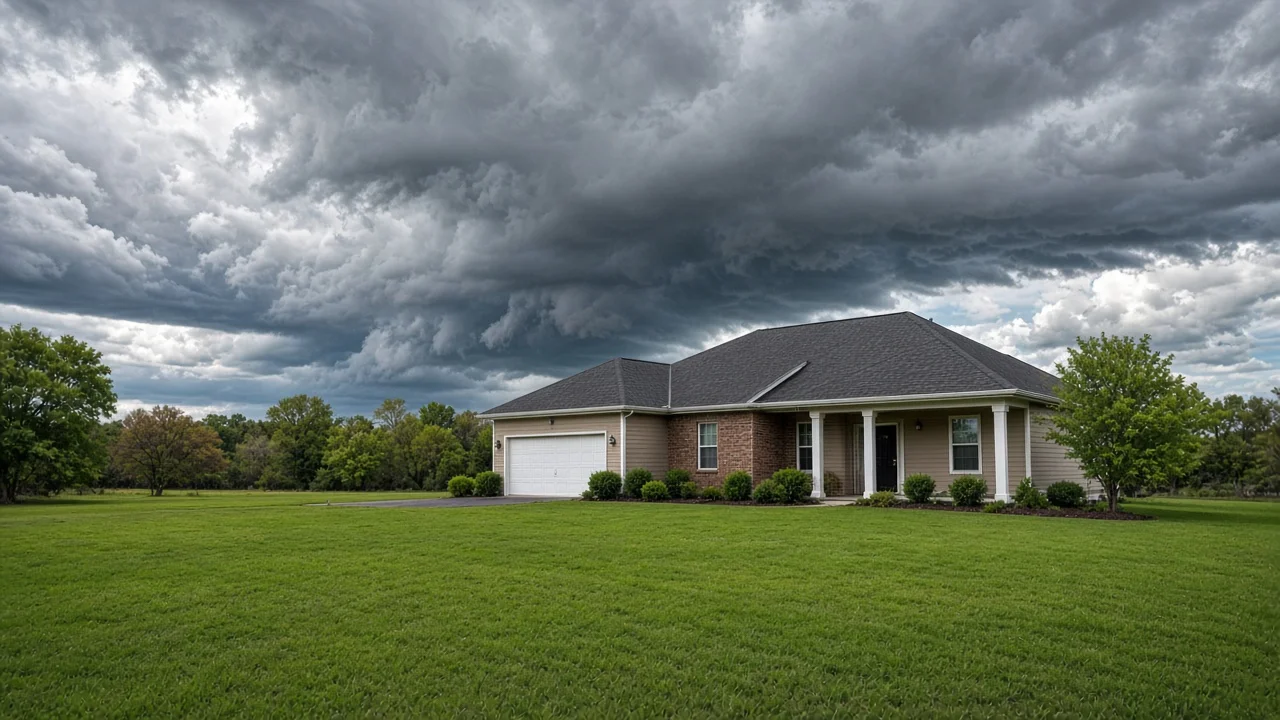
Why Oklahoma premiums rank near the top nationally
Reports from the National Association of Insurance Commissioners and the Insurance Information Institute have repeatedly placed Oklahoma among the three or four most expensive states for average homeowners premium, alongside Florida, Louisiana, and Texas — despite Oklahoma home values sitting well below the national median. Landlord dwelling-fire policies follow the same loss curve with an occupancy surcharge.
The reasons are physical, not regulatory:
- Tornado frequency. Oklahoma averages dozens of tornadoes a year, and the Oklahoma City metro has taken multiple violent tornadoes in the past three decades, including the 1999 Bridge Creek–Moore and 2013 Moore EF5 storms. Carriers model total-loss probability here that most states never see.
- Hail. Severe hail reports from the NOAA Storm Prediction Center consistently rank Oklahoma near the top per square mile. Hail damages roofs, siding, windows, and HVAC condensers, and roof claims are the most frequent and expensive claim category in the state.
- Straight-line wind. Derechos and downbursts cause widespread roof and fence damage even when no tornado forms.
- Reinsurance. Global reinsurers repriced Midwest severe convective storm risk sharply after record 2023 losses, and Oklahoma carriers passed the increase through at renewal.
The practical outcome for a landlord: roof age, roof material, and deductible structure dominate the quote more than the neighborhood.
Oklahoma City and Tulsa: the rental math with insurance included
Oklahoma’s two major metros contain most of the state’s rental investment, and they price similarly on insurance. Here is how the premium fits into a typical acquisition in each.
| Input | Oklahoma City (south OKC / Moore) | Tulsa (midtown / Broken Arrow) |
|---|---|---|
| Purchase price | $185,000 | $205,000 |
| Replacement cost (dwelling) | $210,000 | $225,000 |
| Monthly rent | $1,450 | $1,550 |
| Estimated annual landlord premium | $800–$1,300 | $855–$1,395 |
| Premium as % of gross rent | 4.6%–7.5% | 4.6%–7.5% |
| Property tax (estimated ~1.0% effective) | $1,850 | $2,050 |
In a lower-risk state, insurance typically consumes 3 to 4 percent of gross rent on a single-family rental. In Oklahoma it runs closer to 5 to 8 percent, and older roofs push it higher. On a thin-margin rental that difference is the gap between positive and negative monthly cash flow after reserves.
Oklahoma City notes
The south metro — Moore, Norman, Del City, Midwest City — carries the heaviest tornado history, but carriers rate the whole metro for severe convective storm, so premiums do not vary much by suburb. Where they do vary is construction: brick veneer, hip roofs, and post-2010 construction price better than frame siding and gable roofs. Northwest OKC and Edmond offer newer housing stock, which helps the quote even though purchase prices are higher.
Tulsa notes
Tulsa’s older midtown housing stock — 1920s to 1950s bungalows near Cherry Street and Brookside — produces premium surcharges for roof age, older wiring, and galvanized plumbing. Broken Arrow, Owasso, and Bixby have newer stock that insures more cheaply. Tulsa also has a river-and-creek flood footprint along the Arkansas River and tributaries; check the FEMA Flood Map Service Center for properties in Sand Springs, Jenks, and parts of west Tulsa before assuming flood is optional.
How tornado and hail exposure changes the policy terms
Oklahoma’s peril mix changes not only the price but the structure of the landlord policy. Four features show up in nearly every quote.
Separate wind-hail deductible. Nearly all Oklahoma dwelling forms apply a percentage deductible — most commonly 1 or 2 percent of Coverage A — to wind and hail losses, with a flat deductible for everything else. On a $225,000 Tulsa rental, 1 percent is $2,250 and 2 percent is $4,500. Some carriers now offer 5 percent options at a tempting discount; for a landlord, that effectively self-insures every hail event short of a tornado.
Roof settlement terms. Carriers increasingly write roofs over 10 to 15 years old on an actual-cash-value basis, which depreciates the payout for age. A 2007 roof replaced after a 2027 hail storm might recover half its replacement cost. Replacement-cost roof coverage is worth the premium difference on any rental you plan to hold.
Cosmetic damage exclusions. Several carriers exclude cosmetic hail damage to metal roofs and siding — dents that do not cause leaks. Read the endorsement before buying a rental with a metal roof.
Matching and ordinance coverage. When hail destroys half a roof or siding elevation, the carrier may pay only for the damaged portion unless the policy includes matching coverage. Ordinance-or-law coverage pays for code upgrades required during repair, which matters on older Tulsa housing.
No FAIR plan: what happens when a carrier declines
Unlike coastal states with wind pools, Oklahoma has no FAIR plan or state-backed insurer of last resort. The Oklahoma Insurance Department regulates the market but does not run a residual pool. For investors this has two consequences.
First, a rental that standard carriers decline — because of a roof past 20 years, prior claims on the address, extended vacancy, or an open rehab — goes to the surplus-lines (non-admitted) market. Surplus-lines policies are legitimate and lenders accept them, but premiums commonly run 50 to 150 percent above standard-market rates, and the forms may carry narrower coverage. Budget accordingly during a flip or a stabilization period.
Second, staying in the standard market is a management discipline. Replace roofs on a schedule, avoid small claims that stain the loss run, keep vacancy inside policy limits with a vacancy permit when a unit sits empty, and document maintenance. Those habits save more premium in Oklahoma than in almost any other state.
FORTIFIED roofs and Oklahoma’s incentive program
Oklahoma is one of a handful of states where the legislature has directed insurers to offer premium discounts for roofs built to the IBHS FORTIFIED standard. A FORTIFIED Roof adds a sealed roof deck, ring-shank nails, enhanced edge metal, and impact-resistant shingles — the components that most often fail in hail and high wind. The Oklahoma Insurance Department launched the Strengthen Oklahoma Homes grant program to help homeowners fund FORTIFIED re-roofs; eligibility has focused on owner-occupied homes, so verify current rules before counting on grant funds for a rental.
Even without a grant, the math favors FORTIFIED on a buy-and-hold. The incremental cost over a standard re-roof is modest relative to a $12,000 to $18,000 roof job, the premium credit recurs every year, and a sealed deck sharply reduces the interior water damage that turns a $9,000 roof claim into a $30,000 claim with lost rent. For investors buying older OKC or Tulsa houses through fix-and-flip loans in Oklahoma, building the FORTIFIED roof into the rehab scope and documenting it with the IBHS designation certificate makes the eventual DSCR refinance cheaper to insure.
Worked example: Moore single-family on a DSCR refinance
An investor bought a 1,500-square-foot brick ranch in Moore for $160,000, put $25,000 into a new FORTIFIED roof, HVAC, and cosmetics, and rented it for $1,450. The appraisal comes in at $215,000 and the investor refinances at 75 percent loan-to-value through a DSCR loan in Oklahoma at 7.5 percent on a 30-year fixed, inside the 5.75% to 10.5% DSCR range.
| Monthly line | With 2007 roof (actual cash value) | With new FORTIFIED roof |
|---|---|---|
| Principal and interest on $161,250 | $1,128 | $1,128 |
| Property tax (estimated) | $175 | $175 |
| Landlord insurance | $118 | $82 |
| PITIA | $1,421 | $1,385 |
| Rent | $1,450 | $1,450 |
| DSCR | 1.02 | 1.05 |
Neither version is a fat ratio — Oklahoma rentals at this price point rarely are — but the $36 monthly insurance savings moves the file from a borderline 1.02 to a 1.05 that clears most lenders’ minimum without pricing adjustments. At scale across a ten-door portfolio, that is $4,300 a year in premium and a cleaner approval on every refinance. Check your own figures in the DSCR calculator and size reserves for a 1 percent hail deductible per property with the DSCR reserves calculator.
What an Oklahoma lender requires at closing
For a long-term rental loan the binder must show a DP-3 or equivalent landlord form with replacement-cost dwelling coverage at or above the loan amount, loss-of-rents coverage of at least six months, premises liability of $300,000 or more, and a mortgagee clause naming the lender. Percentage wind-hail deductibles are acceptable to most DSCR lenders up to 2 percent; a 5 percent deductible may trigger a lender exception or additional reserve requirement. The checklist in rental insurance lenders require covers each field.
For a rehab loan through hard money lenders in Oklahoma, a builders risk or vacant-dwelling policy covers the construction period. Standard landlord forms suspend key coverages after 30 to 60 days of vacancy, so a four-month OKC rehab needs the right form from day one. Spring is Oklahoma’s peak severe-weather season, and several builders-risk carriers tighten terms from March through June; submit the fix-and-flip insurance request form at contract so the quote is in hand before closing.
Flood coverage is required only in a FEMA Special Flood Hazard Area, which in Oklahoma concentrates along the Arkansas, Canadian, and Cimarron river corridors and urban creeks. When required, the flood insurance request form gets the quote started.
Checklist: lowering landlord insurance cost in Oklahoma
- Re-roof to FORTIFIED at turnover and send the designation certificate to every carrier you quote.
- Choose Class 4 impact-resistant shingles if a full FORTIFIED package is out of budget; most carriers still credit the shingle rating.
- Prefer brick veneer and hip roofs when selecting properties; both price better and perform better in wind.
- Carry a 1 percent wind-hail deductible and hold that amount in reserves per door.
- Keep replacement-cost roof coverage on any hold longer than three years.
- Add matching and ordinance-or-law coverage on older Tulsa and OKC housing.
- Protect HVAC condensers with hail guards; condenser fin damage is a frequent small claim.
- Install leak sensors under water heaters and behind washers; non-weather water losses are the second most common claim.
- Require renters insurance in every lease and verify it annually.
- Avoid filing small claims. In a state with no FAIR plan, two claims in three years can push a property to surplus lines.
- Ask about a portfolio policy once you reach five or more doors; blanket limits and a single aggregate deductible can beat individual DP-3 pricing.
- Quote the policy before you write the offer, and run the DSCR with the real premium.
Where to verify Oklahoma insurance facts
- Oklahoma Insurance Department — consumer guides, rate and complaint data, Strengthen Oklahoma Homes program details.
- IBHS FORTIFIED Home — roof standards, evaluator directory, and designation process.
- NOAA Storm Prediction Center — tornado and hail climatology for central Oklahoma.
- National Weather Service Norman — local severe-weather history and seasonal outlooks.
- FEMA Flood Map Service Center — flood zone lookup for Tulsa and OKC river corridors.
- Insurance Information Institute — national premium comparisons and landlord coverage explainers.
Financing an Oklahoma rental once the premium is real
Oklahoma rewards disciplined operators: cheap entry prices, strong rent-to-price ratios, and a weather bill that punishes anyone who ignores the roof. Get the insurance quote first, confirm the deductible structure, and run the DSCR with the actual premium and a realistic reserve. Jaken Finance Group funds non-owner-occupied residential across Oklahoma — DSCR rental loans from 5.75% to 10.5% on 30-year terms, and fix-and-flip, bridge, and construction loans from 8.99% to 13.5% interest-only for the rehab and FORTIFIED re-roof phase.
If you also need coverage placed, start with the rental property insurance request form and we will coordinate the binder with the loan. Call (833) 264-7776 or email info@jakenfinancegroup.com with the address, the rent, and the roof age — those three facts determine most of what an Oklahoma rental will cost to carry.