South Carolina is two insurance markets sharing one state line. Inland, a landlord policy on a Greenville or Columbia rental looks like most of the country. Within thirty miles of the Atlantic, the same house carries a named-storm deductible, a wind policy that may come from the state’s Beach Plan, and a flood policy the lender will require before closing. Landlord insurance cost in South Carolina depends on which side of that line you buy.
This page covers what the policy costs on the properties investors actually buy in both markets, how Charleston flood works, what the Beach Plan is, and how the premium flows into a DSCR loans South Carolina ratio. Jaken Finance Group’s investment property insurance program quotes coastal and inland policies while the loan is in underwriting.
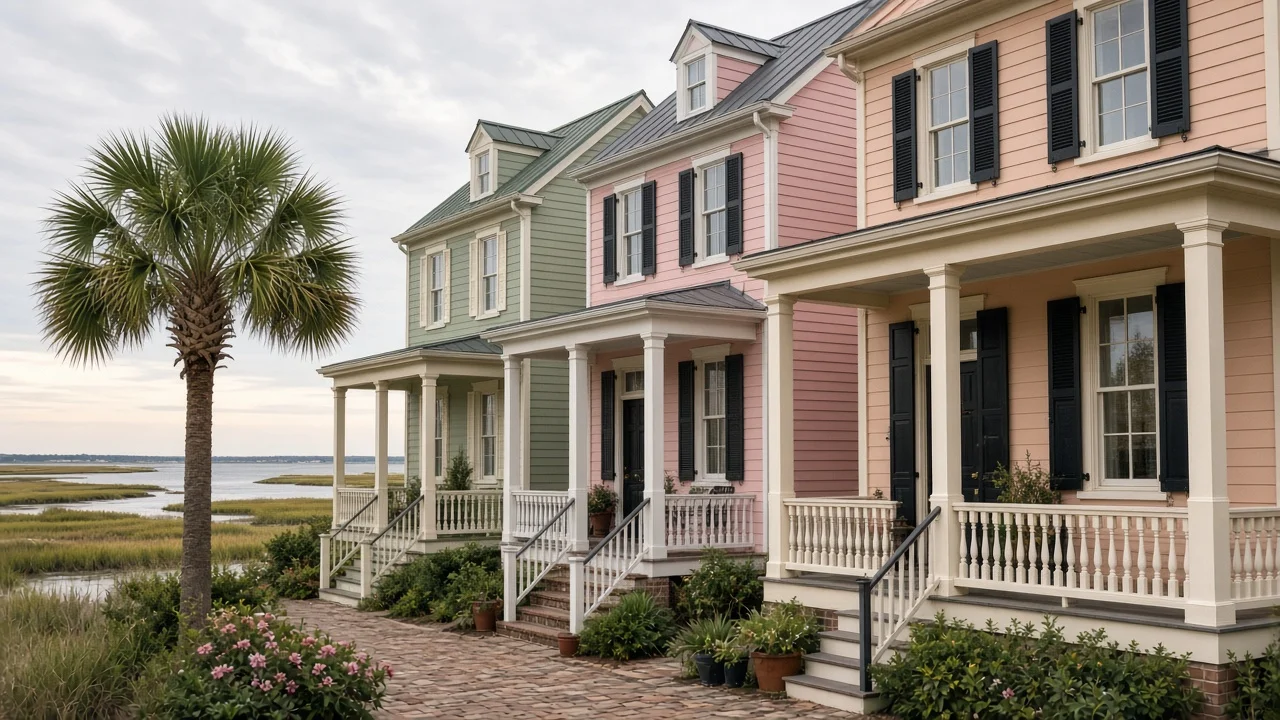
The coastal line and why it matters
The South Carolina Department of Insurance regulates the market and publishes consumer guides on coastal coverage. For a landlord, the practical boundary is the set of counties that carry named-storm exposure: Horry, Georgetown, Charleston, Berkeley, Dorchester, Colleton, Beaufort, and Jasper. Inside those counties, and especially east of Highway 17, three things change.
- Wind may be written separately. Private carriers that write fire on a near-beach house may exclude wind. You then buy wind from the state residual market.
- Named-storm deductibles replace flat deductibles. A percentage of the dwelling limit applies to any named-storm loss.
- Flood becomes a lender requirement on a large share of parcels rather than an option.
Inland, in Greenville, Spartanburg, Columbia, Rock Hill, and Aiken, none of that applies. You carry a standard dwelling fire policy with a wind and hail deductible, and the premium tracks the national market.
Illustrative premium bands for South Carolina rentals
These are planning bands drawn from investor quotes, not published averages. Use them to model, then pull quotes on the specific address.
| Property profile | Annual dwelling policy | Flood if required | Monthly in the DSCR stack |
|---|---|---|---|
| 1960s brick ranch, Greenville or Spartanburg, renovated | $1,600–$2,600 | Rarely | $135–$215 |
| 1990s SFR, Lexington County near Columbia | $1,500–$2,400 | Rarely | $125–$200 |
| 1970s brick ranch, Summerville or Goose Creek | $2,400–$3,800 | Sometimes | $200–$320 |
| 1950s frame SFR, North Charleston or West Ashley | $3,500–$6,500 | Often, $900–$2,500 | $370–$750 |
| Raised cottage, James Island or Johns Island, AE zone | $5,000–$9,000 | Required, $1,200–$3,500 | $520–$1,040 |
| Beach Plan wind plus ex-wind fire, Folly or Isle of Palms | $8,000–$15,000 | Required, $2,000–$5,000 | $830–$1,670 |
The landlord insurance cost calculator lets you change county, flood zone, and deductible and watch the monthly figure move. That figure belongs in your DSCR model, not a statewide average.
Charleston flood: the policy the lender asks about first
Charleston floods from three directions. Storm surge arrives with a hurricane. Tidal flooding arrives on a sunny day when a king tide backs up the drainage system on the peninsula and in parts of West Ashley. Rain flooding arrives when a summer storm drops several inches on flat ground that drains slowly. A landlord policy excludes all three. Only a flood policy responds.
Where the lender requires it. Any building touching a FEMA Special Flood Hazard Area, zones A, AE, or VE, must carry flood coverage at closing on a federally regulated or federally backed loan. Most DSCR lenders apply the same rule. Pull the parcel on the FEMA Flood Map Service Center before you go under contract, and ask for the elevation certificate if the seller has one.
What the federal program covers. The National Flood Insurance Program caps residential building coverage at $250,000 and contents at $100,000. Buildings with five or more units are rated as non-residential with a $500,000 building cap. Under Risk Rating 2.0, premiums reflect the structure’s elevation, distance to water, and rebuild cost, so a raised cottage on James Island and a slab house two streets over can quote very differently.
Community Rating System discounts. The City of Charleston and Charleston County participate in the NFIP Community Rating System, which lowers federal flood premiums for properties inside participating jurisdictions. Ask the agent whether the discount is applied.
Timing. A new federal flood policy generally carries a 30-day waiting period, waived when purchased in connection with a loan closing. Start the flood insurance request when you go under contract so the binder is ready with the closing package.
Private flood. A $600,000 raised cottage leaves a gap above the $250,000 federal cap. Private flood carriers and excess flood layers fill it, and lenders accept private flood that meets the federal equivalency standard.
The Beach Plan: South Carolina’s wind market of last resort
The South Carolina Wind and Hail Underwriting Association, usually called the Beach Plan, writes wind and hail coverage on property in designated coastal zones that private carriers decline. The association’s territory covers barrier islands and defined areas near the beach in the coastal counties. It is funded by member insurers and can assess them after a bad storm year.
For a landlord the mechanics look like this:
- You buy a fire policy that excludes wind from a private carrier.
- You buy a wind and hail policy from the Beach Plan on the same dwelling limit.
- The lender receives two declarations pages and two mortgagee clauses.
- The Beach Plan policy carries its own named-storm deductible, often higher than a standard carrier’s.
Beach Plan premiums are higher than a bundled policy, and coverage is narrower. Many Isle of Palms, Sullivan’s Island, Folly Beach, and Pawleys Island investors have no other wind option. Price it before you write the offer, not after the inspection.
The state’s SC Safe Home grant program funds wind-resistance upgrades, but it is limited to owner-occupied primary residences. Investors pay for their own retrofits and recover the cost through lower premiums and smaller claims.
Wind mitigation credits on the coast
South Carolina carriers offer premium credits for construction features that resist wind. They are not as standardized as Florida’s statutory form, but the same features count:
| Feature | Why it lowers the quote |
|---|---|
| Hip roof | Fewer uplift points than a gable |
| Roof-to-wall straps or clips | Keeps the roof on the walls in high wind |
| Secondary water barrier under the roof covering | Limits interior damage if shingles blow off |
| Impact-rated windows or code-approved shutters | Keeps pressure from building inside the house |
| Roof covering installed to the current code | Verified by permit date |
| Elevated first floor above base flood elevation | Lowers flood premium, sometimes wind too |
On a fix-and-flip in Charleston or Beaufort, the rehab is the moment to add straps and a peel-and-stick underlayment while the roof is open. Fold the cost into the fix and flip loans South Carolina scope, then get a second quote based on the finished house for the DSCR model.
Inland pricing: Greenville, Spartanburg, Columbia
The Upstate and Midlands are where South Carolina landlord insurance looks like the rest of the Southeast. Hail and straight-line wind are the dominant claims. Carriers respond with roof age limits, wind and hail deductibles of 1 to 2 percent of the dwelling limit, and actual cash value roof endorsements on older roofs.
The properties investors buy there, renovated mill-village houses near downtown Greenville, 1960s brick ranches in Spartanburg, 1990s SFR in Lexington and Richland counties, insure cleanly once the roof and systems are updated. Flood is rarely required outside the Saluda, Reedy, Congaree, and Broad river corridors.
That is why the same gross rent produces a stronger ratio inland. A $1,750 Greenville rent with a $190 insurance line clears a DSCR payment that a $1,750 North Charleston rent with a $550 combined wind and flood line cannot.
How the premium flows into a South Carolina DSCR loan
Underwriters subtract taxes, insurance, and HOA dues from rent before they compute the ratio. Here is the coast-versus-inland comparison on two houses with the same rent.
House A — Greenville, renovated 1960s brick ranch, 3/2: bought for $215,000, renovated for $45,000, appraised at $295,000, leased at $1,850 a month.
- Annual premium $2,200, or $183 a month, no flood
- Taxes $265 a month at the 6 percent assessment ratio that applies to non-owner-occupied property
- Rent $1,850, less 5 percent vacancy, equals about $1,758 effective
- Less insurance, taxes, 8 percent management at $148, and $110 maintenance leaves about $1,052 of monthly net operating income
House B — West Ashley, renovated 1950s frame SFR, 3/2, AE zone: bought for $310,000, renovated for $55,000, appraised at $410,000, leased at $2,350 a month.
- Annual wind-inclusive premium $4,800 plus flood $1,800, or $550 a month combined
- Taxes $480 a month at the 6 percent assessment ratio
- Rent $2,350, less 5 percent vacancy, equals about $2,233 effective
- Less insurance, taxes, 8 percent management at $188, and $130 maintenance leaves about $885 of monthly net operating income
At a 7.5 percent 30-year rate, a 1.0 ratio supports roughly $150,000 of debt on House A and roughly $127,000 on House B. House B cost $95,000 more to buy, rents for $500 more a month, and qualifies for a smaller loan. The insurance line is most of the reason.
Run both through the DSCR calculator with real quotes. The Jaken Finance Group DSCR program prices from 5.75%–10.5% and allows up to 85 percent of purchase on qualified files, but the ratio sets how much of that ceiling a coastal rent can reach.
Named-storm deductibles are a reserve requirement
A coastal South Carolina policy carries two deductibles: a flat all-other-perils deductible, often $1,000 to $2,500, and a named-storm deductible stated as a percentage of the dwelling limit. Two to five percent is common. Beach Plan policies can run higher.
On $400,000 of dwelling coverage:
- 2 percent named-storm deductible: $8,000 out of pocket
- 3 percent named-storm deductible: $12,000 out of pocket
- 5 percent named-storm deductible: $20,000 out of pocket
A higher deductible lowers the premium. It also means you need that cash the week after landfall, on top of the flood deductible if surge reached the house. Most lenders cap the acceptable named-storm deductible at 5 percent. Confirm the cap before you choose the cheaper policy, and hold the deductible in reserves beyond what the lender requires.
Builder’s risk during a Lowcountry rehab
A landlord policy does not respond to a vacant house under construction. Coastal builder’s risk in South Carolina is priced per month on the completed value and often carries its own named-storm deductible. Carriers also want to know whether the house will be dried in before hurricane season.
Order it before the hard money funds. The fix-and-flip insurance request form collects the scope, timeline, and lender mortgagee clause so the binder arrives with the closing package. Switch to the landlord form the day the lease is signed and send the new declarations page to the DSCR lender before the refinance appraisal.
What the lender reads on the declarations page
The rental property insurance lender requirements post walks through the declarations page in detail. On a South Carolina file, four lines get the most attention: replacement cost on the dwelling, 12 months of loss of rents, a named-storm or wind and hail deductible within the lender’s cap, and a flood policy whose building limit meets the lesser of the loan balance, the replacement cost, or the federal maximum. Send all of it with the lease, not after the appraisal comes back.
Where South Carolina sits against other states
The Insurance Information Institute and the NAIC dwelling fire and homeowners report place South Carolina above the national median for property insurance cost, with the coast pulling the average up and the Upstate pulling it down. The statewide number tells you very little about your property. A Greenville ranch and a Folly Beach cottage are not in the same market, even though they are in the same report.
A pre-contract insurance checklist for South Carolina rentals
- Identify the county and whether the address falls inside a Beach Plan wind zone.
- Pull the FEMA flood zone and base flood elevation, and request the elevation certificate.
- Confirm the roof permit date and any straps or clips from a prior retrofit.
- Get a written landlord quote with replacement cost, 12 months of loss of rents, and the named-storm deductible stated in dollars.
- Get a flood quote on every coastal parcel, X zone included.
- On an inland file, ask whether the roof is on a replacement cost or actual cash value schedule.
- Put the combined monthly figure into the DSCR model and recompute the loan size before you write the offer.
Get the quote and the loan together
Jaken Finance Group lends in all 50 states and underwrites the property and exit plan, not W-2 income. The investment property insurance request form sends the address, flood zone, roof year, and construction details to an insurance partner who writes South Carolina coastal and inland landlord policies, so the quote and the loan file move on the same timeline.
Call (833) 264-7776, pre-qualify, or start with the landlord insurance cost calculator and bring the result to the loan conversation.
Pre-Qualify for South Carolina DSCR · DSCR loans South Carolina · Fix and flip loans South Carolina · (833) 264-7776
Rates, terms and conditions offered only to qualified borrowers and are subject to change at any time without notice. All loans are subject to full underwriting. Jaken Finance Group only finances non-owner occupied investment properties. Insurance premiums shown are illustrations for planning, not quotes.